Efrata Denny

Personal Blog contains Wines, Foods, Traveling, and Photography

  • Home
  • All About Me
    • Yes This is Me
    • Private Message
    • Guest Book
    • Collection
      • Cigars
      • IntermezZo
      • Liquors
      • Sketch
      • Zombie Story
    • Friends
    • Portfolio
      • Kraft Foods
      • Arnott’s
      • Glaxo Smith Kline
      • Online Store
    • Press
  • Wines
    • Argentina
    • Australia
    • Austria
    • Chile
    • France
    • Indonesia
    • Israel
    • Italia
    • Portugal
    • South Africa
    • Spain
    • USA
    • Vietnam
  • Food
  • Traveling
    • Australia
    • China
    • Hong Kong
    • Indonesia
    • Macau
    • Malaysia
    • Philippines
    • Singapore
    • Thailand
    • Vietnam
  • Photography
    • Model
    • Still Life
    • Liquidart
    • Underwater
  • Awards
  • Supply Chain
    • Sustainability
    • Workshop

Strategic Sourcing Unveiled: Unlocking Cost Savings Through Total Cost of Ownership Analysis

Posted by efratadenny on 2 February 2024
Posted in: Procurement, Supply Chain. Tagged: enablingsupplychain, Procurement, Purchasing, Sourcing, Supply Chain, Supply Chain Management. Leave a comment

“Engage in strategic sourcing by analyzing total cost of ownership.” – Efrata Denny

In the intricate realm of supply chain procurement, the amalgamation of strategic sourcing and a comprehensive analysis of the total cost of ownership (TCO) emerges as a transformative strategy. This article delves into the significance of these methodologies, elucidating why they matter and how they collaboratively contribute to unlocking substantial cost savings.

  1. Holistic Cost Perspective: TCO analysis transcends the conventional approach by encompassing not only the purchase price but the entire spectrum of costs associated with procurement, operations, maintenance, and disposal. This holistic perspective ensures a thorough understanding of the true cost implications.
  2. Supplier Evaluation: Assessing suppliers through the lens of TCO involves a comprehensive evaluation that extends beyond the initial costs. Consider factors such as quality, reliability, lead times, support services, and potential risks, allowing for a more nuanced and informed supplier selection.
  3. Value Optimization: Strategic sourcing aligns with the objective of maximizing value by harmonizing considerations of quality, cost, and service. It pivots the focus towards long-term benefits rather than short-term gains, fostering a strategic approach to procurement.
  4. Cost Transparency: TCO analysis provides a transparent and comprehensive view of all costs involved in the procurement process. Armed with this transparency, procurement professionals can make informed decisions and engage in effective negotiations with suppliers.
  5. Total Lifecycle Perspective: Consideration of the total lifecycle of products or services is integral to TCO analysis. By evaluating costs from acquisition to disposal or replacement, organizations can make decisions that optimize costs throughout the entire product lifecycle.
  6. Risk Mitigation: TCO analysis serves as a potent tool for identifying potential risks and hidden costs associated with suppliers or products. This foresight empowers organizations to implement proactive risk mitigation strategies, ensuring resilience in the face of uncertainties.
  7. Continuous Improvement: The dynamic nature of markets and businesses necessitates the regular review and update of TCO analysis. Embracing a mindset of continuous improvement enables organizations to adapt to changing conditions and optimize costs over time.
  8. Collaborative Partnerships: Engaging suppliers in discussions around TCO fosters collaborative partnerships. Aligning expectations, sharing insights, and identifying joint opportunities for cost reduction creates a synergistic relationship that goes beyond transactional engagements.

In the pursuit of procurement excellence, the synergy between strategic sourcing and TCO analysis stands as a beacon. By embracing a holistic cost perspective, evaluating suppliers comprehensively, and optimizing value over the entire product lifecycle, organizations can unlock cost savings, foster resilience, and chart a course for sustainable success.

Share this:

  • Click to share on Facebook (Opens in new window) Facebook
  • Click to share on X (Opens in new window) X
  • Click to share on LinkedIn (Opens in new window) LinkedIn
  • Click to email a link to a friend (Opens in new window) Email
  • Click to share on Tumblr (Opens in new window) Tumblr
  • Click to share on Pinterest (Opens in new window) Pinterest
Like Loading...

Elevating Excellence: The Power of Supplier Scorecards in Procurement

Posted by efratadenny on 1 February 2024
Posted in: Procurement, Supply Chain. Tagged: enablingsupplychain, Procurement, Purchasing, Sourcing, Supply Chain, Supply Chain Management. Leave a comment

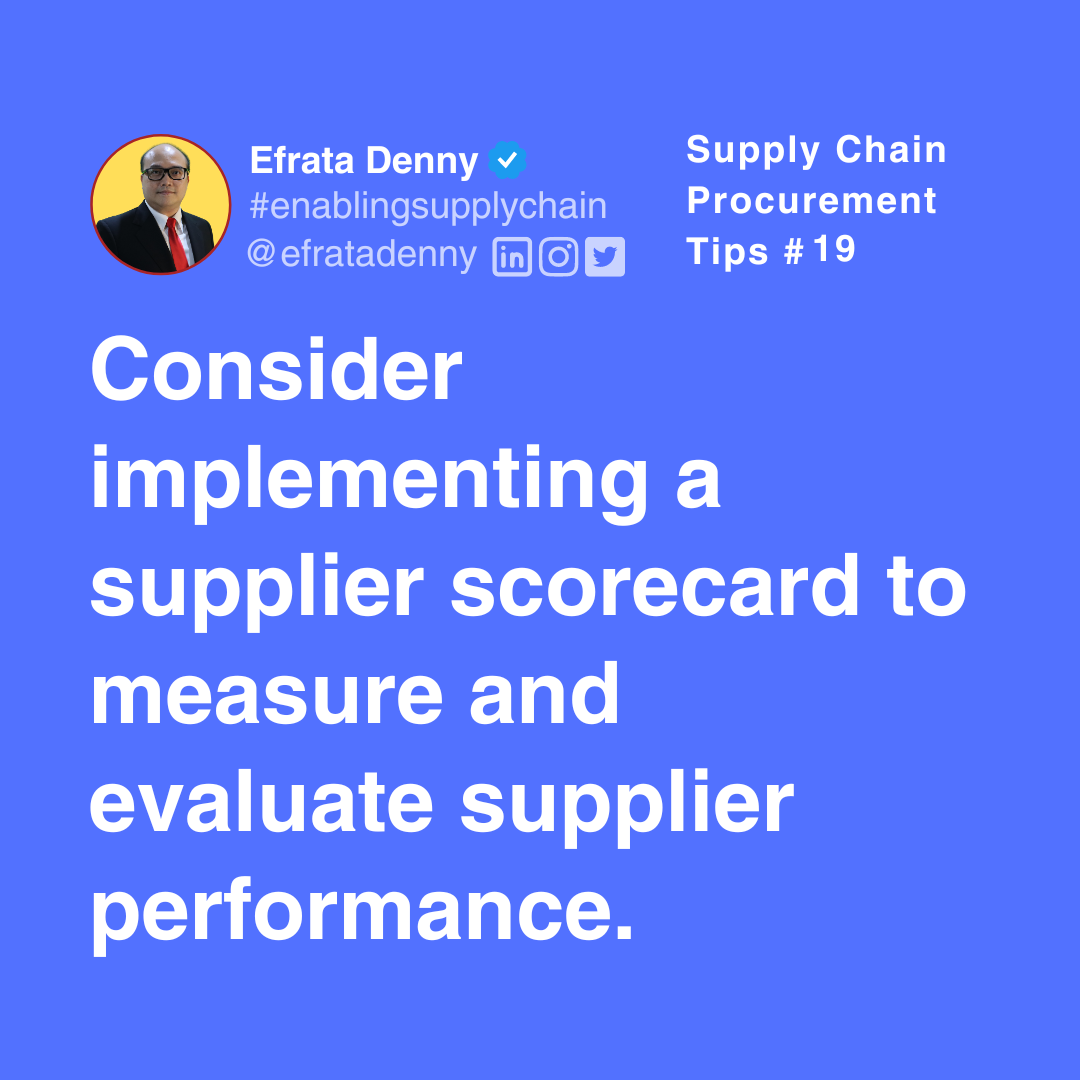
“Consider implementing a supplier scorecard to measure and evaluate supplier performance.” – Efrata Denny

In the dynamic landscape of supply chain procurement, the implementation of a supplier scorecard emerges as a pivotal strategy to enhance performance measurement and drive continuous improvement. This article explores the multifaceted value of supplier scorecards and how they can serve as catalysts for elevating supplier excellence in your supply chain.

  1. Performance Measurement: Supplier scorecards serve as objective tools for measuring and evaluating supplier performance against a set of predefined metrics. This ensures a standardized and transparent assessment of suppliers’ contributions to your supply chain.
  2. Key Performance Indicators (KPIs): Define and align key performance indicators (KPIs) with your business objectives. Whether it’s on-time delivery, product quality, cost savings, or responsiveness, KPIs provide a comprehensive framework for evaluating supplier performance.
  3. Data-Driven Insights: Leverage supplier scorecards to gather data on performance, enabling deep analysis of trends and patterns. These data-driven insights empower procurement professionals to make informed decisions and identify strategic areas for improvement.
  4. Transparent Evaluation: Promoting transparency is a cornerstone of effective supplier relationship management. Sharing scorecard results with suppliers fosters collaboration, allowing both parties to engage in constructive dialogue and work together towards shared goals.
  5. Supplier Development: Use the scorecard as a tool for supplier development. Engage in meaningful discussions based on scorecard metrics, identifying opportunities for mutual growth, and collaboratively addressing areas that require improvement.
  6. Supplier Segmentation: Categorize suppliers based on their performance scores to enable tailored strategies. Supplier segmentation allows for focused efforts in supplier development and relationship management, maximizing the impact of resources.
  7. Continuous Monitoring: The dynamic nature of supply chains demands continuous monitoring. Regularly update the scorecard and monitor supplier performance to ensure ongoing accountability and provide timely feedback.
  8. Supplier Recognition: Recognize and reward high-performing suppliers. Acknowledging excellence fosters a positive supplier relationship, motivates continued high performance, and contributes to a culture of excellence within the supply chain.

Incorporating supplier scorecards into your procurement strategy is not just a methodology; it’s a commitment to excellence. By measuring performance, defining KPIs, and fostering transparency and collaboration, supplier scorecards become powerful instruments for elevating supplier performance and driving continuous improvement. Elevate excellence in your supply chain through the strategic implementation of supplier scorecards.

Share this:

  • Click to share on Facebook (Opens in new window) Facebook
  • Click to share on X (Opens in new window) X
  • Click to share on LinkedIn (Opens in new window) LinkedIn
  • Click to email a link to a friend (Opens in new window) Email
  • Click to share on Tumblr (Opens in new window) Tumblr
  • Click to share on Pinterest (Opens in new window) Pinterest
Like Loading...

Navigating Uncertainty: Proactive Supply Chain Risk Management for Lasting Success

Posted by efratadenny on 31 January 2024
Posted in: Procurement, Supply Chain. Tagged: enablingsupplychain, Procurement, Purchasing, Sourcing, Supply Chain, Supply Chain Management. Leave a comment

“Continuously assess and manage supply chain risks.” – Efrata Denny

In the ever-evolving landscape of supply chain procurement, the ability to proactively identify, prioritize, and manage risks is a linchpin for sustained success. This article delves into the critical importance of proactively managing supply chain risks and outlines strategies to fortify your organization against potential disruptions, ensuring resilience and success in the face of uncertainty.

  1. Risk Identification: Regular assessments of your supply chain are the first line of defense against potential disruptions. Identifying risks such as supplier reliability, market volatility, or geopolitical factors provides the foundation for effective risk management.
  2. Risk Prioritization: Not all risks are created equal. Prioritizing risks based on their potential impact and likelihood allows organizations to allocate resources judiciously, focusing efforts on areas with the most significant potential impact.
  3. Risk Mitigation Strategies: Robust mitigation strategies are the backbone of effective risk management. Developing proactive measures to minimize the impact of identified risks ensures that your supply chain operations remain resilient in the face of challenges.
  4. Supplier Diversification: Reducing reliance on a single source is a cornerstone of risk mitigation. Diversifying your supplier base minimizes the risk of disruptions caused by supplier-related issues, fostering a more resilient and adaptable supply chain.
  5. Contingency Plans: Preparedness is key. Developing contingency plans for various risk scenarios provides a roadmap for predefined actions in the event of disruptions or emergencies, enabling swift and effective response.
  6. Monitoring and Early Warning Systems: Real-time monitoring systems and early warning mechanisms are essential tools for proactive risk management. Swift detection and response to potential risks ensure that organizations can navigate challenges before they escalate.
  7. Collaborative Relationships: Strong relationships with suppliers and stakeholders form a crucial component of risk management. Fostering open communication and collaboration creates a network of support, enabling collective efforts in managing and mitigating risks.
  8. Continuous Improvement: Effective risk management is an ongoing commitment to improvement. Regularly reviewing and updating risk management strategies allows organizations to adapt to new risks, market changes, and incorporate lessons learned from past incidents.

In a world marked by uncertainty, proactively managing supply chain risks is not just a strategy; it’s a necessity. By identifying, prioritizing, and mitigating risks, organizations build resilience, ensure business continuity, and maintain a competitive edge in a dynamic environment. Navigate uncertainty with confidence through proactive supply chain risk management.

Share this:

  • Click to share on Facebook (Opens in new window) Facebook
  • Click to share on X (Opens in new window) X
  • Click to share on LinkedIn (Opens in new window) LinkedIn
  • Click to email a link to a friend (Opens in new window) Email
  • Click to share on Tumblr (Opens in new window) Tumblr
  • Click to share on Pinterest (Opens in new window) Pinterest
Like Loading...

Navigating Uncertainty: The Imperative of Contingency Plans in Supply Chain Procurement

Posted by efratadenny on 30 January 2024
Posted in: Procurement, Supply Chain. Tagged: enablingsupplychain, Procurement, Purchasing, Sourcing, Supply Chain, Supply Chain Management. Leave a comment

“Develop contingency plans to mitigate supply chain disruptions.” – Efrata Denny

In the unpredictable landscape of supply chain procurement, the ability to navigate disruptions with resilience is a hallmark of successful organizations. This article delves into the critical importance of developing robust contingency plans and how they serve as a strategic shield against unforeseen challenges, ensuring continuity and success in the face of adversity.

  1. Risk Preparedness: Contingency plans serve as the linchpin of risk preparedness. By anticipating potential disruptions, organizations can proactively prepare for challenges, minimizing the impact on operations and ensuring seamless business continuity.
  2. Supply Chain Mapping: Understanding the intricacies of your supply chain is paramount. Robust contingency plans begin with a comprehensive supply chain map, identifying critical nodes and enabling organizations to target their planning efforts with precision.
  3. Alternative Suppliers: Diversification is a key principle in contingency planning. By identifying and building relationships with alternative suppliers, organizations create a safety net, ensuring a resilient and diversified supplier base to counteract unforeseen disruptions.
  4. Safety Stock and Buffer Inventory: Strategic stock reserves act as a buffer against supply disruptions. Contingency plans include the maintenance of safety stock and buffer inventory, providing organizations with the flexibility to navigate disruptions without compromising operational efficiency.
  5. Communication Protocols: Clear communication is the lifeblood of effective contingency planning. Establishing transparent channels with suppliers facilitates real-time updates and enables proactive problem-solving during disruptions, fostering collaboration and swift resolution.
  6. Scenario Planning: Anticipating various disruption scenarios is a proactive approach to contingency planning. Organizations develop response strategies to different challenges, minimizing downtime, and maintaining customer satisfaction even in the face of unexpected events.
  7. Technology Utilization: In the digital age, technology is a formidable ally in supply chain resilience. Contingency plans leverage digital tools and technologies to enhance visibility, track inventory, and enable agile decision-making, providing organizations with the tools needed to navigate disruptions effectively.
  8. Continuous Evaluation and Improvement: Contingency planning is not a one-time effort; it’s an ongoing commitment to improvement. Organizations continuously assess and refine their plans based on evolving risks and lessons learned from past disruptions, ensuring that their strategies remain effective and adaptive.

In a world marked by uncertainty, the development and implementation of comprehensive contingency plans are not just strategic choices; they are imperatives. By embracing the principles of risk preparedness, diversification, and continuous improvement, organizations fortify their supply chains, ensuring resilience and success in the face of disruptions. Navigate uncertainty with confidence, armed with robust contingency plans.

Share this:

  • Click to share on Facebook (Opens in new window) Facebook
  • Click to share on X (Opens in new window) X
  • Click to share on LinkedIn (Opens in new window) LinkedIn
  • Click to email a link to a friend (Opens in new window) Email
  • Click to share on Tumblr (Opens in new window) Tumblr
  • Click to share on Pinterest (Opens in new window) Pinterest
Like Loading...

Unleashing Innovation: The Power of Supplier Collaboration in Procurement

Posted by efratadenny on 29 January 2024
Posted in: Procurement, Supply Chain. Tagged: enablingsupplychain, Procurement, Purchasing, Sourcing, Supply Chain, Supply Chain Management. Leave a comment

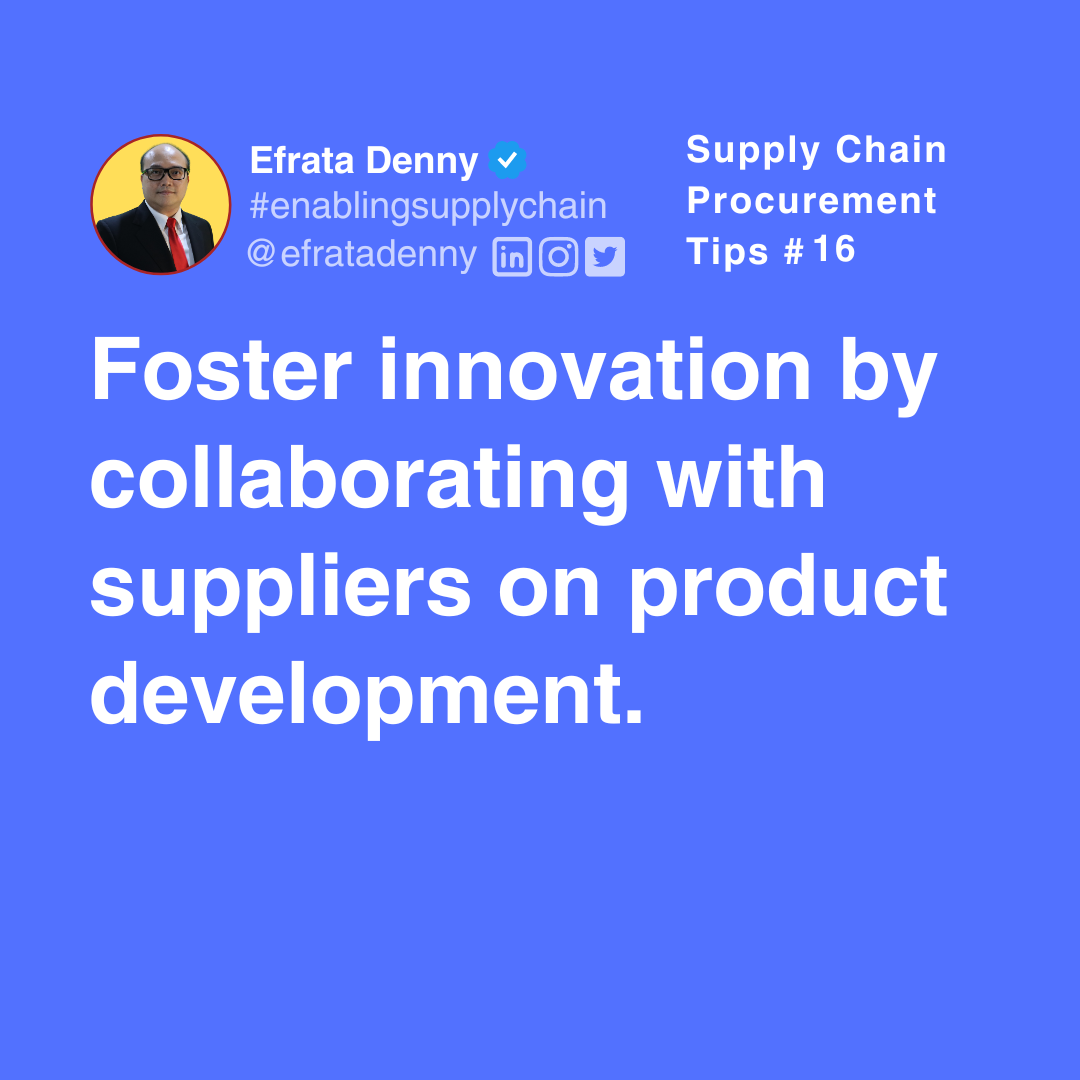
“Foster innovation by collaborating with suppliers on product development.” – Efrata Denny

In the dynamic realm of supply chain procurement, the key to unlocking innovation lies in fostering collaborative relationships with suppliers. This article explores the transformative impact of supplier collaboration on product development, highlighting why it’s essential and how it propels organizations towards a future defined by creativity, agility, and a competitive edge.

  1. Shared Expertise: Suppliers are not just transactional partners; they are reservoirs of industry knowledge and technical expertise. Collaborating with suppliers brings shared expertise to the table, infusing product development with fresh perspectives and cutting-edge solutions.
  2. Co-Creation Opportunities: The true magic happens when organizations and suppliers join forces in the spirit of co-creation. By closely collaborating on product development, organizations leverage the unique capabilities of their suppliers, fostering an environment of mutual growth and innovation.
  3. Market Responsiveness: In a fast-paced market, adaptability is key. Supplier collaboration enables organizations to respond swiftly to market trends. The collaborative synergy ensures that products remain not just relevant but also ahead of the competition, creating a dynamic and responsive supply chain.
  4. Enhanced Product Quality: Early involvement of suppliers in the development process is a recipe for enhanced product quality. By tapping into their insights and expertise from the outset, organizations benefit from improved product quality and performance, meeting or exceeding customer expectations.
  5. Cost Optimization: Collaborative innovation is not just about ideation; it’s a strategic approach to cost optimization. Suppliers, intimately familiar with production processes, materials, and alternatives, contribute to identifying efficient solutions that drive cost optimization without compromising quality.
  6. Accelerated Time-to-Market: Time is often a critical factor in the competitive landscape. Supplier collaboration streamlines product development cycles, accelerating time-to-market. This efficiency not only meets market demands more swiftly but also positions the organization as a frontrunner in the race for innovation.
  7. Risk Sharing: Collaboration extends beyond ideation to shared responsibility. In the spirit of true partnership, organizations and suppliers share risks and accountability. This collaborative risk-sharing fosters stronger partnerships and a sense of joint commitment to success.
  8. Continuous Improvement: Supplier collaboration is not a one-time affair; it’s a commitment to continuous improvement. The culture of collaboration promotes ongoing innovation, ensuring that organizations and suppliers evolve together, staying at the forefront of industry trends.

Fostering innovation through supplier collaboration is not just a strategy; it’s a mindset. By unlocking the collective intelligence of suppliers, organizations propel themselves into a future where innovation is not just a goal but a constant journey. Embrace collaboration, ignite creativity, and gain a competitive advantage in the ever-evolving market.

Share this:

  • Click to share on Facebook (Opens in new window) Facebook
  • Click to share on X (Opens in new window) X
  • Click to share on LinkedIn (Opens in new window) LinkedIn
  • Click to email a link to a friend (Opens in new window) Email
  • Click to share on Tumblr (Opens in new window) Tumblr
  • Click to share on Pinterest (Opens in new window) Pinterest
Like Loading...

Posts navigation

← Older Entries
Newer Entries →
  • Yes You Can Search

  • Yes This is Calendar

    December 2025
    M T W T F S S
    1234567
    891011121314
    15161718192021
    22232425262728
    293031  
    « Sep    
  • Yes These are Archives

  • Yes Recent Posts

    • The Future of Supply Chain: How AI and Automation Are Revolutionizing the Industry
    • Top 10 Supply Chain Innovations to Watch in 2024
    • The Rise of Sustainable Supply Chains: Why Going Green is Now a Business Imperative
    • The Great Debate: Centralized vs. Decentralized Supply Chains—Which is Better for 2024?
    • The Paradox of Supply Chain and Logistics
    • Agility Unleashed: The Power of Continuous Evaluation in Procurement Strategy
    • Cost Clarity: Mastering Total Cost of Acquisition for Procurement Excellence
    • Strategic Sourcing Mastery: Unleashing Procurement Excellence through Consolidated Purchasing
    • Unleashing Operational Excellence Through Just-in-Time (JIT) Inventory Management
    • Revolutionizing Procurement: The Strategic Impact of Harnessing Reverse Auctions for Maximum Cost Savings
  • Yes Follow Me

    Post a Day 2012 Twitter EfrataDenny
  • Yes This is My Twitter

    Tweets by efratadenny
  • Yes Advertising

    Roppopo.com
  • Yes This is Category

    Australia Bali Bandung China Collection Food France Indonesia Intermezzo Jakarta Kraft Foods Leadership Lighting Experiences Liquidart Manado Management Model Online Store Photography Portfolio Press Procurement Still Life Supply Chain Sustainability Traveling Underwater Wines Yes This is Me
  • Enter your email address to follow this blog and receive notifications of new posts by email.

    Join 986 other subscribers
  • Flickr Photos

    Last Supper Wood EngravingChristmas SockChristmas Bell
    More Photos
  • Recent Comments

    Bogdan Kolos's avatarBogdan Kolos on The Power of Strong Supplier R…
    Reighne Sq's avatarReighne Sq on Weekly Photo Challenge: One Sh…
    Shubham's avatarShubham on Long Tail and Short Tail Red…
    Terrence M's avatarTerrence M on Fettuccine Carbonara
    Ivan's avatarIvan on Maria Clara Sangria Red W…
    wahyu jatmiko krisdiyanto's avatarwahyu jatmiko krisdi… on Mie Bakso
    Weekly Photo Challen… on Weekly Photo Challenge: F…
    bali ratih's avatarbali ratih on Diving at Benoa
    Berita Hari Ini's avatarBerita Hari Ini on Miss Indonesia will increase W…
    geraldine's avatargeraldine on Maria Clara Sangria Red W…
    Chika Lesmana's avatarChika Lesmana on Shanghai Ice
    Chika Lesmana's avatarChika Lesmana on Shanghai Ice
    ipah kholipah's avataripah kholipah on Shanghai Ice
    Evi's avatarEvi on Platinum Hill Limited Edition…
    renxkyoko's avatarrenxkyoko on Sirloin Steak
  • Yes Page Info

    Yahoo bot last visit Msn bot last visit Google PageRank Checker

    The best of travel stories in and around Singapore TravelerVoice Bloggers - Meet Millions of Bloggers Personal Blogs visitor counters
  • Yes Facebook

    Yes Facebook
Blog at WordPress.com.
Efrata Denny
Create a free website or blog at WordPress.com.
Privacy & Cookies: This site uses cookies. By continuing to use this website, you agree to their use.
To find out more, including how to control cookies, see here: Cookie Policy
  • Subscribe Subscribed
    • Efrata Denny
    • Join 966 other subscribers
    • Already have a WordPress.com account? Log in now.
    • Efrata Denny
    • Subscribe Subscribed
    • Sign up
    • Log in
    • Report this content
    • View site in Reader
    • Manage subscriptions
    • Collapse this bar
 

Loading Comments...
 

    %d