Efrata Denny

Personal Blog contains Wines, Foods, Traveling, and Photography

  • Home
  • All About Me
    • Yes This is Me
    • Private Message
    • Guest Book
    • Collection
      • Cigars
      • IntermezZo
      • Liquors
      • Sketch
      • Zombie Story
    • Friends
    • Portfolio
      • Kraft Foods
      • Arnott’s
      • Glaxo Smith Kline
      • Online Store
    • Press
  • Wines
    • Argentina
    • Australia
    • Austria
    • Chile
    • France
    • Indonesia
    • Israel
    • Italia
    • Portugal
    • South Africa
    • Spain
    • USA
    • Vietnam
  • Food
  • Traveling
    • Australia
    • China
    • Hong Kong
    • Indonesia
    • Macau
    • Malaysia
    • Philippines
    • Singapore
    • Thailand
    • Vietnam
  • Photography
    • Model
    • Still Life
    • Liquidart
    • Underwater
  • Awards
  • Supply Chain
    • Sustainability
    • Workshop

Collaborative Procurement: Strengthening Internal Stakeholder Relationships for Success

Posted by efratadenny on 12 February 2024
Posted in: Procurement, Supply Chain. Tagged: enablingsupplychain, Procurement, Purchasing, Sourcing, Supply Chain, Supply Chain Management. Leave a comment

“Build strong relationships with internal stakeholders to align procurement with business objectives.” – Efrata Denny

In the intricate tapestry of supply chain procurement, the cornerstone of success lies in the art of building robust relationships with internal stakeholders. This article navigates the significance of fostering these connections, highlighting how they underpin strategic alignment, shared vision, and effective communication in the pursuit of overarching business objectives.

1. Strategic Alignment: The linchpin of procurement success is the seamless alignment with overarching business objectives. By collaborating closely with internal stakeholders, procurement strategies can be calibrated to resonate with and support the broader organizational goals.

2. Shared Vision: Strong relationships engender a shared vision among departments, transcending isolated objectives. This unity promotes collective efforts and a harmonized pursuit of organizational goals, creating a cohesive and purpose-driven environment.

3. Effective Communication: The lifeblood of collaboration lies in effective communication. Establishing open channels ensures a clear understanding of stakeholder requirements, facilitating precision in procurement planning and execution.

4. Early Involvement: Proactive engagement with stakeholders from the genesis of the procurement process is pivotal. Early involvement allows for the assimilation of insights, tapping into stakeholder expertise, and integrating their needs seamlessly into the supplier selection process.

5. Mutual Trust: The bedrock of successful collaboration is mutual trust. Nurturing strong relationships fosters an environment of trust and respect, creating a collaborative ethos that amplifies procurement effectiveness.

6. Stakeholder Satisfaction: Aligning procurement activities with stakeholder expectations is a compass for success. This alignment not only enhances stakeholder satisfaction but also fortifies internal partnerships, creating a resilient and symbiotic relationship.

7. Value Optimization: Collaboration with stakeholders is a crucible for value optimization. It serves as a conduit for identifying cost-saving opportunities, pioneering process improvements, and crafting innovative procurement solutions that resonate with stakeholder needs.

8. Continuous Improvement: The iterative cycle of feedback and continuous improvement is catalyzed by regular interaction with stakeholders. This ongoing dialogue propels procurement practices toward excellence, ensuring they evolve in tandem with organizational dynamics.

The tapestry of collaborative procurement, woven through strategic alignment, shared vision, and effective communication, forms the fabric of success. By building strong relationships with internal stakeholders, organizations not only enhance procurement effectiveness but also create a resilient foundation that propels the business forward.

Share this:

  • Click to share on Facebook (Opens in new window) Facebook
  • Click to share on X (Opens in new window) X
  • Click to share on LinkedIn (Opens in new window) LinkedIn
  • Click to email a link to a friend (Opens in new window) Email
  • Click to share on Tumblr (Opens in new window) Tumblr
  • Click to share on Pinterest (Opens in new window) Pinterest
Like Loading...

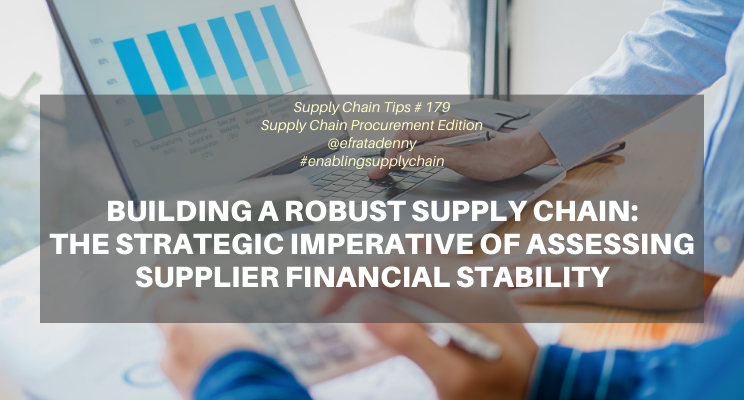
Building a Robust Supply Chain: The Strategic Imperative of Assessing Supplier Financial Stability

Posted by efratadenny on 11 February 2024
Posted in: Procurement, Supply Chain. Tagged: enablingsupplychain, Procurement, Purchasing, Sourcing, Supply Chain, Supply Chain Management. Leave a comment

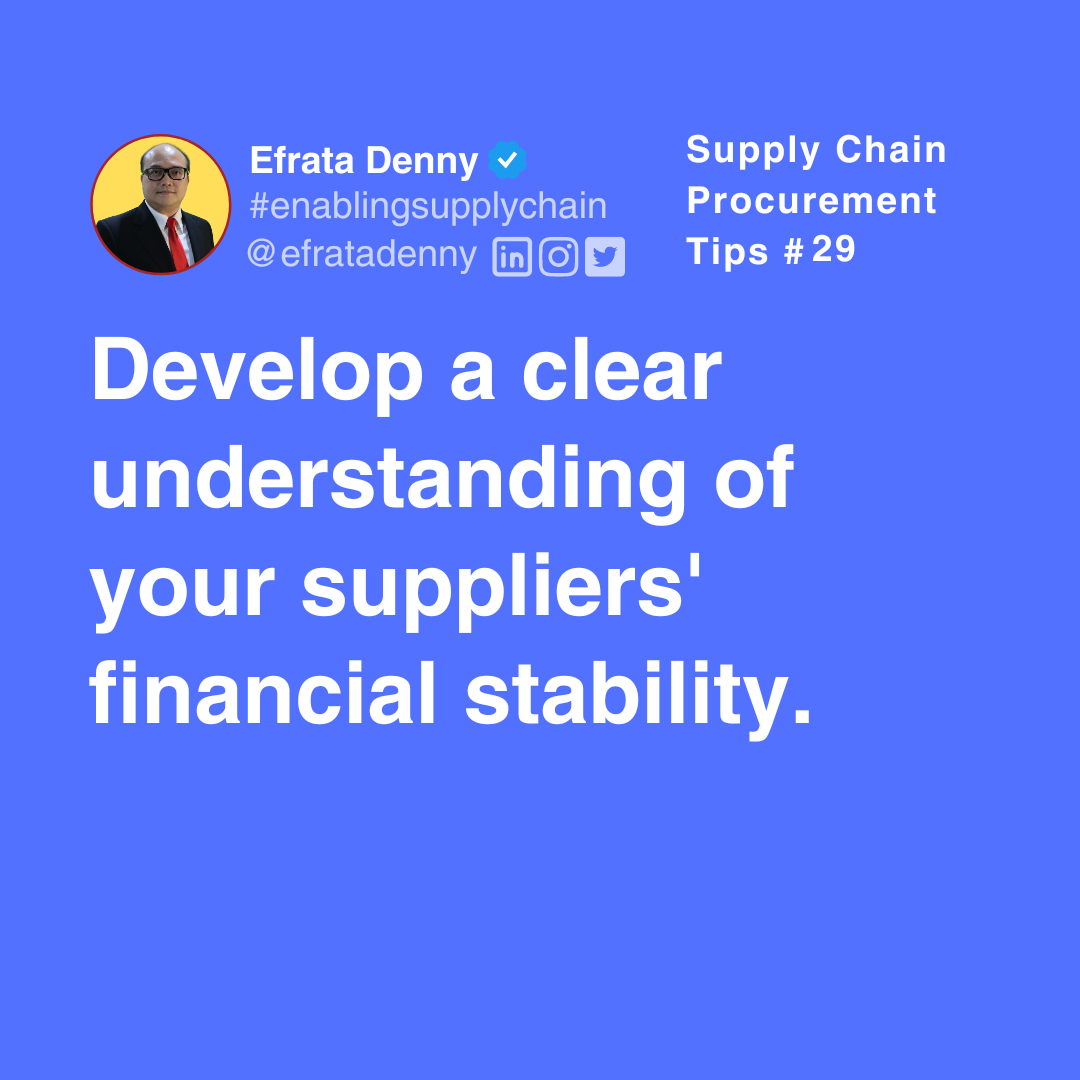
“Develop a clear understanding of your suppliers’ financial stability.” – Efrata Denny

In the intricate landscape of supply chain procurement, the financial stability of suppliers emerges as a strategic linchpin for resilience and sustained success. This article delves into the pivotal reasons why understanding and assessing suppliers’ financial stability is not just a precaution but a proactive measure to fortify the foundations of a robust supply chain.

1. Risk Mitigation: The assessment of financial stability serves as a potent tool in identifying suppliers vulnerable to financial distress. This knowledge empowers organizations to proactively implement measures that mitigate potential disruptions in the supply chain.

2. Continuity Assurance: The financial health of suppliers directly correlates with their ability to fulfill contractual obligations. An understanding of suppliers’ financial standing ensures continuity by averting delays or sudden disruptions, contributing to seamless operations.

3. Supplier Selection: Informed decisions in supplier selection hinge on the evaluation of financial stability. Prioritizing suppliers with a strong financial foundation enhances the reliability and resilience of the supply chain.

4. Performance Reliability: Financially stable suppliers are inherently more reliable. Their capacity to consistently deliver quality products, adhere to deadlines, and provide dependable services bolsters the overall reliability of the supply chain.

5. Long-Term Partnerships: Partnerships with financially stable suppliers foster sustainable, long-term relationships. This mutual commitment paves the way for shared growth, contributing to the success of both parties.

6. Business Continuity Planning: Insights into supplier financials are integral to crafting robust business continuity plans. By accounting for potential financial risks, organizations can fortify their capacity to weather disruptions.

7. Proactive Risk Management: A clear understanding of supplier financial stability enables proactive risk management. Organizations equipped with this knowledge can strategically diminish the impact of potential disruptions, preserving the flow of the supply chain.

8. Competitive Advantage: Leveraging insights into supplier financial stability confers a competitive advantage. It ensures a resilient supply chain, thereby maintaining customer satisfaction and positioning the organization as a stalwart in the market.

Incorporating supplier financial stability assessments into procurement strategies is not merely a precautionary measure; it is a proactive strategy to fortify the core of the supply chain. By cultivating this understanding, organizations pave the way for a robust, reliable, and resilient supply chain.

Share this:

  • Click to share on Facebook (Opens in new window) Facebook
  • Click to share on X (Opens in new window) X
  • Click to share on LinkedIn (Opens in new window) LinkedIn
  • Click to email a link to a friend (Opens in new window) Email
  • Click to share on Tumblr (Opens in new window) Tumblr
  • Click to share on Pinterest (Opens in new window) Pinterest
Like Loading...

Navigating the Regulatory Landscape: A Crucial Pillar for Procurement Excellence

Posted by efratadenny on 10 February 2024
Posted in: Procurement, Supply Chain. Tagged: enablingsupplychain, Procurement, Purchasing, Sourcing, Supply Chain, Supply Chain Management. Leave a comment

“Monitor and comply with relevant regulatory requirements.” – Efrata Denny

In the intricate world of supply chain procurement, vigilantly monitoring and adhering to regulatory requirements is not merely a necessity; it’s a cornerstone for achieving and sustaining excellence. This article delves into the pivotal role of regulatory monitoring in ensuring smooth operations and fostering a responsible, compliant procurement environment.

1. Legal Adherence: Staying abreast of relevant regulations is fundamental to aligning procurement practices with legal requirements. This diligence protects organizations from penalties and legal entanglements, forming the bedrock of a legally sound procurement framework.

2. Risk Mitigation: Regulatory monitoring serves as a proactive risk mitigation strategy. By identifying potential risks associated with non-compliance, such as working with non-compliant suppliers or lacking essential documentation, organizations can implement measures to forestall complications.

3. Ethical Sourcing: Compliance with regulations promotes ethical sourcing practices. Ensuring fair treatment, sustainable production, and responsible supply chain operations contribute to the creation of an ethical procurement ecosystem.

4. Reputation Management: Adhering to regulations is synonymous with safeguarding reputation. Organizations that prioritize compliance not only foster trust among stakeholders but also demonstrate an unwavering commitment to responsible business practices.

5. Financial Implications: Non-compliance can exact a heavy financial toll, encompassing fines, legal expenses, and reputational damage. Diligent adherence to regulations protects the bottom line and sustains financial health.

6. Supply Chain Transparency: Regulatory compliance is a catalyst for transparency. Organizations can trace and verify the origin, quality, and sustainability of procured goods, establishing a transparent and accountable supply chain.

7. International Trade Facilitation: In the global arena, compliance with trade regulations is paramount. Smooth international transactions hinge on adherence to regulatory frameworks, minimizing customs delays and fostering efficient cross-border supply chains.

8. Continuous Monitoring: Regulations are dynamic and subject to change. Continuous monitoring ensures organizations stay ahead of regulatory shifts, enabling ongoing compliance and the ability to adapt swiftly to evolving requirements.

Diligent monitoring and compliance with regulatory landscapes form the bedrock of a resilient and responsible procurement strategy. Organizations that navigate the regulatory maze with acumen not only ensure smooth operations but also contribute to building a sustainable and ethically sound supply chain.

Share this:

  • Click to share on Facebook (Opens in new window) Facebook
  • Click to share on X (Opens in new window) X
  • Click to share on LinkedIn (Opens in new window) LinkedIn
  • Click to email a link to a friend (Opens in new window) Email
  • Click to share on Tumblr (Opens in new window) Tumblr
  • Click to share on Pinterest (Opens in new window) Pinterest
Like Loading...

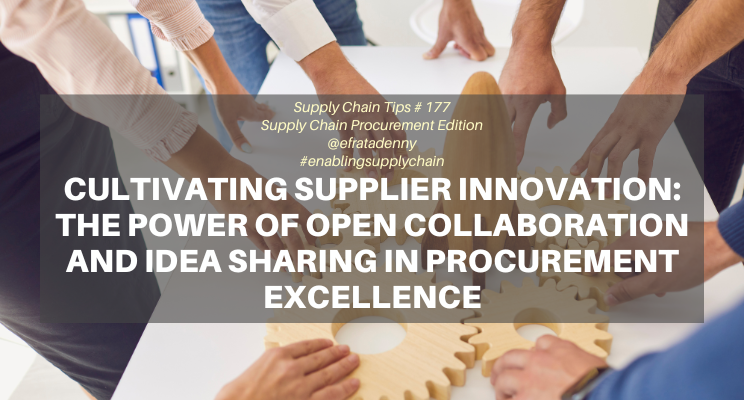
Cultivating Supplier Innovation: The Power of Open Collaboration and Idea Sharing in Procurement Excellence

Posted by efratadenny on 9 February 2024
Posted in: Procurement, Supply Chain. Tagged: enablingsupplychain, Procurement, Purchasing, Sourcing, Supply Chain, Supply Chain Management. Leave a comment

“Encourage supplier innovation by soliciting their input and ideas.” – Efrata Denny

In the ever-evolving landscape of supply chain procurement, recognizing the potential for supplier-driven innovation is a strategic imperative. This article explores the critical role of open collaboration and idea sharing in unlocking supplier innovation, offering insights into why it’s a cornerstone for procurement excellence.

1. Supplier Expertise: Harnessing the wealth of knowledge and expertise suppliers bring to the table is a key driver for innovation. By actively tapping into supplier insights, organizations unlock a reservoir of industry-specific expertise that can revolutionize procurement practices.

2. Fresh Perspectives: Suppliers inject fresh perspectives into the procurement ecosystem. Their unique vantage points and alternative approaches foster creativity, ensuring that innovative ideas emerge from a diverse array of viewpoints.

3. Co-Creation Opportunities: Creating a platform for co-creation fosters an environment where both buyers and suppliers actively contribute to the innovation process. Collaborative idea generation leads to breakthrough solutions that may not have been achievable in isolation.

4. Early Supplier Involvement: Engaging suppliers early in the stages of product development or process improvement initiatives is a strategic move. By incorporating supplier inputs from the outset, organizations benefit from their expertise and enhance the overall innovation potential.

5. Value-Driven Partnerships: Encouraging supplier innovation goes beyond transactions; it cultivates value-driven partnerships. Both parties actively contribute to each other’s success and growth, forming relationships that transcend traditional buyer-supplier dynamics.

6. Collaborative Problem-Solving: Open collaboration with suppliers fosters effective problem-solving. When faced with challenges, leveraging supplier input results in more robust solutions and optimized procurement strategies.

7. Market Insights: Suppliers are often at the forefront of industry trends, market dynamics, and emerging technologies. By actively seeking their insights, organizations gain a competitive edge through a deeper understanding of the market landscape.

8. Continuous Improvement: A culture of continuous improvement is nurtured through active collaboration and idea sharing. Organizations that embrace supplier-driven innovation are better positioned to learn from supplier ideas and implement innovative practices continuously.

By inspiring innovation through open collaboration and idea sharing, organizations propel their supply chains to new heights of excellence. Recognizing the immense potential within supplier relationships transforms procurement into a dynamic, innovative force that adapts and thrives in a rapidly changing business landscape.

Share this:

  • Click to share on Facebook (Opens in new window) Facebook
  • Click to share on X (Opens in new window) X
  • Click to share on LinkedIn (Opens in new window) LinkedIn
  • Click to email a link to a friend (Opens in new window) Email
  • Click to share on Tumblr (Opens in new window) Tumblr
  • Click to share on Pinterest (Opens in new window) Pinterest
Like Loading...

Transforming Supplier Partnerships: The Power of SRM Tools in Procurement Excellence

Posted by efratadenny on 8 February 2024
Posted in: Procurement, Supply Chain. Tagged: enablingsupplychain, Procurement, Purchasing, Sourcing, Supply Chain, Supply Chain Management. Leave a comment

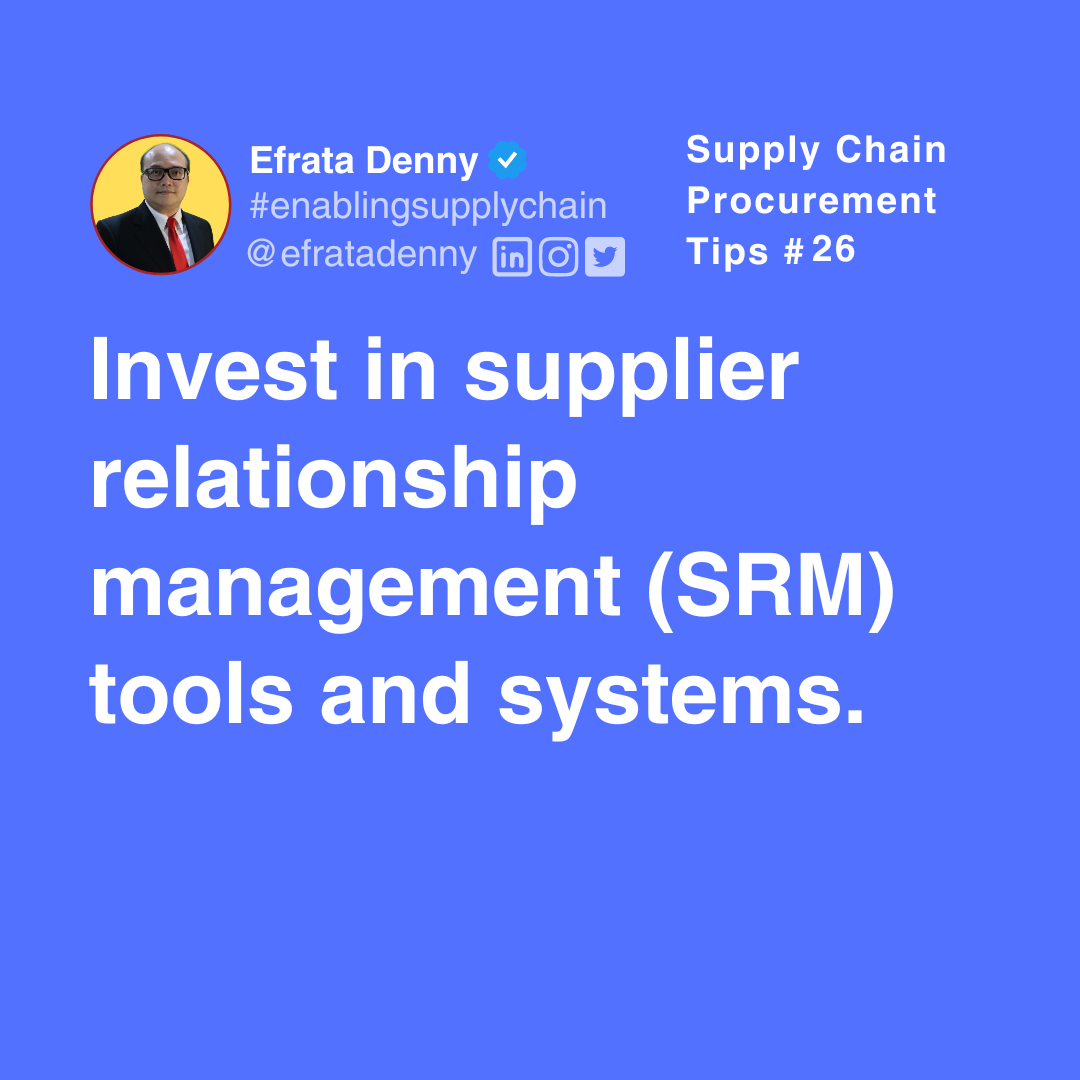
“Invest in supplier relationship management (SRM) tools and systems.” – Efrata Denny

In the dynamic landscape of supply chain procurement, the strategic integration of Supplier Relationship Management (SRM) tools and systems emerges as a linchpin for organizations seeking to elevate their supplier partnerships. This article delves into the pivotal role of SRM tools, highlighting their transformative impact on collaboration, performance tracking, risk mitigation, and the cultivation of enduring supplier relationships.

1. Enhanced Collaboration: SRM tools act as conduits for seamless communication and collaboration, transcending geographical boundaries. With features facilitating document sharing and real-time interaction, these tools lay the foundation for robust, collaborative relationships between organizations and their suppliers.

2. Performance Tracking: Real-time insights into supplier performance form the bedrock of effective SRM. By utilizing tracking metrics and key performance indicators, organizations can objectively evaluate supplier contributions, identify areas for improvement, and foster a culture of continuous enhancement.

3. Supplier Segmentation: Strategic supplier segmentation is made more accessible through SRM tools. By categorizing suppliers based on their strategic importance, risk profiles, and overall value, organizations can tailor management approaches, ensuring that each supplier relationship aligns with organizational objectives.

4. Contract Management: Streamlining the complexities of contract management is a forte of SRM tools. From the creation of contracts to negotiation and tracking, these systems ensure that agreements are compliant, optimized, and contribute to the overall success of procurement strategies.

5. Supplier Evaluation: Objective evaluation of suppliers is empowered by SRM tools. Organizations can employ predefined criteria, conduct comprehensive supplier audits, and make well-informed decisions regarding supplier selection and retention, enhancing the reliability of their supply chains.

6. Risk Mitigation: Effective risk mitigation begins with a clear understanding of supplier-related risks. SRM tools facilitate this process by enabling organizations to track supplier performance, conduct due diligence, and proactively address potential issues before they escalate.

7. Relationship Nurturing: Cultivating long-term relationships with suppliers goes beyond transactional interactions. SRM tools provide platforms for collaborative innovation, joint strategy development, and proactive problem-solving, nurturing relationships that stand the test of time.

8. Data-Driven Insights: The analytical capabilities of SRM systems empower organizations with data-driven insights. These insights drive continuous improvement, inform strategic decisions, and contribute to the overall resilience of the supply chain.

In the pursuit of procurement excellence, the adoption of SRM tools emerges as a transformative strategy. From enhancing collaboration to providing data-driven insights, these tools fortify supplier relationships, improve performance, and contribute to the overall success and resilience of the supply chain.

Share this:

  • Click to share on Facebook (Opens in new window) Facebook
  • Click to share on X (Opens in new window) X
  • Click to share on LinkedIn (Opens in new window) LinkedIn
  • Click to email a link to a friend (Opens in new window) Email
  • Click to share on Tumblr (Opens in new window) Tumblr
  • Click to share on Pinterest (Opens in new window) Pinterest
Like Loading...

Posts navigation

← Older Entries
Newer Entries →
  • Yes You Can Search

  • Yes This is Calendar

    December 2025
    M T W T F S S
    1234567
    891011121314
    15161718192021
    22232425262728
    293031  
    « Sep    
  • Yes These are Archives

  • Yes Recent Posts

    • The Future of Supply Chain: How AI and Automation Are Revolutionizing the Industry
    • Top 10 Supply Chain Innovations to Watch in 2024
    • The Rise of Sustainable Supply Chains: Why Going Green is Now a Business Imperative
    • The Great Debate: Centralized vs. Decentralized Supply Chains—Which is Better for 2024?
    • The Paradox of Supply Chain and Logistics
    • Agility Unleashed: The Power of Continuous Evaluation in Procurement Strategy
    • Cost Clarity: Mastering Total Cost of Acquisition for Procurement Excellence
    • Strategic Sourcing Mastery: Unleashing Procurement Excellence through Consolidated Purchasing
    • Unleashing Operational Excellence Through Just-in-Time (JIT) Inventory Management
    • Revolutionizing Procurement: The Strategic Impact of Harnessing Reverse Auctions for Maximum Cost Savings
  • Yes Follow Me

    Post a Day 2012 Twitter EfrataDenny
  • Yes This is My Twitter

    Tweets by efratadenny
  • Yes Advertising

    Roppopo.com
  • Yes This is Category

    Australia Bali Bandung China Collection Food France Indonesia Intermezzo Jakarta Kraft Foods Leadership Lighting Experiences Liquidart Manado Management Model Online Store Photography Portfolio Press Procurement Still Life Supply Chain Sustainability Traveling Underwater Wines Yes This is Me
  • Enter your email address to follow this blog and receive notifications of new posts by email.

    Join 986 other subscribers
  • Flickr Photos

    Last Supper Wood EngravingChristmas SockChristmas Bell
    More Photos
  • Recent Comments

    Bogdan Kolos's avatarBogdan Kolos on The Power of Strong Supplier R…
    Reighne Sq's avatarReighne Sq on Weekly Photo Challenge: One Sh…
    Shubham's avatarShubham on Long Tail and Short Tail Red…
    Terrence M's avatarTerrence M on Fettuccine Carbonara
    Ivan's avatarIvan on Maria Clara Sangria Red W…
    wahyu jatmiko krisdiyanto's avatarwahyu jatmiko krisdi… on Mie Bakso
    Weekly Photo Challen… on Weekly Photo Challenge: F…
    bali ratih's avatarbali ratih on Diving at Benoa
    Berita Hari Ini's avatarBerita Hari Ini on Miss Indonesia will increase W…
    geraldine's avatargeraldine on Maria Clara Sangria Red W…
    Chika Lesmana's avatarChika Lesmana on Shanghai Ice
    Chika Lesmana's avatarChika Lesmana on Shanghai Ice
    ipah kholipah's avataripah kholipah on Shanghai Ice
    Evi's avatarEvi on Platinum Hill Limited Edition…
    renxkyoko's avatarrenxkyoko on Sirloin Steak
  • Yes Page Info

    Yahoo bot last visit Msn bot last visit Google PageRank Checker

    The best of travel stories in and around Singapore TravelerVoice Bloggers - Meet Millions of Bloggers Personal Blogs visitor counters
  • Yes Facebook

    Yes Facebook
Blog at WordPress.com.
Efrata Denny
Blog at WordPress.com.
Privacy & Cookies: This site uses cookies. By continuing to use this website, you agree to their use.
To find out more, including how to control cookies, see here: Cookie Policy
  • Subscribe Subscribed
    • Efrata Denny
    • Join 966 other subscribers
    • Already have a WordPress.com account? Log in now.
    • Efrata Denny
    • Subscribe Subscribed
    • Sign up
    • Log in
    • Report this content
    • View site in Reader
    • Manage subscriptions
    • Collapse this bar
 

Loading Comments...
 

    %d