Efrata Denny

Personal Blog contains Wines, Foods, Traveling, and Photography

  • Home
  • All About Me
    • Yes This is Me
    • Private Message
    • Guest Book
    • Collection
      • Cigars
      • IntermezZo
      • Liquors
      • Sketch
      • Zombie Story
    • Friends
    • Portfolio
      • Kraft Foods
      • Arnott’s
      • Glaxo Smith Kline
      • Online Store
    • Press
  • Wines
    • Argentina
    • Australia
    • Austria
    • Chile
    • France
    • Indonesia
    • Israel
    • Italia
    • Portugal
    • South Africa
    • Spain
    • USA
    • Vietnam
  • Food
  • Traveling
    • Australia
    • China
    • Hong Kong
    • Indonesia
    • Macau
    • Malaysia
    • Philippines
    • Singapore
    • Thailand
    • Vietnam
  • Photography
    • Model
    • Still Life
    • Liquidart
    • Underwater
  • Awards
  • Supply Chain
    • Sustainability
    • Workshop

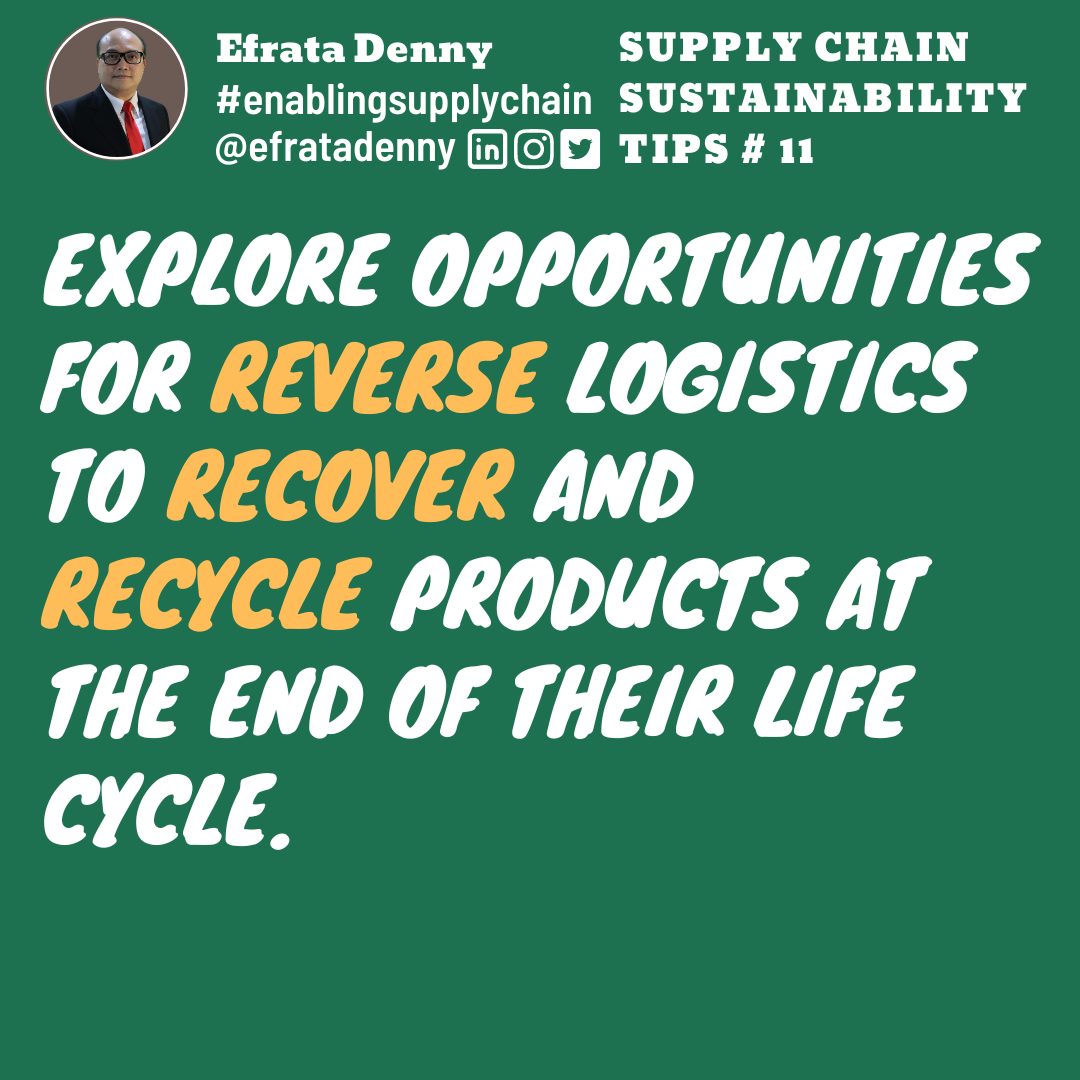
Embrace Reverse Logistics: Recover and Recycle for a Circular Economy!

Posted by efratadenny on 8 June 2023
Posted in: Supply Chain, Sustainability. Tagged: enablingsupplychain, Supply Chain, Supply Chain Management, Sustainability, Sustainable. Leave a comment

In the pursuit of a sustainable future, embracing reverse logistics plays a crucial role in reducing waste and promoting a circular economy. By incorporating strategies to recover and recycle products at the end of their life cycle, businesses can minimize environmental impact and maximize resource efficiency. In this article, we will explore the benefits of reverse logistics and provide practical tips on how to integrate it into your supply chain for a more sustainable and circular approach.

  1. Plan for product recovery: To embrace reverse logistics, it’s essential to incorporate it into your supply chain strategy from the beginning. Consider how products can be recovered and recycled at the end of their life cycle, ensuring a seamless transition from consumption to responsible disposal.
  2. Design for recyclability: Optimizing product design is key to facilitating the disassembly and recycling process. By using materials that are easily separable and recyclable, businesses can ensure that products can be efficiently recycled, reducing waste and preserving valuable resources.
  3. Establish collection points: Setting up collection centers or take-back programs is crucial in encouraging customers to return products for recycling or proper disposal. By providing convenient and accessible collection points, businesses can actively involve consumers in the recycling process.
  4. Partner with recycling facilities: Collaborating with recycling facilities or specialized vendors is essential to ensure proper recycling and disposal of recovered products. Building strong partnerships with these entities will facilitate the efficient handling of recycled materials and contribute to the circular economy.
  5. Implement refurbishment programs: Exploring opportunities to refurbish and resell products can extend their life cycle and reduce waste. By implementing refurbishment programs, businesses can breathe new life into products, minimizing the need for new production and conserving resources.
  6. Educate consumers: Raising awareness among customers about the importance of recycling is crucial. Provide clear instructions on how to return and recycle products, educating consumers on the proper disposal methods. By empowering consumers with knowledge, businesses can drive positive environmental change.
  7. Measure and optimize: Continuously monitoring and evaluating the performance of your reverse logistics program is essential. Measure key metrics, such as the volume of products recovered and the efficiency of recycling processes, to identify areas for improvement. Implement targeted measures to optimize the effectiveness and sustainability of your reverse logistics initiatives.

By embracing reverse logistics, businesses can recover valuable resources, reduce waste, and contribute to the development of a circular economy. Let’s work together to create a sustainable future by integrating reverse logistics into our supply chains.
Share this:

  • Share on Facebook (Opens in new window) Facebook
  • Share on X (Opens in new window) X
  • Share on LinkedIn (Opens in new window) LinkedIn
  • Email a link to a friend (Opens in new window) Email
  • Share on Tumblr (Opens in new window) Tumblr
  • Share on Pinterest (Opens in new window) Pinterest
Like Loading...

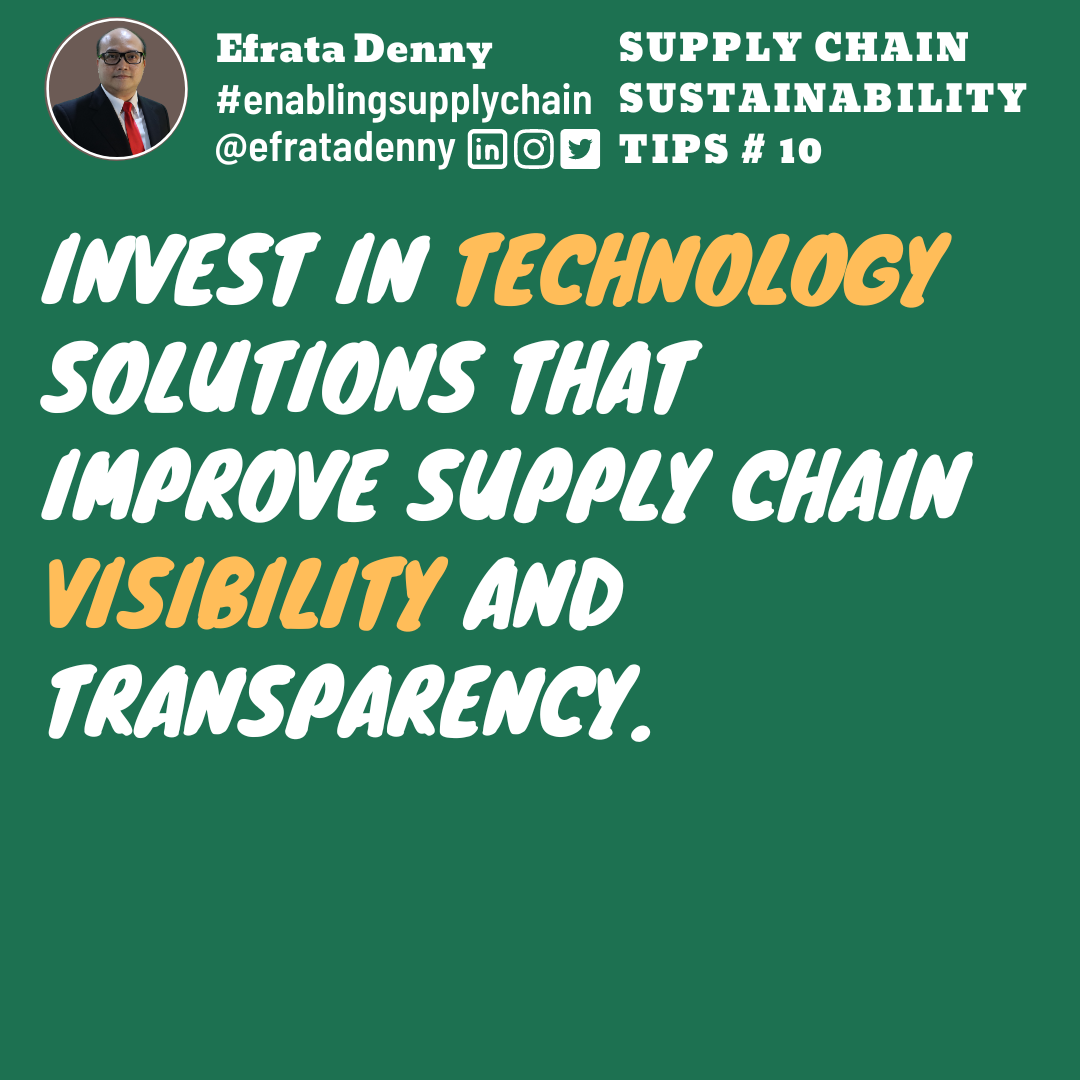
Enhance Visibility and Transparency! Invest in Technology for a Sustainable Supply Chain!

Posted by efratadenny on 7 June 2023
Posted in: Supply Chain, Sustainability. Tagged: enablingsupplychain, Supply Chain, Supply Chain Management, Sustainability, Sustainable. Leave a comment

In today’s fast-paced and interconnected world, investing in technology solutions that enhance visibility and transparency is crucial for building a sustainable supply chain. By adopting advanced software, leveraging IoT devices, implementing blockchain technology, and utilizing data analytics, businesses can make informed decisions, optimize operations, and drive sustainability. In this article, we will explore practical tips on how to invest in technology for a greener future and achieve a more transparent and efficient supply chain.

  1. Adopt supply chain management systems: Implementing robust supply chain management systems provides real-time visibility into the entire supply chain. These software solutions enable better decision-making, streamline processes, and enhance collaboration among stakeholders. By having a comprehensive overview of the supply chain, businesses can identify areas for improvement and implement sustainable practices.
  2. Embrace IoT and sensors: The Internet of Things (IoT) devices and sensors play a crucial role in tracking and monitoring various aspects of the supply chain. By utilizing IoT devices and sensors, businesses can collect real-time data on inventory levels, transportation conditions, and storage parameters. This data allows for proactive decision-making, reduces waste, and ensures optimal efficiency throughout the supply chain.
  3. Implement blockchain technology: Blockchain technology offers a secure, transparent, and traceable system for supply chain transactions. By leveraging blockchain, businesses can ensure ethical sourcing, reduce the risk of fraud, and promote transparency. This technology enables stakeholders to verify the origin and authenticity of products, fostering trust and supporting sustainability initiatives.
  4. Enable data sharing: Collaboration is key to building a sustainable supply chain. By sharing data securely with partners and suppliers, businesses can promote transparency and foster a culture of sustainability. Digital platforms and data sharing tools facilitate efficient communication, encourage knowledge exchange, and drive collaborative efforts towards sustainable practices.
  5. Use predictive analytics: Data analytics and machine learning can provide valuable insights for supply chain optimization. By harnessing predictive analytics, businesses can anticipate demand, optimize routes, and reduce inefficiencies such as overstocking or understocking. These data-driven decisions lead to improved resource utilization, minimized waste, and enhanced sustainability performance.
  6. Monitor sustainability metrics: Technology allows for the monitoring of key sustainability metrics such as carbon emissions, water usage, or waste generation. By tracking these metrics, businesses can identify areas for improvement and implement targeted sustainability initiatives. Continuous monitoring of sustainability metrics enables progress tracking and supports the achievement of sustainability goals.
  7. Engage with stakeholders: Digital platforms and communication tools provide opportunities for engaging with customers, suppliers, and stakeholders. Businesses can share sustainability initiatives, gather feedback, and foster collaboration through these channels. Engaging stakeholders in the sustainability journey creates a sense of shared responsibility and promotes a greener future.

By investing in technology solutions that enhance visibility and transparency, businesses can achieve a more sustainable supply chain. Leveraging supply chain management systems, IoT devices, blockchain technology, data analytics, and digital platforms, companies can drive efficiency, make data-driven decisions, and foster collaboration. Let’s embrace innovation and technology for a greener future!

Share this:

  • Share on Facebook (Opens in new window) Facebook
  • Share on X (Opens in new window) X
  • Share on LinkedIn (Opens in new window) LinkedIn
  • Email a link to a friend (Opens in new window) Email
  • Share on Tumblr (Opens in new window) Tumblr
  • Share on Pinterest (Opens in new window) Pinterest
Like Loading...

Track and Reduce Emissions! Monitor Energy Consumption for a Sustainable Supply Chain!

Posted by efratadenny on 6 June 2023
Posted in: Supply Chain, Sustainability. Tagged: enablingsupplychain, Supply Chain, Supply Chain Management, Sustainability, Sustainable. Leave a comment

In the pursuit of sustainability, tracking and monitoring supply chain emissions and energy consumption play a crucial role in driving efficiency and reducing environmental impact. By implementing systems to measure and analyze data, businesses can make informed decisions, set emission reduction targets, and foster a more sustainable supply chain. In this article, we will explore practical steps to track and reduce emissions, promote energy efficiency, and transition to renewable energy sources.

  1. Set emission reduction targets: To kickstart the journey towards a sustainable supply chain, it is essential to define clear emission reduction targets. These targets should align with science-based goals and provide a roadmap for reducing greenhouse gas emissions throughout the supply chain. By setting ambitious yet achievable targets, businesses can drive meaningful change.
  2. Invest in tracking technology: Investing in tracking technology is vital for accurately measuring and monitoring emissions at different stages of the supply chain. This technology allows businesses to collect data on carbon emissions, identify emission hotspots, and track progress towards reduction targets. By leveraging advanced tracking systems, companies gain valuable insights to inform decision-making.
  3. Conduct energy audits: Conducting energy audits is a crucial step in identifying areas for improvement in energy consumption. By assessing energy usage in operations, businesses can pinpoint inefficiencies, such as outdated equipment or energy-intensive processes. Energy audits provide a baseline for measuring progress and identifying opportunities for energy savings.
  4. Implement energy-saving measures: Optimizing energy use is a key strategy for reducing emissions. Businesses can implement energy-saving measures such as upgrading to energy-efficient equipment, adopting LED lighting, or implementing automated systems. These measures not only reduce environmental impact but also lead to cost savings and improved operational efficiency.
  5. Use renewable energy sources: Transitioning to renewable energy sources is a significant step towards a sustainable supply chain. By incorporating solar, wind, or other renewable energy options, businesses can reduce their reliance on fossil fuels and decrease carbon emissions. Embracing renewable energy sources demonstrates a commitment to a cleaner and greener future.
  6. Collaborate with suppliers: To create a comprehensive approach to emission reduction, collaboration with suppliers is essential. Encourage suppliers to track and report their emissions, fostering transparency and accountability across the supply chain. By working together, businesses and suppliers can identify shared opportunities for emission reduction and drive collective change.
  7. Analyze data and identify hotspots: Regularly analyzing emissions and energy consumption data is crucial for informed decision-making. By analyzing data, businesses can identify emission hotspots, prioritize reduction efforts, and implement targeted strategies. Data-driven insights enable businesses to focus their resources effectively and make impactful changes.

By tracking and monitoring supply chain emissions and energy consumption, businesses can drive efficiency, reduce environmental impact, and contribute to a more sustainable future. Let’s embrace data-driven decision-making, set ambitious emission reduction targets, and work collaboratively towards a greener supply chain. Together, we can build a sustainable and resilient future!

Share this:

  • Share on Facebook (Opens in new window) Facebook
  • Share on X (Opens in new window) X
  • Share on LinkedIn (Opens in new window) LinkedIn
  • Email a link to a friend (Opens in new window) Email
  • Share on Tumblr (Opens in new window) Tumblr
  • Share on Pinterest (Opens in new window) Pinterest
Like Loading...

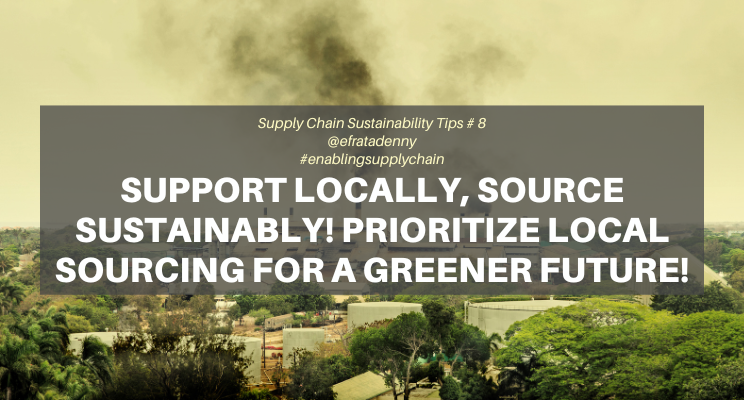
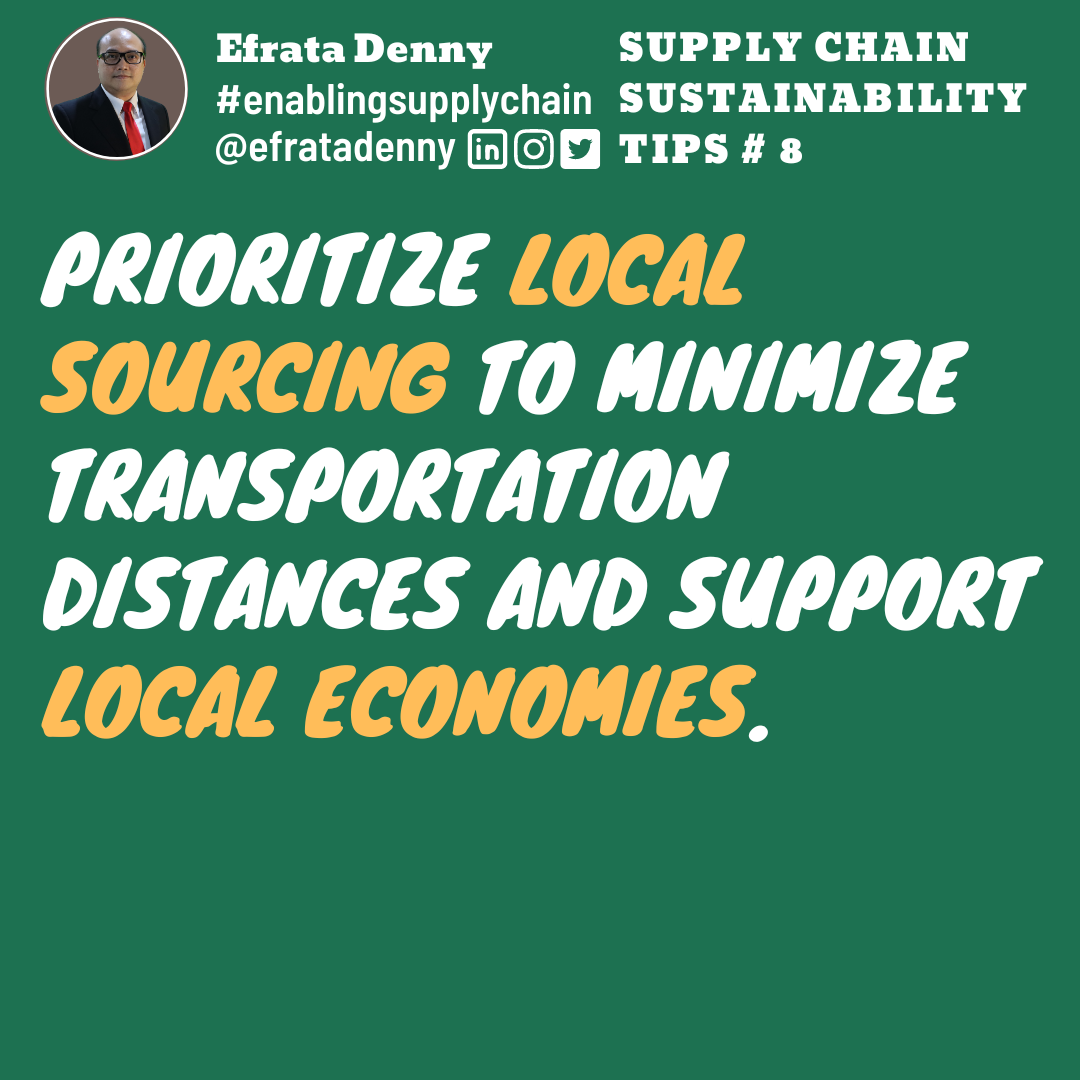
Support Locally, Source Sustainably! Prioritize Local Sourcing for a Greener Future!

Posted by efratadenny on 5 June 2023
Posted in: Supply Chain, Sustainability. Tagged: enablingsupplychain, Supply Chain, Supply Chain Management, Sustainability, Sustainable. Leave a comment

In the pursuit of a greener future, prioritizing local sourcing in supply chains can make a significant positive impact on both the environment and local economies. By shifting our focus to local suppliers, businesses can reduce transportation distances, minimize carbon emissions, and support resilient communities. In this article, we will explore the benefits of local sourcing and provide practical tips on how to integrate it into your sustainable supply chain strategy.

  1. Assess local suppliers: The first step towards prioritizing local sourcing is to assess and identify reliable local suppliers who align with your sustainability goals and can meet your quality standards. Look for suppliers who share your commitment to environmental responsibility and social impact.
  2. Reduce transportation distances: Sourcing locally means shorter transportation distances, resulting in reduced carbon emissions and transportation costs. By minimizing the distance goods need to travel, businesses can contribute to a greener supply chain and reduce their environmental footprint.
  3. Promote local resilience: Supporting local suppliers not only benefits the environment but also strengthens local economies. By choosing local sourcing, businesses help create job opportunities, foster economic growth, and build resilient communities. The support provided to local businesses has a ripple effect that extends beyond the supply chain.
  4. Embrace seasonal and regional products: Prioritizing seasonal and regional products reduces the need for long-distance transportation. By embracing locally available products, businesses can minimize the environmental impact associated with shipping goods from distant locations. Additionally, it allows for fresher, higher-quality products that resonate with the local culture and preferences.
  5. Foster collaboration: Establishing strong partnerships with local suppliers is key to driving sustainable practices and innovation. Collaborate with local suppliers to exchange knowledge, share best practices, and jointly develop sustainable solutions. By working together, businesses can enhance their supply chain resilience and collectively contribute to a greener future.
  6. Consider local raw materials: Whenever possible, source raw materials locally. This reduces the environmental impact associated with long-distance transportation, supports local producers, and helps build a circular economy. Prioritizing local raw materials is a significant step towards achieving sustainability goals and minimizing the carbon footprint.
  7. Communicate your commitment: Share your dedication to local sourcing with your customers and stakeholders. Highlight the positive social and environmental impacts of your approach and the value it brings to local communities. Transparently communicate your commitment to sustainability and engage stakeholders in supporting your efforts.

By prioritizing local sourcing, businesses can make a tangible difference in reducing transportation distances, lowering carbon emissions, and supporting local economies. Let’s embrace sustainable choices that benefit the planet and foster the growth of our communities. Together, we can create a greener future!

Share this:

  • Share on Facebook (Opens in new window) Facebook
  • Share on X (Opens in new window) X
  • Share on LinkedIn (Opens in new window) LinkedIn
  • Email a link to a friend (Opens in new window) Email
  • Share on Tumblr (Opens in new window) Tumblr
  • Share on Pinterest (Opens in new window) Pinterest
Like Loading...

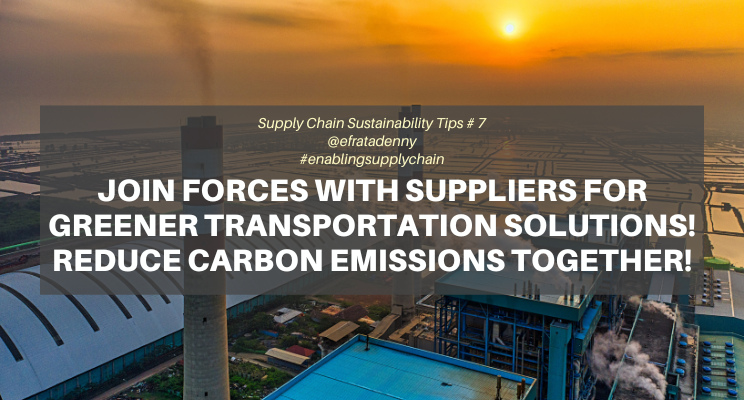
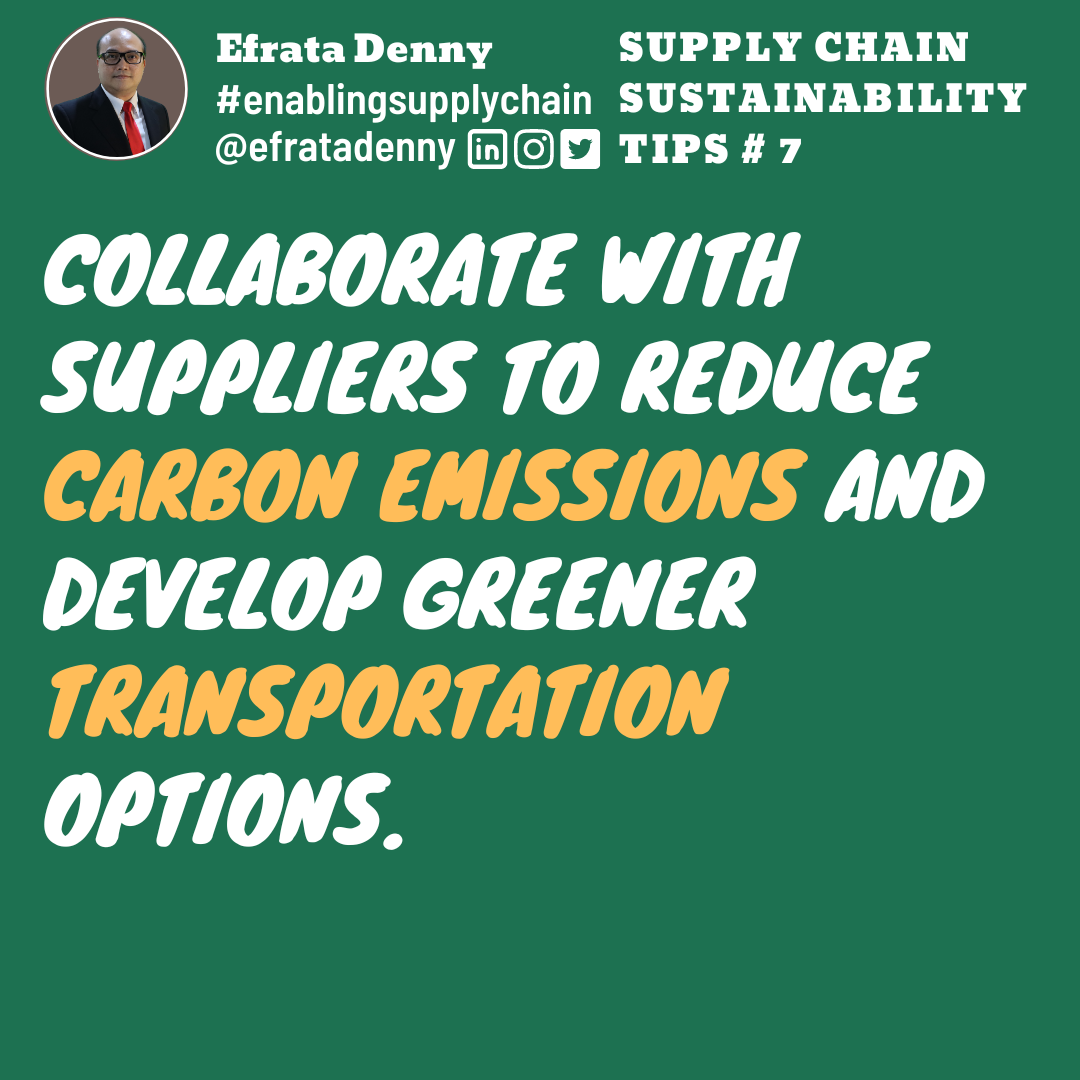
Join Forces with Suppliers for Greener Transportation Solutions! Reduce Carbon Emissions Together!

Posted by efratadenny on 4 June 2023
Posted in: Supply Chain, Sustainability. Tagged: enablingsupplychain, Supply Chain, Supply Chain Management, Sustainability, Sustainable. Leave a comment

In the quest for a sustainable future, collaboration with suppliers is essential to achieving a greener supply chain. By working together and focusing on transportation practices, businesses can make significant strides in reducing carbon emissions and developing sustainable transportation solutions. In this article, we will explore practical ways to collaborate with suppliers, optimize transportation practices, and create a more environmentally friendly supply chain.

1. Engage in dialogue: Initiating conversations with suppliers about the importance of reducing carbon emissions and exploring sustainable transportation alternatives is the first step towards driving change. By raising awareness and discussing the mutual benefits of greener transportation, businesses can foster a shared commitment to sustainability.

2. Assess current transportation practices: Evaluating the carbon footprint of transportation activities within the supply chain is crucial to identifying areas for improvement. Conducting a comprehensive assessment allows businesses and suppliers to pinpoint inefficiencies and develop targeted strategies for reducing emissions.

3. Optimize transportation routes: Collaborating with suppliers to optimize transportation routes is an effective way to minimize distance and reduce fuel consumption. By strategically planning routes, businesses can minimize the environmental impact of transportation and enhance overall efficiency.

4. Promote shared transportation: Exploring opportunities for shared logistics or transportation services is another way to maximize efficiency and reduce emissions. By pooling resources and sharing transportation infrastructure, businesses and suppliers can minimize the number of vehicles on the road, leading to significant environmental benefits.

5. Encourage fuel efficiency: Encouraging suppliers to adopt fuel-efficient vehicles or alternative fuel options is a powerful way to reduce carbon emissions. By incentivizing the use of efficient technologies and promoting the maintenance of fleets, businesses can drive the transition towards greener transportation.

6. Support low-carbon transportation modes: Considering alternative transportation modes such as rail, waterways, or electric vehicles whenever feasible can make a significant impact on carbon emissions. By leveraging low-carbon transportation options, businesses and suppliers can contribute to a more sustainable future.

7. Explore packaging optimization: Collaborating with suppliers to optimize packaging materials is an often-overlooked aspect of greener transportation. By reducing packaging weight and maximizing cargo capacity, businesses can decrease the number of trips required for transportation, resulting in lower emissions.

By collaborating with suppliers, sharing knowledge, and implementing sustainable transportation solutions, businesses can drive innovation and create greener transportation options. Together, let’s unite our efforts to reduce carbon emissions, build a sustainable supply chain, and create a cleaner, healthier planet for future generations.

Share this:

  • Share on Facebook (Opens in new window) Facebook
  • Share on X (Opens in new window) X
  • Share on LinkedIn (Opens in new window) LinkedIn
  • Email a link to a friend (Opens in new window) Email
  • Share on Tumblr (Opens in new window) Tumblr
  • Share on Pinterest (Opens in new window) Pinterest
Like Loading...

Posts navigation

← Older Entries
Newer Entries →
  • Yes You Can Search

  • Yes This is Calendar

    February 2026
    M T W T F S S
     1
    2345678
    9101112131415
    16171819202122
    232425262728  
    « Sep    
  • Yes These are Archives

  • Yes Recent Posts

    • The Future of Supply Chain: How AI and Automation Are Revolutionizing the Industry
    • Top 10 Supply Chain Innovations to Watch in 2024
    • The Rise of Sustainable Supply Chains: Why Going Green is Now a Business Imperative
    • The Great Debate: Centralized vs. Decentralized Supply Chains—Which is Better for 2024?
    • The Paradox of Supply Chain and Logistics
    • Agility Unleashed: The Power of Continuous Evaluation in Procurement Strategy
    • Cost Clarity: Mastering Total Cost of Acquisition for Procurement Excellence
    • Strategic Sourcing Mastery: Unleashing Procurement Excellence through Consolidated Purchasing
    • Unleashing Operational Excellence Through Just-in-Time (JIT) Inventory Management
    • Revolutionizing Procurement: The Strategic Impact of Harnessing Reverse Auctions for Maximum Cost Savings
  • Yes Follow Me

    Post a Day 2012 Twitter EfrataDenny
  • Yes This is My Twitter

    Tweets by efratadenny
  • Yes Advertising

    Roppopo.com
  • Yes This is Category

    Australia Bali Bandung China Collection Food France Indonesia Intermezzo Jakarta Kraft Foods Leadership Lighting Experiences Liquidart Manado Management Model Online Store Photography Portfolio Press Procurement Still Life Supply Chain Sustainability Traveling Underwater Wines Yes This is Me
  • Enter your email address to follow this blog and receive notifications of new posts by email.

    Join 986 other subscribers
  • Flickr Photos

    Last Supper Wood EngravingChristmas SockChristmas Bell
    More Photos
  • Recent Comments

    Bogdan Kolos's avatarBogdan Kolos on The Power of Strong Supplier R…
    Reighne Sq's avatarReighne Sq on Weekly Photo Challenge: One Sh…
    Shubham's avatarShubham on Long Tail and Short Tail Red…
    Terrence M's avatarTerrence M on Fettuccine Carbonara
    Ivan's avatarIvan on Maria Clara Sangria Red W…
    wahyu jatmiko krisdiyanto's avatarwahyu jatmiko krisdi… on Mie Bakso
    Weekly Photo Challen… on Weekly Photo Challenge: F…
    bali ratih's avatarbali ratih on Diving at Benoa
    Berita Hari Ini's avatarBerita Hari Ini on Miss Indonesia will increase W…
    geraldine's avatargeraldine on Maria Clara Sangria Red W…
    Chika Lesmana's avatarChika Lesmana on Shanghai Ice
    Chika Lesmana's avatarChika Lesmana on Shanghai Ice
    ipah kholipah's avataripah kholipah on Shanghai Ice
    Evi's avatarEvi on Platinum Hill Limited Edition…
    renxkyoko's avatarrenxkyoko on Sirloin Steak
  • Yes Page Info

    Yahoo bot last visit Msn bot last visit Google PageRank Checker

    The best of travel stories in and around Singapore TravelerVoice Bloggers - Meet Millions of Bloggers Personal Blogs visitor counters
  • Yes Facebook

    Yes Facebook
Blog at WordPress.com.
Efrata Denny
Blog at WordPress.com.
Privacy & Cookies: This site uses cookies. By continuing to use this website, you agree to their use.
To find out more, including how to control cookies, see here: Cookie Policy
  • Subscribe Subscribed
    • Efrata Denny
    • Join 966 other subscribers
    • Already have a WordPress.com account? Log in now.
    • Efrata Denny
    • Subscribe Subscribed
    • Sign up
    • Log in
    • Report this content
    • View site in Reader
    • Manage subscriptions
    • Collapse this bar
 

Loading Comments...
 

    %d