Efrata Denny

Personal Blog contains Wines, Foods, Traveling, and Photography

  • Home
  • All About Me
    • Yes This is Me
    • Private Message
    • Guest Book
    • Collection
      • Cigars
      • IntermezZo
      • Liquors
      • Sketch
      • Zombie Story
    • Friends
    • Portfolio
      • Kraft Foods
      • Arnott’s
      • Glaxo Smith Kline
      • Online Store
    • Press
  • Wines
    • Argentina
    • Australia
    • Austria
    • Chile
    • France
    • Indonesia
    • Israel
    • Italia
    • Portugal
    • South Africa
    • Spain
    • USA
    • Vietnam
  • Food
  • Traveling
    • Australia
    • China
    • Hong Kong
    • Indonesia
    • Macau
    • Malaysia
    • Philippines
    • Singapore
    • Thailand
    • Vietnam
  • Photography
    • Model
    • Still Life
    • Liquidart
    • Underwater
  • Awards
  • Supply Chain
    • Sustainability
    • Workshop

Fortifying Success: The Imperative of a Robust Risk Management Framework in Supply Chain Procurement

Posted by efratadenny on 22 February 2024
Posted in: Procurement, Supply Chain. Tagged: enablingsupplychain, Procurement, Purchasing, Sourcing, Supply Chain, Supply Chain Management. Leave a comment

“Develop and maintain a robust risk management framework for procurement.” – Efrata Denny

Navigating the dynamic landscape of supply chain procurement requires more than just agility; it demands resilience. At the core of this resilience lies a robust risk management framework. This article delves into the pivotal role a comprehensive risk management approach plays in fortifying procurement success.

1. Proactive Risk Identification: The first line of defense in procurement resilience is proactive risk identification. A robust risk management framework equips organizations to identify potential risks early on, allowing for strategic and preemptive mitigation measures before they cast shadows over procurement activities.

2. Supply Chain Resilience: The strength of a supply chain is tested in the face of disruptions. A well-constructed risk management framework contributes to the fortification of supply chain resilience. It acts as a shield, ensuring that the supply chain can weather disruptions and maintain continuity of operations.

3. Cost Control: Effective risk management isn’t just about averting crises; it’s a cornerstone of cost control. By minimizing unexpected expenses, protecting against supply shortages, and mitigating financial and reputational risks, a robust risk management framework becomes a strategic ally in optimizing procurement costs.

4. Supplier Relationship Protection: The bonds forged with suppliers are vital to the procurement ecosystem. Mitigating risks through a robust framework safeguards these relationships, fostering smooth collaboration and minimizing disruptions. It ensures that suppliers remain reliable partners in the journey towards procurement success.

5. Regulatory Compliance: In a landscape governed by regulations, a robust risk management framework is the compass that ensures compliance. By navigating the regulatory landscape effectively, organizations safeguard themselves from legal and reputational risks, fostering a procurement environment built on integrity and responsibility.

6. Business Continuity Planning: The ability to navigate unforeseen events defines business continuity. A robust risk management framework is the cornerstone of effective business continuity planning. It empowers organizations to develop strategies that navigate disruptions, minimizing downtime and ensuring a resilient path forward.

7. Data-Driven Decision-Making: The strength of a risk management framework lies in its foundation of data analysis. It enables informed decision-making based on accurate risk assessments. In a world inundated with uncertainties, data-driven insights become the lanterns guiding procurement strategies through the fog of risks.

8. Stakeholder Confidence: In the interconnected business landscape, stakeholder confidence is invaluable. A proactive approach to risk management, showcased through a robust framework, builds this confidence. It becomes a testament to an organization’s commitment to responsible and resilient procurement practices.

A resilient procurement function is forged in the crucible of a robust risk management framework. By embracing this imperative, organizations not only protect against uncertainties but fortify their foundations for long-term success. It’s not just risk management; it’s a strategic investment in procurement excellence.

Share this:

  • Click to share on Facebook (Opens in new window) Facebook
  • Click to share on X (Opens in new window) X
  • Click to share on LinkedIn (Opens in new window) LinkedIn
  • Click to email a link to a friend (Opens in new window) Email
  • Click to share on Tumblr (Opens in new window) Tumblr
  • Click to share on Pinterest (Opens in new window) Pinterest
Like Loading...

Elevating Excellence: The Power of Continuous Improvement in Supply Chain Procurement

Posted by efratadenny on 21 February 2024
Posted in: Procurement, Supply Chain. Tagged: enablingsupplychain, Procurement, Purchasing, Sourcing, Supply Chain, Supply Chain Management. Leave a comment

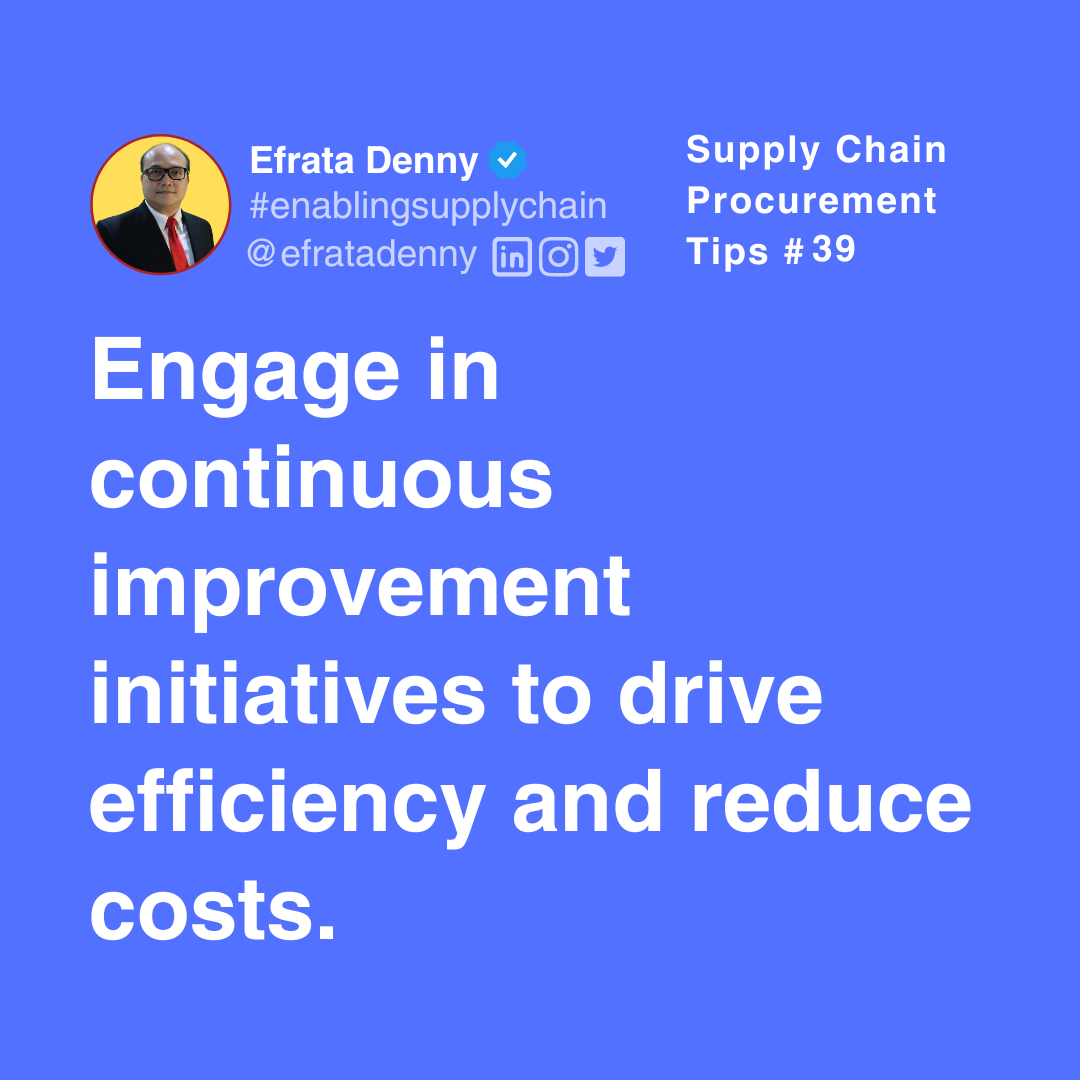
“Engage in continuous improvement initiatives to drive efficiency and reduce costs.” – Efrata Denny

In the ever-evolving landscape of supply chain procurement, where change is constant and innovation is the currency, the beacon guiding organizations towards excellence is continuous improvement. This article explores the transformative impact of embracing a culture of continuous improvement, shedding light on why it’s not just a practice but a strategic imperative.

1. Streamlined Processes: Continuous improvement acts as a vigilant navigator, uncovering bottlenecks and intricacies within procurement processes. Through this lens, organizations can streamline workflows, eliminate wasteful practices, and orchestrate a procurement symphony of efficiency.

2. Cost Optimization: The quest for cost optimization is an ongoing journey. Continuous improvement serves as the compass, consistently evaluating and refining procurement processes. By doing so, organizations unveil cost-saving opportunities, reducing expenses, and maximizing the value extracted from each procurement endeavor.

3. Enhanced Productivity: In the dynamic realm of procurement, productivity is the wind that propels success. Continuous improvement initiatives fuel productivity gains, enabling teams to accomplish more with fewer resources and ensuring that every effort contributes to the overarching goals.

4. Quality Improvement: Excellence in procurement extends beyond efficiency—it encompasses quality. Continuous improvement fosters a culture where quality is not a checkpoint but a guiding principle. Procurement activities, under this ethos, consistently meet or exceed the highest standards.

5. Innovation and Creativity: The seeds of innovation find fertile ground in the soil of continuous improvement. It nurtures an environment where teams are encouraged to think innovatively, fostering creative solutions to challenges and pushing the boundaries of what’s possible in procurement.

6. Collaboration and Teamwork: Continuous improvement is not a solo endeavor; it’s a team sport. Engaging the entire team in improvement initiatives fosters collaboration, unleashing the collective expertise within the organization and driving transformative change.

7. Agility and Adaptability: The seas of business are unpredictable, requiring procurement functions to be agile and adaptable. Continuous improvement isn’t just about refining processes; it’s about building an agile procurement function capable of navigating changing market conditions with ease.

8. Competitive Advantage: In a landscape where every edge matters, continuous improvement becomes a secret weapon. It sets organizations apart from competitors, allowing them to deliver superior value, adapt swiftly to market dynamics, and stay ahead in the race for procurement excellence.

Continuous improvement isn’t a mere practice; it’s a mindset that propels organizations toward new horizons of excellence. By embracing this culture, organizations drive efficiency, reduce costs, and unlock new levels of performance in supply chain procurement. It’s not just about keeping pace with change; it’s about leading the charge and defining the future of procurement.

Share this:

  • Click to share on Facebook (Opens in new window) Facebook
  • Click to share on X (Opens in new window) X
  • Click to share on LinkedIn (Opens in new window) LinkedIn
  • Click to email a link to a friend (Opens in new window) Email
  • Click to share on Tumblr (Opens in new window) Tumblr
  • Click to share on Pinterest (Opens in new window) Pinterest
Like Loading...

Navigating Excellence: The Strategic Value of Benchmarking in Supply Chain Procurement

Posted by efratadenny on 20 February 2024
Posted in: Procurement, Supply Chain. Tagged: enablingsupplychain, Procurement, Purchasing, Sourcing, Supply Chain, Supply Chain Management. Leave a comment

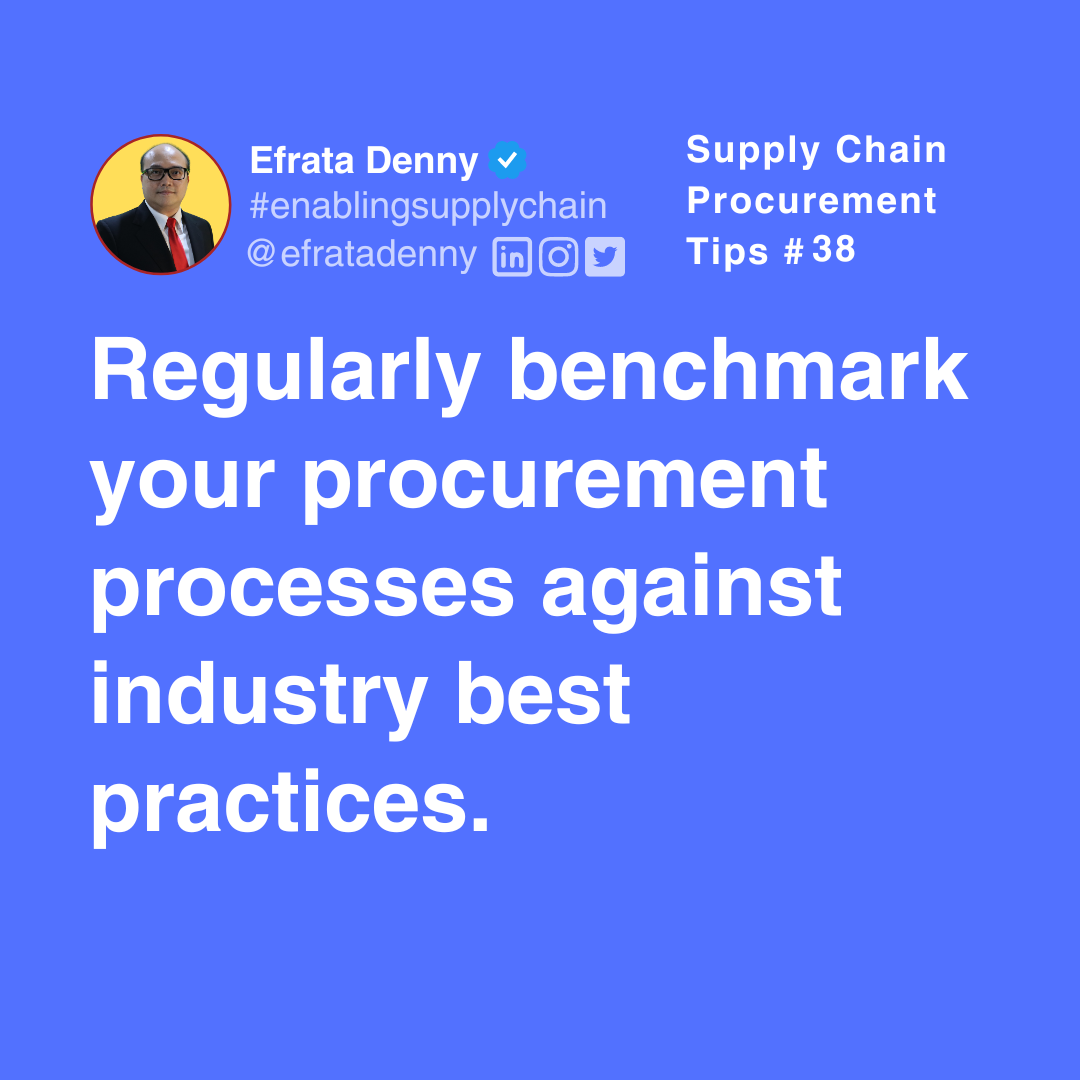
“Regularly benchmark your procurement processes against industry best practices.” – Efrata Denny

In the dynamic seas of supply chain procurement, where tides of change and innovation ebb and flow, the compass that guides success is continuous improvement. This article sets sail into the realm of procurement excellence, highlighting the strategic importance of regularly benchmarking your processes against industry best practices.

1. Performance Optimization: Benchmarking serves as a compass, allowing organizations to chart their course toward optimization. By identifying gaps and areas for improvement, procurement processes can be fine-tuned to achieve peak performance, ensuring efficiency and effectiveness.

2. Competitive Advantage: Adopting industry best practices isn’t merely a choice; it’s a strategic imperative. Organizations that benchmark and incorporate best practices gain a competitive edge, positioning themselves as leaders that not only meet but surpass market trends and customer expectations.

3. Process Efficiency: Efficiency is the wind in the sails of successful procurement. Benchmarking acts as a navigation tool, revealing inefficiencies and bottlenecks. Armed with this knowledge, organizations can streamline processes, reduce costs, and enhance overall productivity.

4. Innovation Opportunities: In the ever-evolving landscape of procurement, innovation is the north star. Benchmarking exposes teams to new ideas, emerging technologies, and innovative approaches. It fosters a culture where innovation isn’t just encouraged; it’s embedded in the DNA of the procurement process.

5. Risk Mitigation: Navigating the procurement seas involves navigating risks. Benchmarking provides a strategic telescope, enabling organizations to spot potential risks on the horizon. Armed with this foresight, proactive strategies can be implemented to mitigate risks effectively.

6. Collaboration and Knowledge Sharing: Benchmarking isn’t a solitary journey; it’s a collaborative expedition. It fosters collaboration with industry peers, creating a network where insights are exchanged, and lessons are learned. This collective knowledge sharing elevates the entire industry.

7. Adaptability to Change: In the tumultuous waters of business, adaptability is a prized asset. Regular benchmarking ensures organizations remain agile and adaptable. It empowers them to embrace new methodologies and practices, steering confidently through changing tides.

8. Continuous Learning: The pursuit of excellence is an ongoing voyage. Benchmarking cultivates a culture of continuous learning and improvement. It empowers teams not only to meet current standards but to exceed them continually.

As organizations navigate the vast and challenging waters of supply chain procurement, the strategic value of benchmarking cannot be overstated. It is the compass, the telescope, and the wind in the sails, propelling them toward the shores of excellence. By regularly benchmarking against industry best practices, organizations unlock opportunities for growth, innovation, and operational excellence, ensuring they remain at the forefront of their industry.

Share this:

  • Click to share on Facebook (Opens in new window) Facebook
  • Click to share on X (Opens in new window) X
  • Click to share on LinkedIn (Opens in new window) LinkedIn
  • Click to email a link to a friend (Opens in new window) Email
  • Click to share on Tumblr (Opens in new window) Tumblr
  • Click to share on Pinterest (Opens in new window) Pinterest
Like Loading...

Empowering Procurement Excellence: The Impact of Training in Negotiation and Supplier Management Skills

Posted by efratadenny on 19 February 2024
Posted in: Procurement, Supply Chain. Tagged: enablingsupplychain, Procurement, Purchasing, Sourcing, Supply Chain, Supply Chain Management. Leave a comment

In the dynamic landscape of supply chain procurement, the winds of success are guided by the sails of effective negotiation and supplier management skills. This article delves into the transformative impact of empowering your procurement team through training, equipping them with the skills necessary to navigate the seas of supplier interactions and negotiations.

1. Effective Negotiations: The cornerstone of procurement prowess lies in the art of negotiation. By imparting robust negotiation skills, organizations empower their staff to secure favorable pricing, terms, and conditions, ultimately maximizing value and ensuring optimal resource allocation.

2. Strong Supplier Relationships: Training in supplier management goes beyond transactions; it cultivates strong, enduring relationships. Enhanced communication and collaboration skills foster partnerships that extend beyond the transactional, contributing to mutual success and long-term collaboration.

3. Win-Win Outcomes: The essence of skilled negotiation is in finding common ground. By arming your team with the ability to balance interests and achieve win-win outcomes, organizations create a culture of collaboration that benefits both parties involved.

4. Conflict Resolution: In the unpredictable waters of supplier interactions, conflicts may arise. Training in conflict resolution equips your team with the skills needed to navigate these challenges, ensuring smooth operations and minimizing disruptions to the supply chain.

5. Cost Savings: Efficient negotiations and supplier management directly impact the bottom line. Equipped with the right skills, your team can drive cost savings, optimize spending, and enhance overall procurement efficiency.

6. Strategic Decision-Making: Enhanced skills empower your team to make strategic decisions. From evaluating supplier performance to driving strategic sourcing initiatives, a well-trained team contributes significantly to the organization’s overall strategic goals.

7. Continuous Improvement: A culture of continuous improvement is cultivated through training. By investing in the growth and development of your team, you create an environment where adaptability and learning become integral to the procurement process.

8. Professional Development: Investing in staff training is an investment in their professional growth. This not only boosts morale and job satisfaction but also demonstrates the organization’s commitment to its most valuable asset—its people.

In the journey towards procurement excellence, the importance of training in negotiation and supplier management skills cannot be overstated. It is the wind in the sails, propelling the procurement ship forward with confidence, strategic acumen, and the ability to weather any storm. By empowering your team, you set the course for success, ensuring that they not only navigate the seas of procurement but emerge as captains of excellence.

Share this:

  • Click to share on Facebook (Opens in new window) Facebook
  • Click to share on X (Opens in new window) X
  • Click to share on LinkedIn (Opens in new window) LinkedIn
  • Click to email a link to a friend (Opens in new window) Email
  • Click to share on Tumblr (Opens in new window) Tumblr
  • Click to share on Pinterest (Opens in new window) Pinterest
Like Loading...

Navigating Smooth Waters: The Importance of Monitoring and Managing Supplier Capacity

Posted by efratadenny on 18 February 2024
Posted in: Procurement, Supply Chain. Tagged: enablingsupplychain, Procurement, Purchasing, Sourcing, Supply Chain, Supply Chain Management. Leave a comment

“Monitor and manage supplier capacity to avoid bottlenecks and delays.” – Efrata Denny

In the intricate dance of supply chain procurement, the ability to navigate the ever-changing tides of supplier capacity emerges as a crucial element for maintaining smooth operations. This article dives into the reasons why effectively monitoring and managing supplier capacity is the compass that ensures an uninterrupted voyage through the procurement seas.

1. Proactive Planning: The compass of supplier capacity monitoring allows procurement professionals to be proactive planners. By anticipating potential bottlenecks or capacity constraints, organizations can plot their course with foresight, steering away from potential delays.

2. Timely Order Fulfillment: Smooth sailing in procurement involves ensuring suppliers have ample capacity to meet demand. This compass guides organizations to verify and guarantee that suppliers can fulfill orders promptly, preventing production delays and ensuring timely order fulfillment.

3. Supply Chain Resilience: A resilient supply chain is one that can weather unexpected storms. By managing supplier capacity, organizations fortify their supply chain against changing demand patterns and unforeseen disruptions, ensuring adaptability in the face of challenges.

4. Collaboration and Communication: The compass of supplier capacity management fosters collaboration and communication. Regular engagement with suppliers about capacity planning ensures alignment of production capabilities with organizational requirements, facilitating a harmonious partnership.

5. Supplier Development: Effective navigation involves recognizing opportunities for growth. By assessing supplier capacity, organizations identify areas for enhancement, opening the door to collaborative efforts on process improvements, and fostering long-term relationships.

6. Risk Mitigation: The vigilant compass of supplier capacity monitoring serves as a lookout for potential risks. By identifying and addressing capacity limitations, organizations mitigate risks and ensure continuity in their supply chain, avoiding treacherous disruptions.

7. Continuous Improvement: A compass is not just for direction; it’s also for improvement. Analyzing supplier capacity data allows organizations to identify areas for enhancement, optimize resource allocation, and drive efficiency across the entire supply chain.

8. Customer Satisfaction: The ultimate destination in procurement is customer satisfaction. The compass ensures reliable supplier capacity, leading to consistent deliveries and avoiding delays. This, in turn, enhances customer satisfaction, fostering loyalty and positive relationships.

In the vast seas of supply chain procurement, the compass of monitoring and managing supplier capacity emerges as the guiding star. It facilitates proactive planning, timely order fulfillment, supply chain resilience, collaboration, supplier development, risk mitigation, continuous improvement, and, ultimately, customer satisfaction. Armed with this compass, organizations can navigate the procurement waters with confidence, ensuring smooth operations and reaching their destination with efficiency and reliability.

Share this:

  • Click to share on Facebook (Opens in new window) Facebook
  • Click to share on X (Opens in new window) X
  • Click to share on LinkedIn (Opens in new window) LinkedIn
  • Click to email a link to a friend (Opens in new window) Email
  • Click to share on Tumblr (Opens in new window) Tumblr
  • Click to share on Pinterest (Opens in new window) Pinterest
Like Loading...

Posts navigation

← Older Entries
Newer Entries →
  • Yes You Can Search

  • Yes This is Calendar

    December 2025
    M T W T F S S
    1234567
    891011121314
    15161718192021
    22232425262728
    293031  
    « Sep    
  • Yes These are Archives

  • Yes Recent Posts

    • The Future of Supply Chain: How AI and Automation Are Revolutionizing the Industry
    • Top 10 Supply Chain Innovations to Watch in 2024
    • The Rise of Sustainable Supply Chains: Why Going Green is Now a Business Imperative
    • The Great Debate: Centralized vs. Decentralized Supply Chains—Which is Better for 2024?
    • The Paradox of Supply Chain and Logistics
    • Agility Unleashed: The Power of Continuous Evaluation in Procurement Strategy
    • Cost Clarity: Mastering Total Cost of Acquisition for Procurement Excellence
    • Strategic Sourcing Mastery: Unleashing Procurement Excellence through Consolidated Purchasing
    • Unleashing Operational Excellence Through Just-in-Time (JIT) Inventory Management
    • Revolutionizing Procurement: The Strategic Impact of Harnessing Reverse Auctions for Maximum Cost Savings
  • Yes Follow Me

    Post a Day 2012 Twitter EfrataDenny
  • Yes This is My Twitter

    Tweets by efratadenny
  • Yes Advertising

    Roppopo.com
  • Yes This is Category

    Australia Bali Bandung China Collection Food France Indonesia Intermezzo Jakarta Kraft Foods Leadership Lighting Experiences Liquidart Manado Management Model Online Store Photography Portfolio Press Procurement Still Life Supply Chain Sustainability Traveling Underwater Wines Yes This is Me
  • Enter your email address to follow this blog and receive notifications of new posts by email.

    Join 986 other subscribers
  • Flickr Photos

    Last Supper Wood EngravingChristmas SockChristmas Bell
    More Photos
  • Recent Comments

    Bogdan Kolos's avatarBogdan Kolos on The Power of Strong Supplier R…
    Reighne Sq's avatarReighne Sq on Weekly Photo Challenge: One Sh…
    Shubham's avatarShubham on Long Tail and Short Tail Red…
    Terrence M's avatarTerrence M on Fettuccine Carbonara
    Ivan's avatarIvan on Maria Clara Sangria Red W…
    wahyu jatmiko krisdiyanto's avatarwahyu jatmiko krisdi… on Mie Bakso
    Weekly Photo Challen… on Weekly Photo Challenge: F…
    bali ratih's avatarbali ratih on Diving at Benoa
    Berita Hari Ini's avatarBerita Hari Ini on Miss Indonesia will increase W…
    geraldine's avatargeraldine on Maria Clara Sangria Red W…
    Chika Lesmana's avatarChika Lesmana on Shanghai Ice
    Chika Lesmana's avatarChika Lesmana on Shanghai Ice
    ipah kholipah's avataripah kholipah on Shanghai Ice
    Evi's avatarEvi on Platinum Hill Limited Edition…
    renxkyoko's avatarrenxkyoko on Sirloin Steak
  • Yes Page Info

    Yahoo bot last visit Msn bot last visit Google PageRank Checker

    The best of travel stories in and around Singapore TravelerVoice Bloggers - Meet Millions of Bloggers Personal Blogs visitor counters
  • Yes Facebook

    Yes Facebook
Create a free website or blog at WordPress.com.
Efrata Denny
Create a free website or blog at WordPress.com.
Privacy & Cookies: This site uses cookies. By continuing to use this website, you agree to their use.
To find out more, including how to control cookies, see here: Cookie Policy
  • Subscribe Subscribed
    • Efrata Denny
    • Join 966 other subscribers
    • Already have a WordPress.com account? Log in now.
    • Efrata Denny
    • Subscribe Subscribed
    • Sign up
    • Log in
    • Report this content
    • View site in Reader
    • Manage subscriptions
    • Collapse this bar
 

Loading Comments...
 

    %d