Efrata Denny

Personal Blog contains Wines, Foods, Traveling, and Photography

  • Home
  • All About Me
    • Yes This is Me
    • Private Message
    • Guest Book
    • Collection
      • Cigars
      • IntermezZo
      • Liquors
      • Sketch
      • Zombie Story
    • Friends
    • Portfolio
      • Kraft Foods
      • Arnott’s
      • Glaxo Smith Kline
      • Online Store
    • Press
  • Wines
    • Argentina
    • Australia
    • Austria
    • Chile
    • France
    • Indonesia
    • Israel
    • Italia
    • Portugal
    • South Africa
    • Spain
    • USA
    • Vietnam
  • Food
  • Traveling
    • Australia
    • China
    • Hong Kong
    • Indonesia
    • Macau
    • Malaysia
    • Philippines
    • Singapore
    • Thailand
    • Vietnam
  • Photography
    • Model
    • Still Life
    • Liquidart
    • Underwater
  • Awards
  • Supply Chain
    • Sustainability
    • Workshop

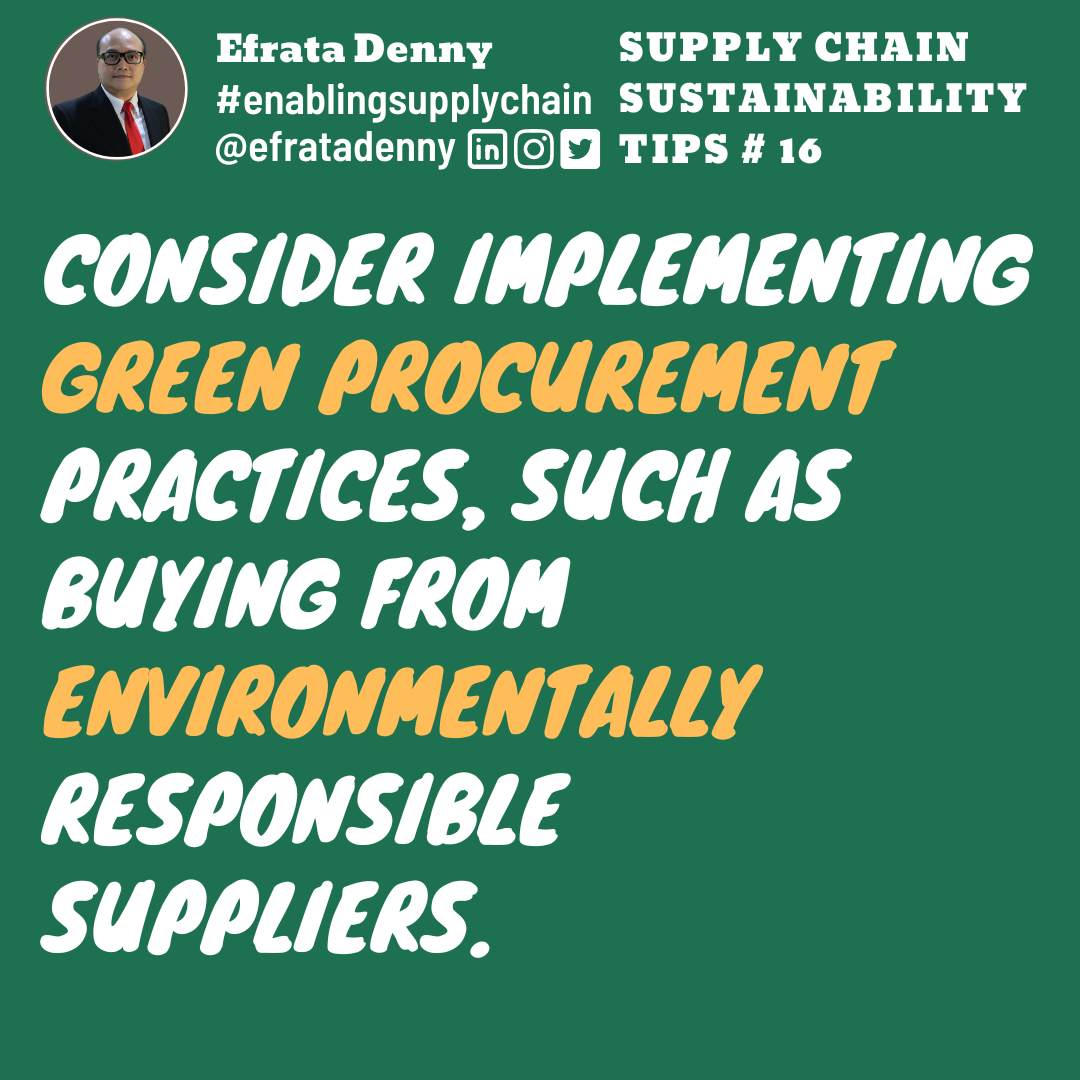
Green Procurement: Driving Sustainability through Supplier Selection

Posted by efratadenny on 13 June 2023
Posted in: Supply Chain, Sustainability. Tagged: enablingsupplychain, Supply Chain, Supply Chain Management, Sustainability, Sustainable. Leave a comment

In today’s era of environmental consciousness, implementing green procurement practices has become an essential strategy for businesses to support sustainability and drive positive change. By prioritizing environmentally responsible suppliers, organizations can make a significant impact on reducing their ecological footprint and promoting a greener future. In this article, we will explore actionable tips to help you select environmentally responsible suppliers and integrate green procurement practices into your supply chain management, fostering a culture of sustainability and responsible choices.

  1. Define green procurement criteria: Start by establishing clear criteria that suppliers must meet to qualify as environmentally responsible. Consider factors such as environmental certifications, sustainable sourcing practices, waste reduction initiatives, or energy-efficient processes. By setting specific criteria, you ensure that suppliers align with your sustainability goals and contribute to your overall environmental performance.
  2. Conduct supplier assessments: Evaluate potential suppliers based on their environmental performance. Assess their commitment to reducing carbon emissions, minimizing waste generation, and utilizing eco-friendly materials. Supplier assessments allow you to make informed decisions and select suppliers who prioritize sustainability in their operations.
  3. Prioritize local and sustainable sourcing: Choose suppliers who prioritize local sourcing whenever possible. This reduces transportation impacts and supports the local economy. Additionally, prioritize suppliers that offer sustainable materials, promoting a circular economy and minimizing the environmental footprint of your products or services.
  4. Collaborate with suppliers: Engage in open dialogue with your suppliers to encourage their adoption of sustainable practices. Work together to explore opportunities for joint initiatives that drive sustainability throughout the supply chain. Collaboration and partnership are key to fostering a culture of sustainability and promoting innovation.
  5. Request sustainability reports: Ask suppliers to provide sustainability reports that outline their environmental practices, performance, and future commitments. These reports offer valuable insights into their sustainability efforts and help you assess their compatibility with your green procurement goals.
  6. Consider life cycle impacts: Evaluate suppliers’ products or services holistically by considering their entire life cycle. Assess the environmental impact from production to use and end-of-life considerations. By taking a comprehensive approach, you can make informed decisions based on the overall sustainability performance of suppliers.
  7. Encourage innovation: Seek out suppliers who demonstrate a commitment to continuous improvement, innovation, and the development of eco-friendly solutions. These suppliers can provide opportunities for collaboration and contribute to your organization’s sustainability goals through their innovative approaches.

By implementing green procurement practices and choosing environmentally responsible suppliers, organizations can drive sustainability throughout the supply chain and make a tangible impact on the environment. By defining green procurement criteria, conducting supplier assessments, prioritizing local and sustainable sourcing, collaborating with suppliers, requesting sustainability reports, considering life cycle impacts, and encouraging innovation, you can make responsible choices that promote a greener future. Let us come together to prioritize sustainability and make conscious decisions that contribute to a better planet for present and future generations.

Remember, sustainability matters, and integrating green procurement practices into your sustainable supply chain management strategies is essential. By selecting environmentally responsible suppliers, you can align your business with sustainable values and drive positive change. Embrace green procurement and be a catalyst for a greener, more sustainable future.
Share this:

  • Share on Facebook (Opens in new window) Facebook
  • Share on X (Opens in new window) X
  • Share on LinkedIn (Opens in new window) LinkedIn
  • Email a link to a friend (Opens in new window) Email
  • Share on Tumblr (Opens in new window) Tumblr
  • Share on Pinterest (Opens in new window) Pinterest
Like Loading...

Promoting Fair Trade and Ethical Labor Standards in Your Supply Chain

Posted by efratadenny on 12 June 2023
Posted in: Supply Chain, Sustainability. Tagged: enablingsupplychain, Supply Chain, Supply Chain Management, Sustainability, Sustainable. Leave a comment

In today’s interconnected global marketplace, promoting fair trade practices and upholding ethical labor standards within your supply chain is not just a moral imperative but also a key component of sustainable and socially responsible business practices. By prioritizing fairness and social responsibility, organizations can make a positive impact on the lives of workers, support communities, and contribute to a more equitable and sustainable world. In this article, we will explore actionable tips to help you promote fair trade and ensure ethical labor standards in your supply chain, fostering a culture of responsible sourcing and social responsibility.

  1. Source from certified fair trade suppliers: When selecting suppliers, prioritize those that are certified by recognized fair trade organizations. These certifications guarantee fair wages, safe working conditions, and community development initiatives. By sourcing from certified suppliers, you support businesses that uphold fair trade principles and contribute to the well-being of workers and their communities.
  2. Conduct supplier audits: Regularly assess your suppliers’ compliance with ethical labor standards by conducting thorough audits. Evaluate factors such as fair wages, reasonable working hours, and adequate health and safety measures. Audits help identify any potential violations and ensure that your suppliers align with your ethical labor expectations.
  3. Engage with workers’ rights organizations: Collaborate with organizations dedicated to workers’ rights and labor advocacy. These organizations can provide valuable insights, guidance, and best practices for promoting ethical labor standards within your supply chain. Their expertise can help you navigate complex labor issues and implement effective strategies to ensure fair and safe working conditions.
  4. Encourage transparency: Transparency is crucial in ensuring ethical labor practices. Request transparency from your suppliers regarding their labor practices, including supply chain traceability and adherence to international labor standards. By fostering transparency, you can gain better visibility into your supply chain and hold suppliers accountable for their practices.
  5. Foster long-term partnerships: Build strong and collaborative relationships with suppliers who share your commitment to ethical labor standards. By nurturing long-term partnerships, you can work together to improve practices, support each other’s sustainability goals, and drive positive change throughout the supply chain. Mutual support and continuous improvement become integral aspects of your sustainable business strategy.
  6. Educate consumers: Raise awareness among consumers about the importance of fair trade and ethical labor practices. Provide information about your commitment to responsible sourcing and the positive impact their purchasing decisions can make. Educated consumers can make informed choices and support businesses that prioritize fair trade, thereby creating a demand for ethically sourced products.
  7. Support fair trade initiatives: Participate in fair trade initiatives and collaborate with industry organizations that promote fair trade practices across the supply chain. By actively engaging in these initiatives, you can contribute to industry-wide improvements and amplify the impact of your efforts. Collaborative efforts are crucial in driving systemic change and establishing ethical labor standards as the norm.

Promoting fair trade practices and upholding ethical labor standards within your supply chain is a powerful way to contribute to a more equitable and sustainable world. By sourcing from certified fair trade suppliers, conducting supplier audits, engaging with workers’ rights organizations, fostering transparency, building long-term partnerships, educating consumers, and supporting fair trade initiatives, you can create a positive impact on workers, communities, and the environment. Let us stand together for fair and responsible business practices, recognizing that our actions have the potential to shape a better future for all. Embrace fair trade and ethical labor standards, and be a driving force for social responsibility within your supply chain.

Remember, sustainability matters, and incorporating fair trade and ethical labor practices into your sustainable supply chain and effective supply chain management (SCM) strategies is essential. By doing so, you can align your business goals with your values and contribute to a more just and sustainable world.

Share this:

  • Share on Facebook (Opens in new window) Facebook
  • Share on X (Opens in new window) X
  • Share on LinkedIn (Opens in new window) LinkedIn
  • Email a link to a friend (Opens in new window) Email
  • Share on Tumblr (Opens in new window) Tumblr
  • Share on Pinterest (Opens in new window) Pinterest
Like Loading...

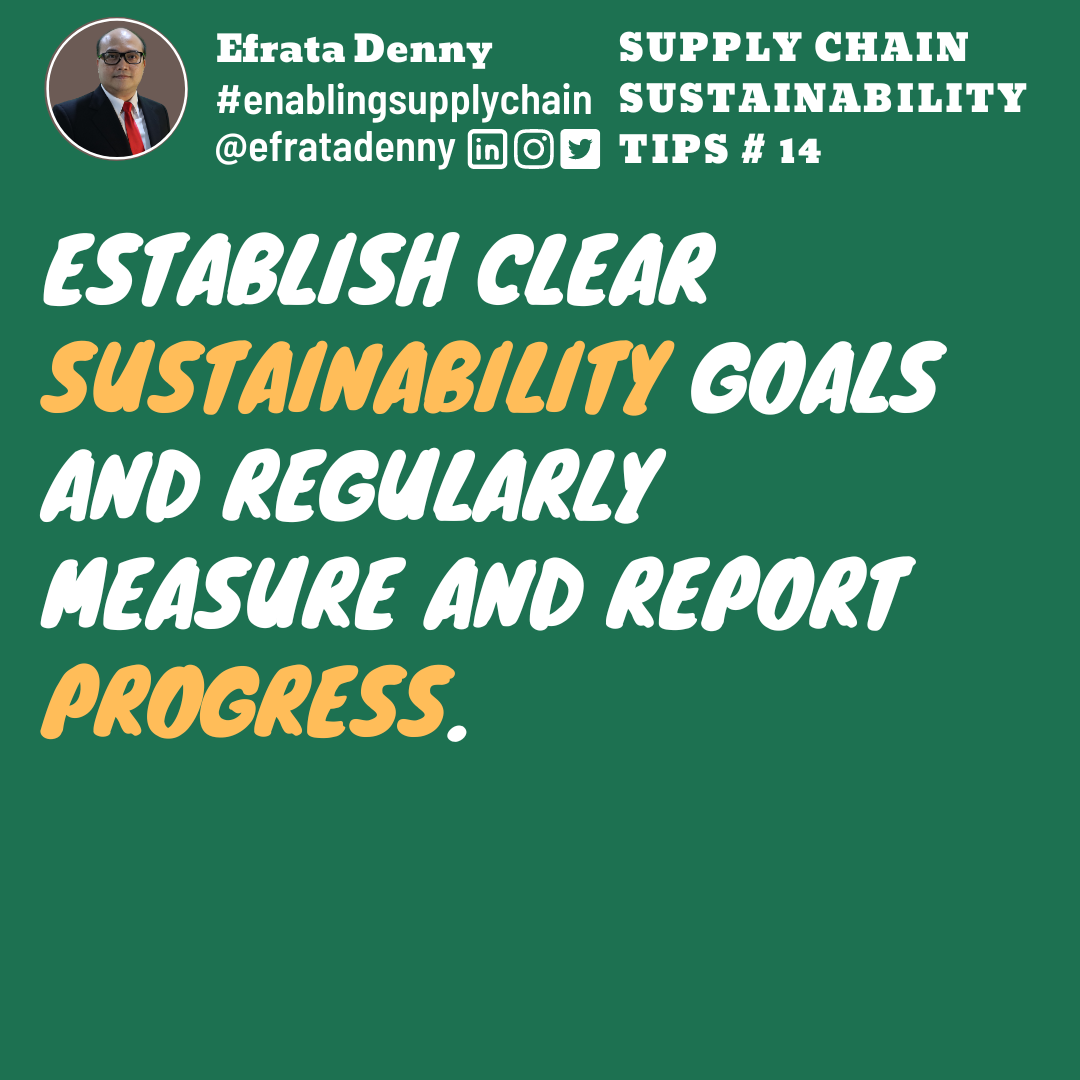
Driving Meaningful Change: Embracing Sustainability through Goal Setting and Progress Measurement

Posted by efratadenny on 11 June 2023
Posted in: Supply Chain, Sustainability. Tagged: enablingsupplychain, Supply Chain, Supply Chain Management, Sustainability, Sustainable. Leave a comment

In today’s rapidly evolving world, sustainability has become a critical focus for organizations across industries. It is not enough to simply acknowledge the importance of sustainability; instead, it is crucial to establish clear goals and measure progress to drive meaningful change. By doing so, businesses can contribute to a better future and make a positive impact on the environment and society. In this article, we will explore the key steps involved in setting sustainability goals, involving stakeholders, tracking progress, utilizing reporting frameworks, embracing transparency, celebrating milestones, and continuously improving practices.

  1. Define your objectives: To kickstart your sustainability journey, it is essential to set specific, measurable, achievable, relevant, and time-bound (SMART) goals that align with your organization’s values and vision. These goals act as a guiding light, providing a clear direction for your sustainability efforts.
  2. Involve stakeholders: Sustainability is a collective responsibility that extends beyond the boundaries of an organization. Engage employees, suppliers, customers, and other stakeholders in the goal-setting process. By involving them from the outset, you can ensure a shared commitment to sustainability and tap into diverse perspectives and expertise.
  3. Track key metrics: Identify key sustainability indicators that are most relevant to your organization. These could include energy consumption, waste generation, water usage, carbon emissions, or any other metrics that align with your business activities. Regularly measure and track these metrics to assess your progress and identify areas for improvement.
  4. Utilize reporting frameworks: Adopt established sustainability reporting frameworks such as the Global Reporting Initiative (GRI), Sustainability Accounting Standards Board (SASB), or Task Force on Climate-related Financial Disclosures (TCFD). These frameworks provide standardized guidelines for reporting sustainability performance, ensuring consistency and comparability in your reporting efforts.
  5. Embrace transparency: Transparency is a cornerstone of sustainability. Communicate your sustainability goals, progress, and challenges to stakeholders through sustainability reports, social media platforms, or dedicated webpages. By being transparent about your sustainability initiatives, you foster trust and demonstrate your commitment to creating a sustainable future.
  6. Celebrate milestones: Recognizing and celebrating milestones along the sustainability journey is essential to maintain motivation and inspire continued progress. Whether it’s achieving a significant reduction in carbon emissions or implementing innovative sustainable practices, milestones provide opportunities to acknowledge accomplishments and showcase the positive impact of your efforts.
  7. Continuously improve: Sustainability is a dynamic process that requires ongoing evaluation and adaptation. Regularly assess your performance, learn from setbacks, and adjust strategies accordingly. By embracing a culture of continuous improvement, you can refine your sustainability practices and stay ahead of emerging challenges and opportunities.

By setting clear sustainability goals, measuring progress, and reporting transparently, organizations can drive positive change and contribute to a more sustainable future. Engaging stakeholders, tracking key metrics, utilizing reporting frameworks, and embracing transparency are essential steps in this transformative journey. Furthermore, celebrating milestones and continuously improving sustainability practices foster a culture of innovation and enable organizations to create a lasting impact. Let us unite in our commitment to sustainability, making a difference and inspiring others to follow suit. Together, we can shape a better future for generations to come.

Remember, sustainability matters, and the sustainable supply chain and effective supply chain management (SCM) practices play vital roles in achieving our collective goals. Embrace sustainability, integrate it into your supply chain, and become a catalyst for positive change.

Share this:

  • Share on Facebook (Opens in new window) Facebook
  • Share on X (Opens in new window) X
  • Share on LinkedIn (Opens in new window) LinkedIn
  • Email a link to a friend (Opens in new window) Email
  • Share on Tumblr (Opens in new window) Tumblr
  • Share on Pinterest (Opens in new window) Pinterest
Like Loading...

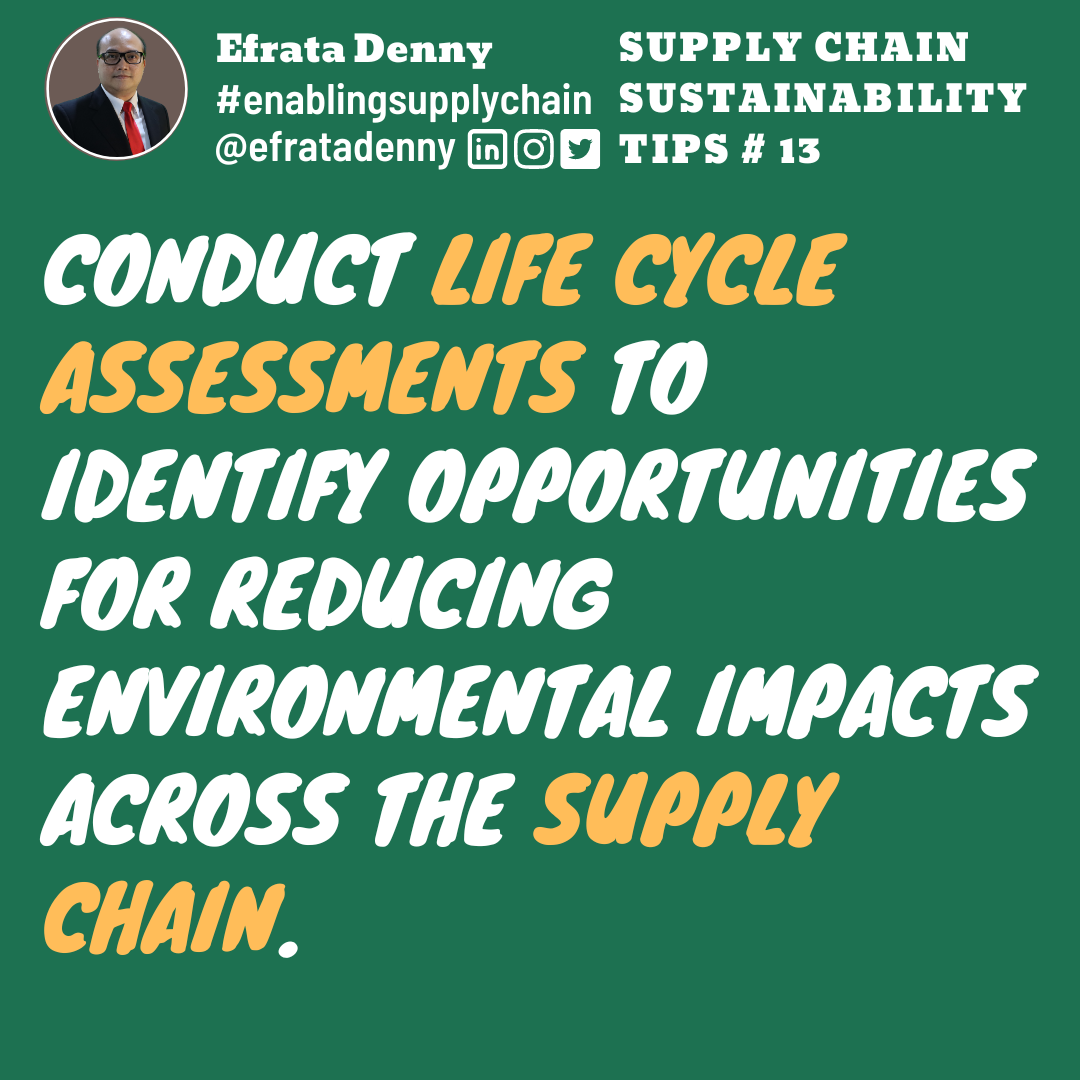
Unleash the Potential of Sustainability Insights! Conduct Life Cycle Assessments for an Eco-Friendly Supply Chain!

Posted by efratadenny on 10 June 2023
Posted in: Supply Chain, Sustainability. Tagged: enablingsupplychain, Supply Chain, Supply Chain Management, Sustainability, Sustainable. Leave a comment

In today’s rapidly changing world, sustainability has become a top priority for businesses across industries. As companies strive to reduce their environmental impact and embrace a greener future, conducting life cycle assessments (LCAs) has emerged as a powerful tool for understanding and improving supply chain sustainability. By analyzing the entire life cycle of products and quantifying environmental impacts, businesses can gain valuable insights, make informed decisions, and drive continuous improvement. Let’s explore some essential tips to get started with life cycle assessments.

  1. Understand the Life Cycle: To conduct a comprehensive LCA, it’s crucial to assess the entire life cycle of your products. This includes understanding the various stages, from raw material extraction and production to distribution, use, and disposal. By examining each stage, you can identify potential environmental hotspots and focus your efforts on areas that have the most significant impact.
  2. Measure Environmental Impacts: LCA methodologies provide a structured framework for measuring and quantifying environmental impacts. These impacts can include carbon emissions, water usage, energy consumption, waste generation, and more. By quantifying these factors, you gain a clearer understanding of the environmental footprint of your supply chain and can set specific targets for improvement.
  3. Identify Hotspots: Analyzing the results of your LCA will help you pinpoint areas with the highest environmental impacts. These hotspots represent significant opportunities for improvement. By focusing on these areas, you can implement targeted strategies and initiatives that address the most critical sustainability challenges in your supply chain.
  4. Collaborate with Suppliers: Sustainability is a collective effort that requires collaboration and transparency throughout the supply chain. Engaging with suppliers is essential for gathering accurate data and working together to reduce shared environmental impacts. By fostering strong relationships with your suppliers, you can encourage sustainable practices, drive innovation, and create a more resilient and responsible supply chain.
  5. Seek Sustainable Alternatives: As you uncover environmental hotspots and areas for improvement, it’s essential to explore sustainable alternatives. Look for opportunities to replace high-impact materials, processes, or packaging with more sustainable options. This might involve sourcing eco-friendly materials, adopting cleaner production methods, or implementing innovative packaging solutions. By making conscious choices, you can significantly reduce the overall environmental footprint of your supply chain.
  6. Optimize Transportation: Transportation is a crucial aspect of the supply chain that often contributes to environmental impacts. Evaluate your transportation processes and identify opportunities to reduce emissions. This could involve optimizing routes to minimize distance or exploring low-carbon transportation modes such as rail or sea freight. By optimizing transportation, you not only reduce your carbon footprint but also potentially enhance cost-efficiency and operational resilience.
  7. Continuously Improve: Sustainability is an ongoing journey. It’s essential to regularly revisit and update your life cycle assessments as new data and technologies become available. As the field of sustainability evolves, new insights and best practices emerge. By staying up to date and continuously improving, you can ensure that your supply chain remains at the forefront of sustainability performance.

By embracing life cycle assessments, businesses can unlock valuable insights that lead to informed decision-making and drive continuous improvement. Sustainable supply chains are not only better for the environment but also offer competitive advantages, enhance brand reputation, and resonate with environmentally conscious consumers. Let’s harness the power of assessment and work together towards a greener future for all!

Share this:

  • Share on Facebook (Opens in new window) Facebook
  • Share on X (Opens in new window) X
  • Share on LinkedIn (Opens in new window) LinkedIn
  • Email a link to a friend (Opens in new window) Email
  • Share on Tumblr (Opens in new window) Tumblr
  • Share on Pinterest (Opens in new window) Pinterest
Like Loading...

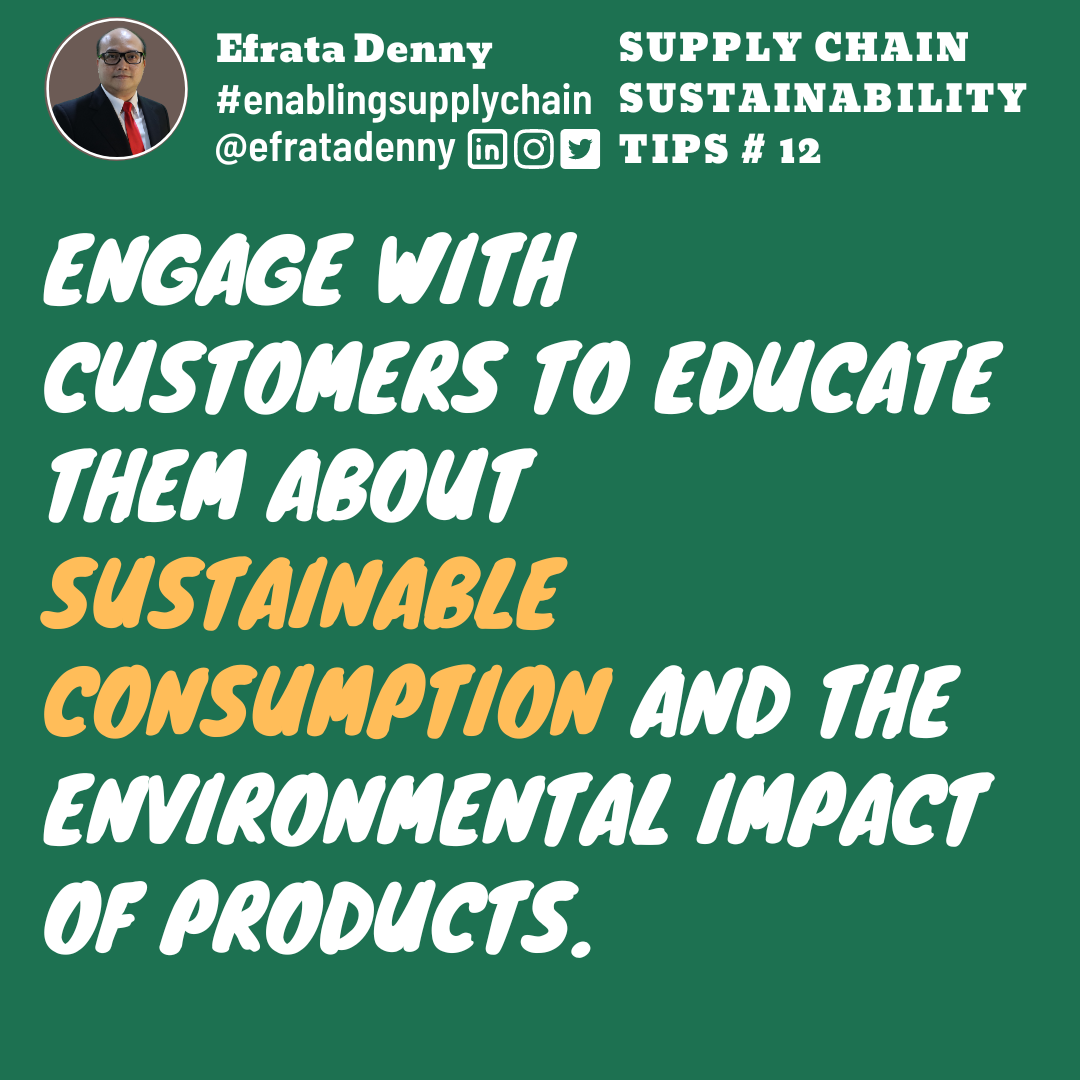
Empower Customers for Sustainable Choices: Learn, Act, and Make a Difference!

Posted by efratadenny on 9 June 2023
Posted in: Supply Chain, Sustainability. Tagged: Supply Chain, Supply Chain Management, Sustainability, Sustainable. Leave a comment

In our collective journey towards a greener future, empowering customers and promoting sustainable consumption play a vital role. By engaging with customers and providing them with the necessary knowledge and tools to make informed choices, we can drive positive change and create a more sustainable world. In this article, we will explore practical tips to promote awareness and inspire sustainable choices among customers, fostering a mindset of conscious consumerism and environmental responsibility.

  1. Share the Environmental Impact: One of the most effective ways to empower customers is by communicating the environmental impact of products. Highlight factors such as carbon emissions, water usage, or resource depletion associated with the production, use, and disposal of items. By making this information accessible and transparent, customers can understand the sustainability implications of their choices and make more informed decisions.
  2. Provide Transparent Information: Transparency is key in empowering customers to make sustainable choices. Offer clear and concise product labels or online descriptions that disclose sustainability attributes, certifications, and ethical practices. This transparency builds trust and allows customers to align their values with their purchasing decisions, supporting brands that prioritize sustainability.
  3. Create Educational Content: Education plays a pivotal role in driving sustainable behavior change. Develop engaging content, such as blog posts, videos, or infographics, that explain sustainability concepts and showcase the benefits of eco-friendly choices. By providing accessible and informative resources, customers can expand their knowledge and understand the positive impact of their actions on the environment.
  4. Encourage Responsible Purchasing: Advocate for conscious consumerism by encouraging customers to consider factors beyond price and aesthetics. Urge them to prioritize durability, recyclability, and ethical production practices when making purchasing decisions. Emphasize the long-term value and positive environmental outcomes of investing in products that are designed to minimize their impact throughout their lifecycle.
  5. Promote Sustainable Alternatives: Highlight eco-friendly alternatives to conventional products and showcase their lower environmental impacts. By raising awareness of sustainable options and their benefits, customers are encouraged to opt for products that align with their values. Showcase innovative solutions and share success stories to inspire individuals to make choices that contribute to a more sustainable future.
  6. Collaborate with Influencers: Partner with sustainability influencers or advocates who can amplify your message and inspire their followers to adopt sustainable practices. These influencers have built dedicated communities around sustainability and have the power to influence consumer behavior positively. Collaborating with them allows you to reach a wider audience and create a ripple effect of sustainable choices.
  7. Offer Incentives for Sustainable Choices: Motivate customers by providing rewards, discounts, or loyalty programs that recognize and encourage sustainable behaviors. By offering tangible benefits for choosing sustainable options and participating in recycling programs, you incentivize customers to actively engage in environmentally responsible actions.

By engaging with customers and raising awareness about sustainable consumption, we have the power to empower individuals to make choices that have a lasting positive impact on the planet. By implementing these tips, businesses can foster a culture of conscious consumerism, driving the demand for sustainable products and practices. Let’s work together to create a greener future, where every individual can learn, act, and make a difference. Join the movement towards sustainable choices and be a catalyst for positive change.

Share this:

  • Share on Facebook (Opens in new window) Facebook
  • Share on X (Opens in new window) X
  • Share on LinkedIn (Opens in new window) LinkedIn
  • Email a link to a friend (Opens in new window) Email
  • Share on Tumblr (Opens in new window) Tumblr
  • Share on Pinterest (Opens in new window) Pinterest
Like Loading...

Posts navigation

← Older Entries
Newer Entries →
  • Yes You Can Search

  • Yes This is Calendar

    February 2026
    M T W T F S S
     1
    2345678
    9101112131415
    16171819202122
    232425262728  
    « Sep    
  • Yes These are Archives

  • Yes Recent Posts

    • The Future of Supply Chain: How AI and Automation Are Revolutionizing the Industry
    • Top 10 Supply Chain Innovations to Watch in 2024
    • The Rise of Sustainable Supply Chains: Why Going Green is Now a Business Imperative
    • The Great Debate: Centralized vs. Decentralized Supply Chains—Which is Better for 2024?
    • The Paradox of Supply Chain and Logistics
    • Agility Unleashed: The Power of Continuous Evaluation in Procurement Strategy
    • Cost Clarity: Mastering Total Cost of Acquisition for Procurement Excellence
    • Strategic Sourcing Mastery: Unleashing Procurement Excellence through Consolidated Purchasing
    • Unleashing Operational Excellence Through Just-in-Time (JIT) Inventory Management
    • Revolutionizing Procurement: The Strategic Impact of Harnessing Reverse Auctions for Maximum Cost Savings
  • Yes Follow Me

    Post a Day 2012 Twitter EfrataDenny
  • Yes This is My Twitter

    Tweets by efratadenny
  • Yes Advertising

    Roppopo.com
  • Yes This is Category

    Australia Bali Bandung China Collection Food France Indonesia Intermezzo Jakarta Kraft Foods Leadership Lighting Experiences Liquidart Manado Management Model Online Store Photography Portfolio Press Procurement Still Life Supply Chain Sustainability Traveling Underwater Wines Yes This is Me
  • Enter your email address to follow this blog and receive notifications of new posts by email.

    Join 986 other subscribers
  • Flickr Photos

    Last Supper Wood EngravingChristmas SockChristmas Bell
    More Photos
  • Recent Comments

    Bogdan Kolos's avatarBogdan Kolos on The Power of Strong Supplier R…
    Reighne Sq's avatarReighne Sq on Weekly Photo Challenge: One Sh…
    Shubham's avatarShubham on Long Tail and Short Tail Red…
    Terrence M's avatarTerrence M on Fettuccine Carbonara
    Ivan's avatarIvan on Maria Clara Sangria Red W…
    wahyu jatmiko krisdiyanto's avatarwahyu jatmiko krisdi… on Mie Bakso
    Weekly Photo Challen… on Weekly Photo Challenge: F…
    bali ratih's avatarbali ratih on Diving at Benoa
    Berita Hari Ini's avatarBerita Hari Ini on Miss Indonesia will increase W…
    geraldine's avatargeraldine on Maria Clara Sangria Red W…
    Chika Lesmana's avatarChika Lesmana on Shanghai Ice
    Chika Lesmana's avatarChika Lesmana on Shanghai Ice
    ipah kholipah's avataripah kholipah on Shanghai Ice
    Evi's avatarEvi on Platinum Hill Limited Edition…
    renxkyoko's avatarrenxkyoko on Sirloin Steak
  • Yes Page Info

    Yahoo bot last visit Msn bot last visit Google PageRank Checker

    The best of travel stories in and around Singapore TravelerVoice Bloggers - Meet Millions of Bloggers Personal Blogs visitor counters
  • Yes Facebook

    Yes Facebook
Create a free website or blog at WordPress.com.
Efrata Denny
Blog at WordPress.com.
Privacy & Cookies: This site uses cookies. By continuing to use this website, you agree to their use.
To find out more, including how to control cookies, see here: Cookie Policy
  • Subscribe Subscribed
    • Efrata Denny
    • Join 966 other subscribers
    • Already have a WordPress.com account? Log in now.
    • Efrata Denny
    • Subscribe Subscribed
    • Sign up
    • Log in
    • Report this content
    • View site in Reader
    • Manage subscriptions
    • Collapse this bar
 

Loading Comments...
 

    %d