Efrata Denny

Personal Blog contains Wines, Foods, Traveling, and Photography

  • Home
  • All About Me
    • Yes This is Me
    • Private Message
    • Guest Book
    • Collection
      • Cigars
      • IntermezZo
      • Liquors
      • Sketch
      • Zombie Story
    • Friends
    • Portfolio
      • Kraft Foods
      • Arnott’s
      • Glaxo Smith Kline
      • Online Store
    • Press
  • Wines
    • Argentina
    • Australia
    • Austria
    • Chile
    • France
    • Indonesia
    • Israel
    • Italia
    • Portugal
    • South Africa
    • Spain
    • USA
    • Vietnam
  • Food
  • Traveling
    • Australia
    • China
    • Hong Kong
    • Indonesia
    • Macau
    • Malaysia
    • Philippines
    • Singapore
    • Thailand
    • Vietnam
  • Photography
    • Model
    • Still Life
    • Liquidart
    • Underwater
  • Awards
  • Supply Chain
    • Sustainability
    • Workshop

Harnessing the Power of Data: Optimizing Supply Chain Operations for Sustainability

Posted by efratadenny on 18 June 2023
Posted in: Supply Chain, Sustainability. Tagged: enablingsupplychain, Supply Chain, Supply Chain Management, Sustainability, Sustainable. Leave a comment

In today’s data-driven world, leveraging the power of data analytics and predictive modeling is key to optimizing supply chain operations and driving sustainability. By collecting, analyzing, and deriving insights from relevant data, organizations can identify inefficiencies, reduce environmental impacts, and make informed decisions for a greener and more sustainable supply chain. In this article, we will explore practical tips for harnessing the power of data-driven sustainability and unlocking its potential to transform supply chain operations.

  1. Collect relevant data: Start by gathering comprehensive data on various aspects of your supply chain operations. Collect information on energy consumption, emissions, waste generation, transportation routes, and supplier performance. The more detailed and comprehensive the data, the better insights you can derive.
  2. Implement data analytics tools: Leverage advanced data analytics tools and techniques to analyze the collected data. Utilize algorithms and machine learning models to identify patterns, correlations, and opportunities for improvement. These tools can provide valuable insights into operational inefficiencies and environmental impacts.
  3. Identify improvement opportunities: Use data analytics to identify inefficiencies, bottlenecks, and areas with the highest environmental impacts across your supply chain. By pinpointing these areas, you can focus your efforts on implementing targeted sustainability initiatives that deliver maximum impact.
  4. Predictive modeling for decision-making: Employ predictive modeling techniques to simulate different scenarios, forecast demand, optimize inventory levels, and make informed decisions that align with sustainability goals. Predictive modeling enables organizations to proactively plan and implement strategies that minimize waste, reduce resource consumption, and optimize supply chain performance.
  5. Optimize transportation routes: Analyze transportation data to identify optimal routes, consolidate shipments, and minimize carbon emissions associated with logistics operations. By optimizing transportation routes, organizations can reduce fuel consumption, decrease greenhouse gas emissions, and lower transportation costs.
  6. Enhance demand forecasting accuracy: Utilize predictive analytics to improve demand forecasting accuracy. By accurately predicting demand, organizations can avoid overproduction, reduce excess inventory, and minimize waste. Precise demand forecasting ensures that resources are utilized efficiently and sustainably.
  7. Continuous improvement through data insights: Regularly monitor and measure key performance indicators (KPIs) related to sustainability. Track progress, identify trends, and use data insights to drive continuous improvement initiatives. Data-driven decision-making ensures that sustainability efforts are continually refined and aligned with organizational goals.

Harnessing the power of data analytics and predictive modeling presents a transformative opportunity for supply chain operations. By collecting relevant data, implementing data analytics tools, identifying improvement opportunities, using predictive modeling for decision-making, optimizing transportation routes, enhancing demand forecasting accuracy, and embracing continuous improvement, organizations can optimize supply chain operations, minimize environmental impacts, and pave the way for a sustainable future. Let’s embrace data-driven sustainability to build a greener planet together!

Unlock the power of data and drive sustainable change in your supply chain operations today!

Share this:

  • Share on Facebook (Opens in new window) Facebook
  • Share on X (Opens in new window) X
  • Share on LinkedIn (Opens in new window) LinkedIn
  • Email a link to a friend (Opens in new window) Email
  • Share on Tumblr (Opens in new window) Tumblr
  • Share on Pinterest (Opens in new window) Pinterest
Like Loading...

Joining Forces for Sustainability: Driving Collective Change through Collaboration

Posted by efratadenny on 17 June 2023
Posted in: Supply Chain, Sustainability. Tagged: enablingsupplychain, Supply Chain, Supply Chain Management, Sustainability, Sustainable. Leave a comment

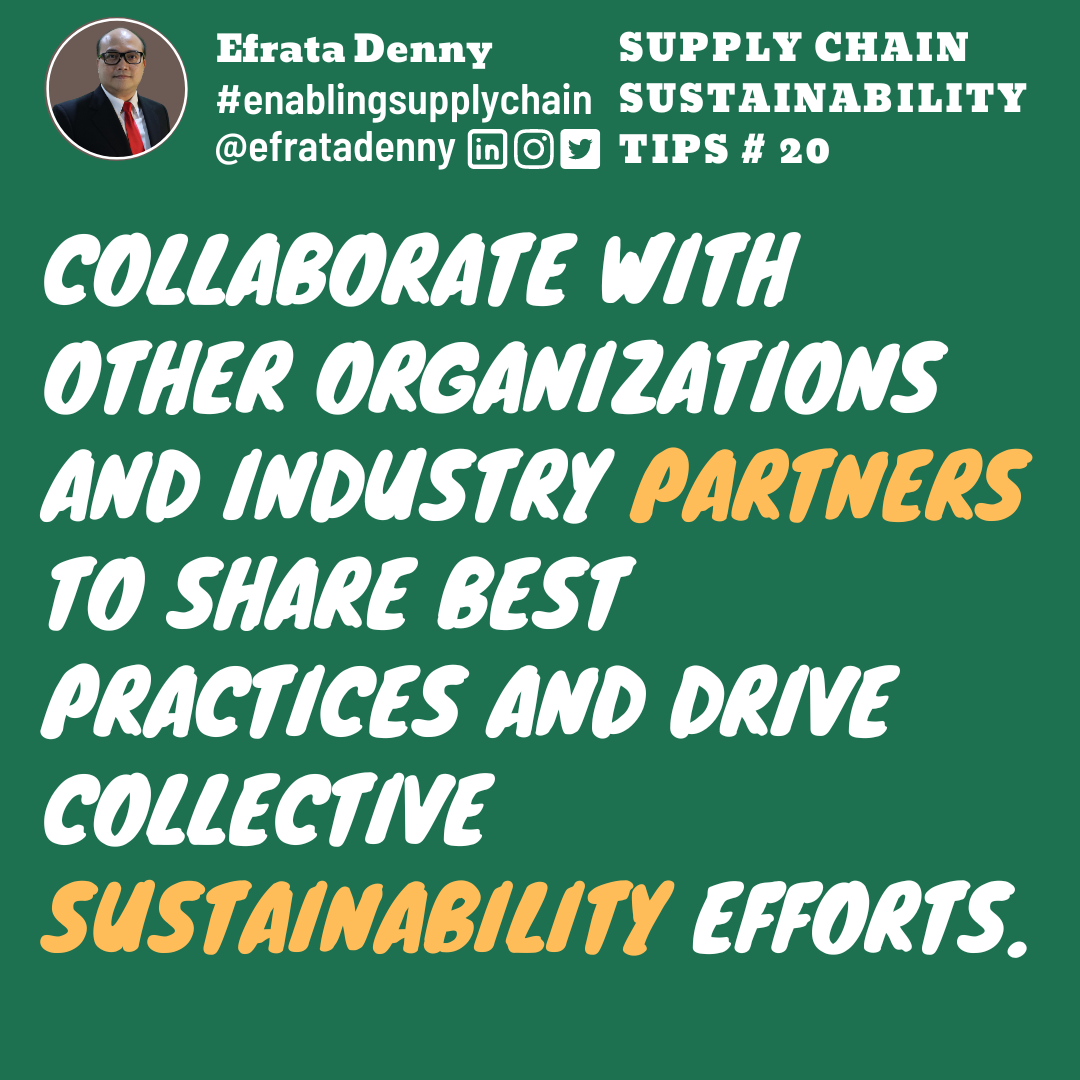
In the quest for a greener and more sustainable future, collaboration plays a crucial role. By joining forces with other organizations and industry partners, we can pool our resources, knowledge, and expertise to drive collective change and accelerate progress towards sustainability. In this article, we will explore key tips to foster collaboration and share best practices, enabling us to make a meaningful and collective impact on the environment.

  1. Form partnerships: Seek out organizations that align with your sustainability values and vision. Establish partnerships that leverage each other’s strengths and resources. Collaborating with like-minded organizations amplifies the impact of sustainability initiatives and creates a united front for change.
  2. Participate in industry networks: Engage in industry networks, associations, or sustainability forums where professionals with similar interests gather. These platforms provide opportunities to connect with peers, share experiences, and exchange valuable insights that can inspire innovative solutions.
  3. Share best practices: Transparency and open sharing of successful sustainability initiatives, learnings, and challenges are essential for fostering collaboration. By openly discussing and disseminating best practices, we empower others to adopt similar strategies and drive positive change within their own organizations.
  4. Collaborate on projects: Collaborative projects are a powerful way to address common environmental challenges. Join forces with partners on research studies, pilot programs, or initiatives aimed at finding innovative solutions and advancing sustainability practices in your industry.
  5. Host knowledge-sharing events: Organize workshops, webinars, or conferences where organizations can come together to share their sustainability journeys, innovations, and strategies. These events foster learning, inspire new ideas, and promote collaboration by creating a space for professionals to connect and exchange valuable insights.
  6. Collaborative supply chain initiatives: Engage with suppliers, customers, and other stakeholders to develop collaborative initiatives that drive sustainability throughout the entire supply chain. By working together, we can align efforts, share resources, and implement sustainable practices that positively impact the entire ecosystem.
  7. Advocate for industry standards: Collective advocacy is crucial for driving systemic change. Collaborate with industry partners to advocate for the development and adoption of sustainability standards and regulations. By speaking with a unified voice, we can influence policy-making and encourage widespread adoption of sustainable practices.

Collaboration is a powerful tool for achieving collective sustainability goals and driving positive change. By forming partnerships, participating in industry networks, sharing best practices, collaborating on projects, hosting knowledge-sharing events, engaging in collaborative supply chain initiatives, and advocating for industry standards, we can amplify our impact and accelerate progress towards a greener future. Let’s join forces, inspire each other, and create a collaborative movement that propels us towards a more sustainable and thriving world.

Together, we can make a lasting difference. Join the collaborative journey for a sustainable future today!

Share this:

  • Share on Facebook (Opens in new window) Facebook
  • Share on X (Opens in new window) X
  • Share on LinkedIn (Opens in new window) LinkedIn
  • Email a link to a friend (Opens in new window) Email
  • Share on Tumblr (Opens in new window) Tumblr
  • Share on Pinterest (Opens in new window) Pinterest
Like Loading...

Illuminating Efficiency: Implementing Energy-Efficient Practices in Warehouses and Distribution Centers

Posted by efratadenny on 16 June 2023
Posted in: Supply Chain, Sustainability. Tagged: enablingsupplychain, Supply Chain, Supply Chain Management, Sustainability, Sustainable. Leave a comment

In the pursuit of sustainability and environmental responsibility, implementing energy-efficient practices in warehouses and distribution centers is a crucial step. By optimizing energy usage, businesses can reduce their environmental impact, lower operational costs, and contribute to a more sustainable supply chain. In this article, we will explore practical tips to make warehouses and distribution centers more energy-efficient, fostering a greener future while maintaining operational efficiency.

  1. Upgrade to LED lighting: One of the simplest and most effective ways to improve energy efficiency is by replacing traditional lighting with energy-efficient LED fixtures. LED lighting consumes significantly less energy, lasts longer, and requires less maintenance, resulting in substantial energy and cost savings.
  2. Install smart temperature control systems: Utilize smart sensors and automated temperature control systems to regulate temperatures in warehouses and distribution centers. These systems optimize energy usage by adjusting heating and cooling based on real-time conditions, ensuring energy efficiency while maintaining product quality.
  3. Optimize ventilation and insulation: Improve insulation and ventilation systems to minimize heat loss or gain in the facility. Proper insulation and well-maintained ventilation systems help regulate indoor temperatures more effectively, reducing the need for excessive heating or cooling and lowering energy consumption.
  4. Embrace natural lighting: Make the most of natural light by incorporating skylights or large windows in the design of your facility. This allows for increased natural lighting during daylight hours, reducing reliance on artificial lighting and further decreasing energy consumption.
  5. Use energy-efficient equipment: Choose energy-efficient machinery and equipment, such as forklifts or conveyor systems, that are designed to minimize energy consumption without compromising productivity. Look for equipment with energy-saving features and technologies to maximize efficiency throughout your operations.
  6. Implement motion sensors: Install motion sensors in less frequently used areas of the facility to automatically turn off lights when they are not in use. This prevents unnecessary energy waste and ensures that lighting is only active when needed, leading to substantial energy savings over time.
  7. Conduct energy audits: Regularly assess energy usage through comprehensive energy audits. Identify areas for improvement and prioritize energy-saving initiatives based on the findings. Energy audits provide valuable insights into energy consumption patterns and guide strategic decision-making for greater efficiency.

Implementing energy-efficient practices in warehouses and distribution centers not only reduces carbon emissions but also lowers operational costs, leading to a more sustainable and economically viable supply chain. By upgrading to LED lighting, installing smart temperature control systems, optimizing ventilation and insulation, embracing natural lighting, using energy-efficient equipment, implementing motion sensors, and conducting regular energy audits, businesses can illuminate efficiency and make a positive impact on the environment.

Let us embrace the power of energy efficiency and work together to create warehouses and distribution centers that prioritize sustainability. By doing so, we contribute to a greener future while maintaining operational excellence. Illuminate efficiency and be a catalyst for positive change in your supply chain!

Share this:

  • Share on Facebook (Opens in new window) Facebook
  • Share on X (Opens in new window) X
  • Share on LinkedIn (Opens in new window) LinkedIn
  • Email a link to a friend (Opens in new window) Email
  • Share on Tumblr (Opens in new window) Tumblr
  • Share on Pinterest (Opens in new window) Pinterest
Like Loading...

Embracing Green Transportation: Reducing Carbon Emissions with Rail and Water

Posted by efratadenny on 15 June 2023
Posted in: Supply Chain, Sustainability. Tagged: enablingsupplychain, Supply Chain, Supply Chain Management, Sustainability, Sustainable. Leave a comment

Transportation plays a significant role in carbon emissions, making it a crucial area to focus on when striving for sustainability in supply chain operations. Exploring alternative transportation methods can be a game-changer, allowing businesses to significantly reduce their carbon footprints and contribute to a greener future. In this article, we will explore practical tips to embrace green transportation options such as rail and water, empowering businesses to make a positive impact on the environment.

  1. Opt for rail transportation: When feasible, consider using rail for long-distance shipments. Trains have lower emissions compared to trucks, providing a more efficient and eco-friendly transportation option. By leveraging rail transportation, businesses can reduce their carbon footprints while maintaining reliable and cost-effective logistics operations.
  2. Embrace water transportation: Exploring the use of waterways for shipping can have a significant impact on carbon emissions reduction. Barges and ships have considerably lower carbon footprints compared to traditional road transport. When appropriate, opt for water transportation to move goods efficiently while minimizing environmental impacts.
  3. Consolidate shipments: Maximize transportation efficiency by consolidating shipments and utilizing full container loads. By reducing the number of trips and optimizing transportation resources, businesses can minimize fuel consumption and decrease carbon emissions. Consolidation also leads to cost savings and improved resource utilization.
  4. Collaborate with logistics providers: Engage with logistics providers who prioritize sustainability commitments and offer environmentally friendly transportation options. Work with providers that have a track record of implementing sustainable practices, ensuring that your transportation partners align with your sustainability goals.
  5. Use intermodal transportation: Leverage the benefits of intermodal transportation by combining different modes of transportation. By seamlessly integrating rail and truck or water and rail, businesses can optimize logistics routes and reduce carbon emissions. Intermodal transportation allows for greater flexibility, efficiency, and environmental sustainability.
  6. Optimize route planning: Leverage technology and data to optimize route planning. Utilize tools and systems that consider various factors such as distance, traffic, and fuel consumption to minimize mileage and reduce unnecessary fuel consumption. Optimized route planning not only reduces carbon emissions but also improves overall transportation efficiency.
  7. Promote sustainable partnerships: Partner with suppliers and customers who share a commitment to sustainable transportation practices. By fostering sustainable partnerships, businesses can collaborate on joint initiatives and support the development of greener supply chains. Together, we can create a collective effort towards sustainable transportation and make a lasting positive impact.

Embracing green transportation options such as rail and water is a vital step toward reducing carbon emissions and promoting sustainability in supply chain operations. By opting for rail transportation, embracing water transportation, consolidating shipments, collaborating with sustainable logistics providers, utilizing intermodal transportation, optimizing route planning, and promoting sustainable partnerships, businesses can significantly contribute to a more sustainable future. Let us embark on the journey of greener logistics, making responsible choices for the planet while ensuring efficient and sustainable supply chain operations.

Remember, sustainability matters, and integrating green transportation practices into your supply chain strategies is a powerful way to reduce carbon emissions and create a positive impact. Embrace the power of rail and water transportation and join the movement toward greener logistics. Together, we can build a sustainable future.

Share this:

  • Share on Facebook (Opens in new window) Facebook
  • Share on X (Opens in new window) X
  • Share on LinkedIn (Opens in new window) LinkedIn
  • Email a link to a friend (Opens in new window) Email
  • Share on Tumblr (Opens in new window) Tumblr
  • Share on Pinterest (Opens in new window) Pinterest
Like Loading...

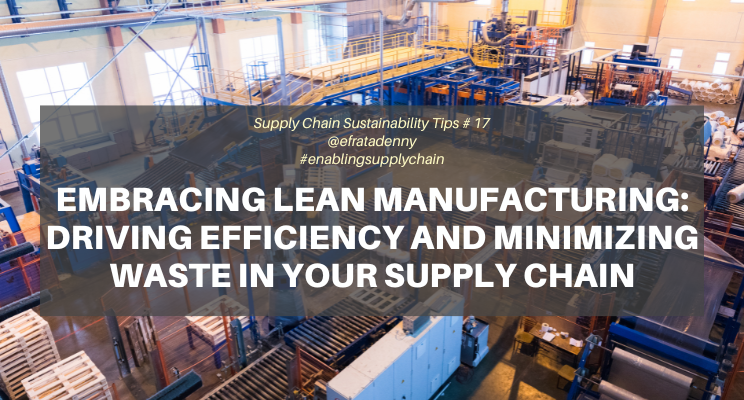
Embracing Lean Manufacturing: Driving Efficiency and Minimizing Waste in Your Supply Chain

Posted by efratadenny on 14 June 2023
Posted in: Supply Chain, Sustainability. Tagged: enablingsupplychain, Supply Chain, Supply Chain Management, Sustainability, Sustainable. Leave a comment

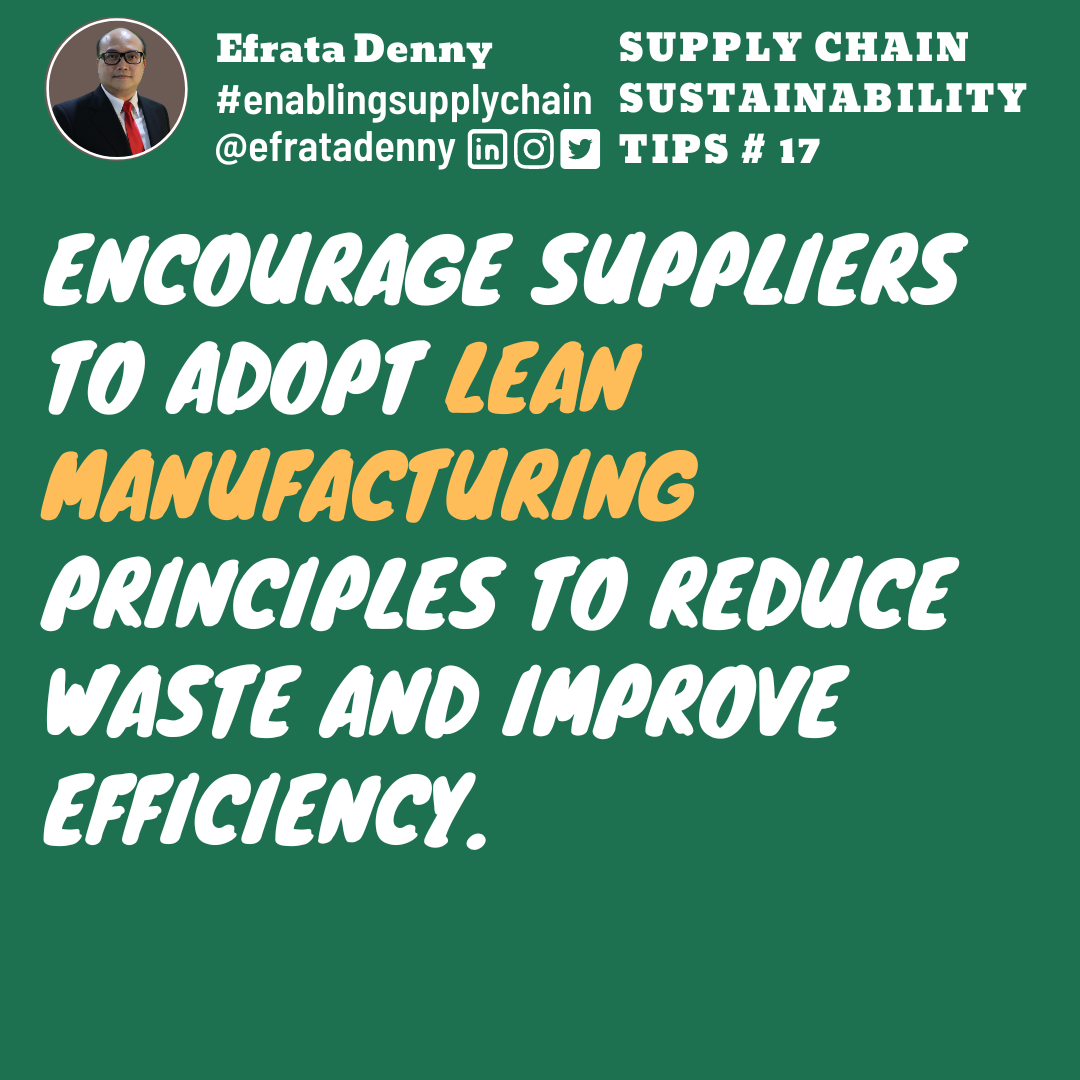
In an era where efficiency and sustainability are paramount, embracing lean manufacturing principles can revolutionize your supply chain operations. By encouraging suppliers to adopt lean practices, businesses can achieve significant improvements in efficiency, reduce waste, and enhance overall sustainability. In this article, we will explore practical tips to inspire lean manufacturing within your supply chain and unlock its transformative benefits.

  1. Educate suppliers: Begin by sharing the benefits of lean manufacturing and providing resources to help suppliers understand and implement lean principles in their operations. Educating suppliers about the advantages of lean practices fosters a shared understanding and commitment to driving efficiency and waste reduction.
  2. Foster collaboration: Establish open lines of communication with suppliers and create a collaborative environment. Encourage suppliers to share ideas, experiences, and challenges related to lean initiatives. Collaborative partnerships facilitate a collective effort to drive continuous improvement throughout the supply chain.
  3. Promote continuous improvement: Inspire suppliers to embrace a culture of continuous improvement by empowering them to identify and eliminate waste at every stage of production. Encourage the adoption of lean tools and methodologies, such as value stream mapping, Kaizen events, and 5S, to drive ongoing process enhancements.
  4. Streamline processes: Work closely with suppliers to analyze their workflows, identify bottlenecks, and streamline processes. By optimizing the flow of materials, information, and activities, you can minimize lead times, reduce delays, and increase overall operational efficiency.
  5. Implement visual management: Support suppliers in implementing visual management techniques, such as Kanban boards or visual work instructions. These tools improve workflow visibility, enhance communication, and minimize errors by providing clear instructions, visual cues, and real-time information.
  6. Optimize inventory management: Collaborate with suppliers to implement just-in-time (JIT) inventory practices. By synchronizing production and delivery schedules, JIT minimizes excess inventory, reduces storage space requirements, and enhances supply chain agility while reducing waste associated with overproduction.
  7. Share best practices: Organize workshops or knowledge-sharing sessions where suppliers can learn from each other’s successful lean initiatives. These collaborative platforms foster a culture of shared learning, enabling suppliers to exchange ideas, experiences, and innovative solutions to drive lean transformation.

Embracing lean manufacturing principles within your supply chain is a powerful strategy to drive efficiency, minimize waste, and enhance sustainability. By educating suppliers, fostering collaboration, promoting continuous improvement, streamlining processes, implementing visual management, optimizing inventory management, and sharing best practices, businesses can unlock the full potential of lean practices. Let us embark on a lean journey together, transforming our supply chains into streamlined, efficient, and sustainable engines that contribute to a greener future.

Remember, sustainability matters, and integrating lean manufacturing principles into your supply chain management strategies is a key step towards operational excellence. By embracing lean practices, you can enhance productivity, reduce waste, and create a competitive advantage while driving sustainability. Embrace the power of lean manufacturing and unlock the transformative benefits for your supply chain.

Share this:

  • Share on Facebook (Opens in new window) Facebook
  • Share on X (Opens in new window) X
  • Share on LinkedIn (Opens in new window) LinkedIn
  • Email a link to a friend (Opens in new window) Email
  • Share on Tumblr (Opens in new window) Tumblr
  • Share on Pinterest (Opens in new window) Pinterest
Like Loading...

Posts navigation

← Older Entries
Newer Entries →
  • Yes You Can Search

  • Yes This is Calendar

    February 2026
    M T W T F S S
     1
    2345678
    9101112131415
    16171819202122
    232425262728  
    « Sep    
  • Yes These are Archives

  • Yes Recent Posts

    • The Future of Supply Chain: How AI and Automation Are Revolutionizing the Industry
    • Top 10 Supply Chain Innovations to Watch in 2024
    • The Rise of Sustainable Supply Chains: Why Going Green is Now a Business Imperative
    • The Great Debate: Centralized vs. Decentralized Supply Chains—Which is Better for 2024?
    • The Paradox of Supply Chain and Logistics
    • Agility Unleashed: The Power of Continuous Evaluation in Procurement Strategy
    • Cost Clarity: Mastering Total Cost of Acquisition for Procurement Excellence
    • Strategic Sourcing Mastery: Unleashing Procurement Excellence through Consolidated Purchasing
    • Unleashing Operational Excellence Through Just-in-Time (JIT) Inventory Management
    • Revolutionizing Procurement: The Strategic Impact of Harnessing Reverse Auctions for Maximum Cost Savings
  • Yes Follow Me

    Post a Day 2012 Twitter EfrataDenny
  • Yes This is My Twitter

    Tweets by efratadenny
  • Yes Advertising

    Roppopo.com
  • Yes This is Category

    Australia Bali Bandung China Collection Food France Indonesia Intermezzo Jakarta Kraft Foods Leadership Lighting Experiences Liquidart Manado Management Model Online Store Photography Portfolio Press Procurement Still Life Supply Chain Sustainability Traveling Underwater Wines Yes This is Me
  • Enter your email address to follow this blog and receive notifications of new posts by email.

    Join 986 other subscribers
  • Flickr Photos

    Last Supper Wood EngravingChristmas SockChristmas Bell
    More Photos
  • Recent Comments

    Bogdan Kolos's avatarBogdan Kolos on The Power of Strong Supplier R…
    Reighne Sq's avatarReighne Sq on Weekly Photo Challenge: One Sh…
    Shubham's avatarShubham on Long Tail and Short Tail Red…
    Terrence M's avatarTerrence M on Fettuccine Carbonara
    Ivan's avatarIvan on Maria Clara Sangria Red W…
    wahyu jatmiko krisdiyanto's avatarwahyu jatmiko krisdi… on Mie Bakso
    Weekly Photo Challen… on Weekly Photo Challenge: F…
    bali ratih's avatarbali ratih on Diving at Benoa
    Berita Hari Ini's avatarBerita Hari Ini on Miss Indonesia will increase W…
    geraldine's avatargeraldine on Maria Clara Sangria Red W…
    Chika Lesmana's avatarChika Lesmana on Shanghai Ice
    Chika Lesmana's avatarChika Lesmana on Shanghai Ice
    ipah kholipah's avataripah kholipah on Shanghai Ice
    Evi's avatarEvi on Platinum Hill Limited Edition…
    renxkyoko's avatarrenxkyoko on Sirloin Steak
  • Yes Page Info

    Yahoo bot last visit Msn bot last visit Google PageRank Checker

    The best of travel stories in and around Singapore TravelerVoice Bloggers - Meet Millions of Bloggers Personal Blogs visitor counters
  • Yes Facebook

    Yes Facebook
Blog at WordPress.com.
Efrata Denny
Create a free website or blog at WordPress.com.
Privacy & Cookies: This site uses cookies. By continuing to use this website, you agree to their use.
To find out more, including how to control cookies, see here: Cookie Policy
  • Subscribe Subscribed
    • Efrata Denny
    • Join 966 other subscribers
    • Already have a WordPress.com account? Log in now.
    • Efrata Denny
    • Subscribe Subscribed
    • Sign up
    • Log in
    • Report this content
    • View site in Reader
    • Manage subscriptions
    • Collapse this bar
 

Loading Comments...
 

    %d