Efrata Denny

Personal Blog contains Wines, Foods, Traveling, and Photography

  • Home
  • All About Me
    • Yes This is Me
    • Private Message
    • Guest Book
    • Collection
      • Cigars
      • IntermezZo
      • Liquors
      • Sketch
      • Zombie Story
    • Friends
    • Portfolio
      • Kraft Foods
      • Arnott’s
      • Glaxo Smith Kline
      • Online Store
    • Press
  • Wines
    • Argentina
    • Australia
    • Austria
    • Chile
    • France
    • Indonesia
    • Israel
    • Italia
    • Portugal
    • South Africa
    • Spain
    • USA
    • Vietnam
  • Food
  • Traveling
    • Australia
    • China
    • Hong Kong
    • Indonesia
    • Macau
    • Malaysia
    • Philippines
    • Singapore
    • Thailand
    • Vietnam
  • Photography
    • Model
    • Still Life
    • Liquidart
    • Underwater
  • Awards
  • Supply Chain
    • Sustainability
    • Workshop

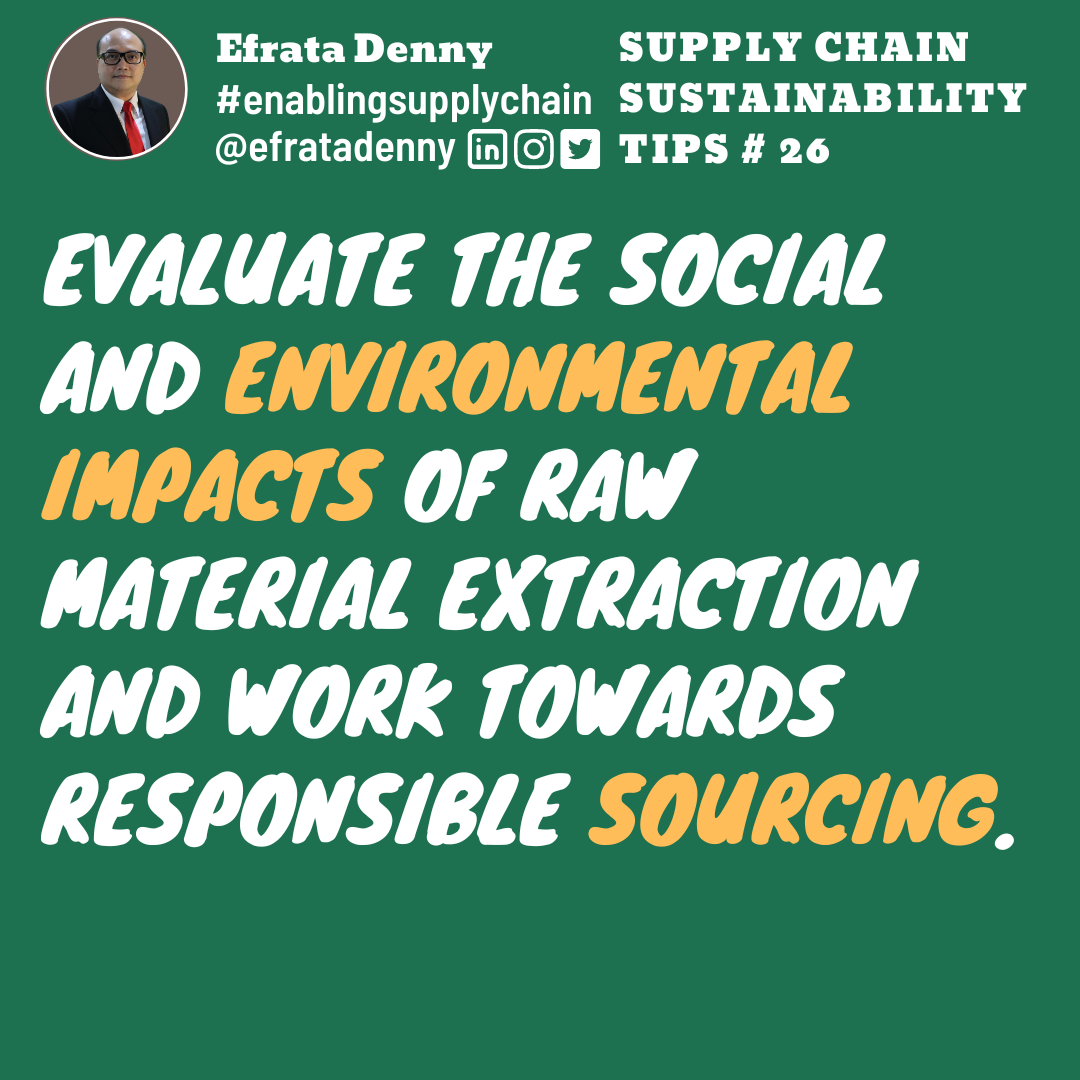
Promoting Responsible Sourcing for a Sustainable Future

Posted by efratadenny on 23 June 2023
Posted in: Supply Chain, Sustainability. Tagged: enablingsupplychain, Supply Chain, Supply Chain Management, Sustainability, Sustainable. Leave a comment

Responsible sourcing of raw materials is a crucial aspect of building a sustainable supply chain. By evaluating the social and environmental impacts associated with raw material extraction and choosing sustainable materials, businesses can make a positive impact on the planet. In this article, we will explore practical tips to promote responsible sourcing and drive positive change towards a more sustainable future.

  1. Conduct impact assessments: Assessing the social and environmental impacts of raw material extraction is essential. Consider factors such as biodiversity, water usage, land degradation, and human rights. Conducting comprehensive impact assessments allows for informed decision-making and enables businesses to choose materials with minimal negative consequences.
  2. Engage with suppliers: Collaborate closely with suppliers to understand their practices, certifications, and commitments to responsible sourcing. Engaging in open dialogue helps ensure alignment with your sustainability goals and encourages suppliers to adopt sustainable practices.
  3. Promote transparency: Transparency in the supply chain is key to responsible sourcing. Request information from suppliers about the origin of raw materials and their environmental and social certifications. Transparency allows for informed decision-making and promotes accountability.
  4. Support sustainable certifications: Give preference to suppliers with recognized sustainability certifications, such as Fairtrade, Forest Stewardship Council (FSC), or Responsible Mining Initiative (RMI). These certifications provide assurance that raw materials have been responsibly sourced, promoting ethical practices and environmental conservation.
  5. Explore alternative materials: Investigate sustainable and innovative alternatives to traditional raw materials. Look for materials with lower environmental impact or those derived from renewable resources. Embracing alternative materials encourages innovation and reduces the ecological footprint of the supply chain.
  6. Engage in supplier development: Collaborate with suppliers to develop sustainable practices. Provide guidance on responsible sourcing, offer resources for improvement, and support their journey towards environmental and social responsibility. Supplier development contributes to a more sustainable supply chain overall.
  7. Share progress and success: Communicate your commitment to responsible sourcing and share stories of progress and positive impact. By highlighting successes and lessons learned, businesses inspire others to join the journey toward sustainability. Collaboration and knowledge sharing accelerate the shift towards responsible sourcing.

By evaluating the social and environmental impacts of raw material extraction and choosing sustainable materials, businesses can make a significant difference in building a sustainable future. Through impact assessments, supplier engagement, transparency, support for sustainable certifications, exploration of alternative materials, supplier development, and sharing progress, responsible sourcing becomes a standard practice. Let’s prioritize responsible sourcing, protect natural resources, and work towards a more sustainable and environmentally conscious supply chain.
Share this:

  • Share on Facebook (Opens in new window) Facebook
  • Share on X (Opens in new window) X
  • Share on LinkedIn (Opens in new window) LinkedIn
  • Email a link to a friend (Opens in new window) Email
  • Share on Tumblr (Opens in new window) Tumblr
  • Share on Pinterest (Opens in new window) Pinterest
Like Loading...

Streamlining Inventory Management for a Greener Supply Chain

Posted by efratadenny on 22 June 2023
Posted in: Supply Chain, Sustainability. Tagged: enablingsupplychain, Supply Chain, Supply Chain Management, Sustainability, Sustainable. Leave a comment

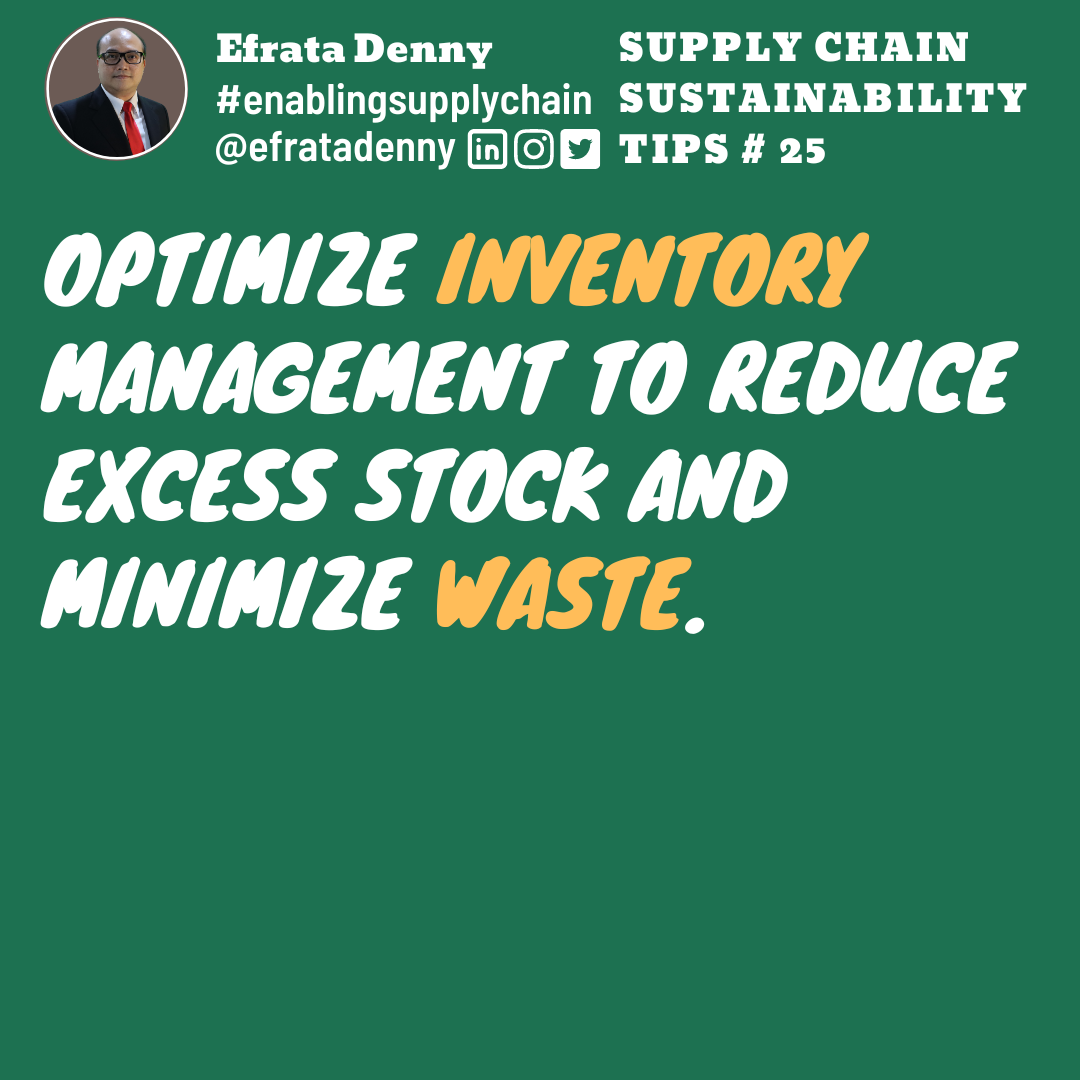
Efficient inventory management plays a vital role in creating a sustainable and environmentally conscious supply chain. By optimizing inventory practices, businesses can minimize waste, reduce costs, and contribute to a greener future. In this article, we will explore practical tips to streamline inventory management and foster a more sustainable supply chain.
  1. Demand forecasting: Accurate demand forecasting techniques are key to aligning inventory levels with customer needs. By analyzing historical data, market trends, and customer insights, businesses can optimize inventory levels and minimize the risk of overstocking.
  2. Embracing the just-in-time (JIT) approach: Adopting the JIT approach helps reduce excess inventory and minimize waste. With JIT, stock is replenished only when needed, ensuring inventory is available at the right time while avoiding unnecessary stock accumulation.
  3. Supplier collaboration: Strong relationships with suppliers are crucial for efficient inventory management. Collaborate closely with suppliers, sharing demand forecasts and optimizing lead times. Improved communication and coordination contribute to inventory availability when required, reducing the need for excess stock.
  4. Efficient order management: Implementing efficient order management processes minimizes errors, avoids duplicate orders, and prevents unnecessary stock accumulation. Streamlining order processes reduces waste and optimizes inventory levels, leading to a more sustainable supply chain.
  5. Safety stock optimization: Analyze historical data, lead times, and demand variability to optimize safety stock levels. Having enough buffer stock is important, but excessive safety stock can lead to waste. By accurately assessing risk and demand fluctuations, businesses can strike the right balance.
  6. Evaluating just-in-case inventory: Evaluate the necessity of “just-in-case” inventory and explore alternative solutions. Improved quality control, proactive maintenance, or flexible production capabilities may eliminate the need for excessive safety stock, reducing waste and optimizing resources.
  7. Inventory tracking and visibility: Leverage technology solutions and real-time data to track inventory levels, monitor expiration dates, and identify slow-moving or obsolete items. Enhanced visibility allows for timely action, reducing waste and minimizing the environmental impact of excess stock.

By optimizing inventory management practices, businesses can minimize waste, reduce costs, and contribute to a more sustainable supply chain. Through demand forecasting, embracing the JIT approach, fostering supplier collaboration, and implementing efficient order management processes, companies can achieve better inventory control and environmental stewardship. By streamlining inventory practices, we can free up valuable storage space, reduce waste, and minimize the environmental impact of excess stock. Let’s strive for efficient and sustainable inventory management to create a greener future!

Share this:

  • Share on Facebook (Opens in new window) Facebook
  • Share on X (Opens in new window) X
  • Share on LinkedIn (Opens in new window) LinkedIn
  • Email a link to a friend (Opens in new window) Email
  • Share on Tumblr (Opens in new window) Tumblr
  • Share on Pinterest (Opens in new window) Pinterest
Like Loading...

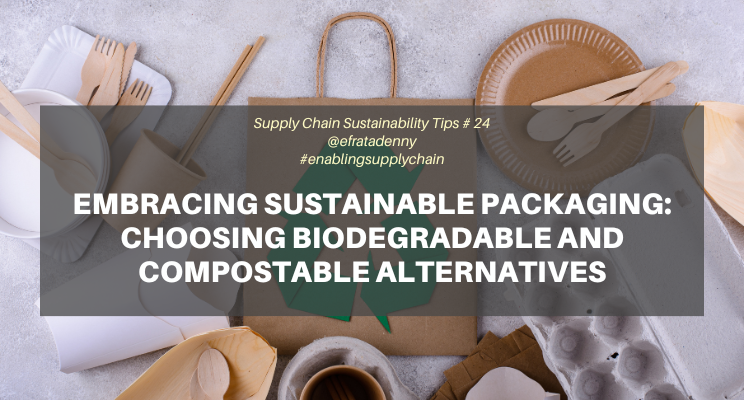
Embracing Sustainable Packaging: Choosing Biodegradable and Compostable Alternatives

Posted by efratadenny on 21 June 2023
Posted in: Supply Chain, Sustainability. Tagged: enablingsupplychain, Supply Chain, Supply Chain Management, Sustainability, Sustainable. Leave a comment

As the world becomes more aware of the environmental impacts of packaging waste, businesses have a crucial role to play in adopting sustainable practices. Embracing sustainable packaging materials not only reduces environmental harm but also promotes a circular economy where resources are used efficiently. In this article, we will explore tips for making greener packaging choices and embracing sustainable alternatives.

  1. Biodegradable options: Consider packaging materials that are biodegradable, meaning they can naturally break down into harmless components over time. These materials reduce the accumulation of waste in landfills and minimize environmental pollution.
  2. Compostable alternatives: Opt for packaging materials that are compostable, allowing them to decompose into nutrient-rich soil when properly managed in composting facilities. Composting not only eliminates waste but also creates valuable resources for agriculture and landscaping.
  3. Recycled content: Choose packaging made from recycled materials, supporting the demand for recycled content and reducing the need for virgin resources. Using recycled materials helps conserve energy, reduce greenhouse gas emissions, and decrease the extraction of raw materials.
  4. Minimalist design: Simplify packaging design to reduce material usage and minimize waste. Focus on functionality and protection while using the least amount of packaging necessary. This approach promotes eco-friendly practices and reduces the environmental footprint of packaging.
  5. Renewable materials: Prioritize packaging materials derived from renewable resources, such as bamboo, hemp, or corn-based plastics. Renewable materials help alleviate the reliance on fossil fuels and contribute to the sustainable management of natural resources.
  6. Reusable packaging: Consider implementing reusable packaging solutions that encourage customers to return and reuse packaging. This approach reduces waste generation and promotes a circular approach to packaging. By designing packaging with durability and reusability in mind, businesses can significantly reduce their environmental impact.
  7. Communicate with customers: Educate customers about the sustainable packaging choices you’ve made and the importance of their participation. Transparently communicate the environmental benefits of the packaging materials you use, empowering customers to make environmentally conscious decisions and support your sustainability efforts.

By embracing sustainable packaging alternatives such as biodegradable and compostable materials, businesses can contribute to waste reduction, minimize environmental harm, and promote a healthier planet. Choosing packaging made from recycled content, adopting minimalist design principles, using renewable materials, and encouraging the reuse of packaging all play a significant role in creating a more sustainable future. Let’s join forces in embracing sustainable packaging practices and work towards a greener and more circular economy.

Together, we can make a positive impact and ensure a healthier planet for future generations!

Share this:

  • Share on Facebook (Opens in new window) Facebook
  • Share on X (Opens in new window) X
  • Share on LinkedIn (Opens in new window) LinkedIn
  • Email a link to a friend (Opens in new window) Email
  • Share on Tumblr (Opens in new window) Tumblr
  • Share on Pinterest (Opens in new window) Pinterest
Like Loading...

Uniting for Sustainability: Partnering with Environmental Organizations and NGOs for a Greener Future

Posted by efratadenny on 20 June 2023
Posted in: Supply Chain, Sustainability. Tagged: enablingsupplychain, Supply Chain, Supply Chain Management, Sustainability, Sustainable. Leave a comment

Developing partnerships with environmental organizations and non-governmental organizations (NGOs) is a powerful way for businesses to support sustainability initiatives and amplify their positive impact on the environment. By collaborating with reputable organizations aligned with their sustainability goals and values, businesses can leverage collective expertise, resources, and influence to drive meaningful change. In this article, we will explore tips for fostering impactful collaborations with environmental organizations and NGOs.

  1. Research and identify partners: Start by researching and identifying environmental organizations and NGOs that share your sustainability goals and values. Look for those with expertise in areas relevant to your industry, such as conservation, climate change, or sustainable development. Thoroughly evaluate their track record, mission, and impact to ensure alignment.
  2. Engage in joint initiatives: Collaborate on sustainability projects, campaigns, or initiatives that address pressing environmental challenges. By joining forces, you can pool resources, knowledge, and networks to create innovative solutions and drive positive change. Together, you can tackle issues such as carbon emissions reduction, waste management, or biodiversity conservation.
  3. Share resources and expertise: Combine your organization’s resources and capabilities with the expertise of environmental organizations and NGOs. This synergy can enhance the effectiveness of sustainability initiatives. Collaborate on research, knowledge sharing, and skill-building activities to develop innovative approaches that balance environmental conservation and business objectives.
  4. Fundraise and donate: Support environmental organizations and NGOs through fundraising campaigns or donations. Contribute financial resources to fuel their efforts in environmental conservation, sustainable development, and community engagement. Regularly review and select organizations that align with your values to ensure your donations have the greatest impact.
  5. Volunteer and participate in events: Engage your employees by encouraging them to volunteer or participate in environmental events, clean-ups, or awareness campaigns organized by partner organizations. This involvement allows employees to directly contribute to environmental causes, fostering a sense of purpose and pride in their work and the organization’s sustainability efforts.
  6. Advocate together: Join forces with environmental organizations and NGOs to advocate for stronger environmental policies, regulations, and sustainable practices in your industry and beyond. Collaborate on advocacy campaigns, engage with policymakers, and actively participate in sustainability dialogues to drive systemic change.
  7. Measure and celebrate impact: Collaboratively measure and track the impact of joint initiatives. Establish key performance indicators (KPIs) to evaluate progress and regularly assess the effectiveness of the partnership. Share success stories, milestones, and lessons learned to inspire others and showcase the collective impact of your collaborations.

By forging partnerships with environmental organizations and NGOs, businesses can leverage their expertise, resources, and influence to drive sustainable change. Collaborating on joint initiatives, sharing resources and expertise, fundraising, volunteering, advocating together, and measuring impact are crucial steps in fostering impactful collaborations. Together, let’s unite for a greener future and make a lasting positive impact on our planet.

Join forces, partner with environmental organizations and NGOs, and together, we can build a sustainable and resilient future!

Share this:

  • Share on Facebook (Opens in new window) Facebook
  • Share on X (Opens in new window) X
  • Share on LinkedIn (Opens in new window) LinkedIn
  • Email a link to a friend (Opens in new window) Email
  • Share on Tumblr (Opens in new window) Tumblr
  • Share on Pinterest (Opens in new window) Pinterest
Like Loading...

Engaging Employees for Sustainable Impact: Fostering a Culture of Sustainability

Posted by efratadenny on 19 June 2023
Posted in: Supply Chain, Sustainability. Tagged: enablingsupplychain, Supply Chain, Supply Chain Management, Sustainability, Sustainable. Leave a comment

Building a sustainable workforce starts with engaging employees and fostering a culture of sustainability within an organization. By raising awareness, providing training, establishing green teams, recognizing sustainable actions, promoting eco-conscious behaviors, incorporating sustainability into performance evaluations, and fostering a culture of collaboration, organizations can empower employees to drive positive change and contribute to a greener future. In this article, we will explore practical tips for engaging employees and creating a sustainable workforce.

  1. Raise awareness: Educate employees about the importance of sustainability and its impact on the environment and society. Help them understand how their individual actions can make a significant difference. Raise awareness through training sessions, workshops, and internal communications that highlight the value of sustainability.
  2. Provide training programs: Offer sustainability training programs to equip employees with the knowledge and skills needed to integrate sustainable practices into their daily work routines. Provide resources and guidance on topics such as waste reduction, energy conservation, responsible procurement, and ethical practices. Empower employees to become sustainability champions in their roles.
  3. Establish green teams: Create cross-functional green teams within the organization to engage employees in sustainability initiatives. These teams can serve as platforms for idea sharing, collaboration, and implementing projects that promote environmental stewardship. Encourage employees from different departments to join and contribute their expertise to drive sustainable change.
  4. Recognize and reward sustainable actions: Celebrate and acknowledge employees who actively contribute to sustainable practices. Recognize their efforts through rewards, incentives, or public recognition platforms. Highlight their achievements to inspire others and create a culture where sustainable actions are valued and encouraged.
  5. Promote eco-conscious behaviors: Encourage employees to adopt sustainable behaviors in their day-to-day work. This can include reducing paper usage, conserving energy, practicing recycling, choosing eco-friendly alternatives, and minimizing waste generation. Provide guidelines and reminders to promote eco-conscious choices and make sustainability a part of everyday work routines.
  6. Incorporate sustainability into performance evaluations: Integrate sustainability metrics into performance evaluations to align employee goals with the organization’s sustainability objectives. By including sustainability as a performance criterion, employees are encouraged to actively contribute to sustainability goals and are accountable for their impact on the environment.
  7. Foster a culture of collaboration: Create a culture of open communication and collaboration among employees. Encourage them to share ideas, experiences, and best practices for sustainability. Foster an environment where employees feel comfortable collaborating across departments and levels to drive sustainable initiatives and create innovative solutions.

Engaging employees and fostering a culture of sustainability is essential for organizations committed to driving positive change. By raising awareness, providing training, establishing green teams, recognizing sustainable actions, promoting eco-conscious behaviors, incorporating sustainability into performance evaluations, and fostering a culture of collaboration, organizations can empower their workforce to become sustainability champions. Together, let’s harness the collective power of employees to create a greener future and make a lasting impact on the planet.

Engage your employees, inspire change, and build a sustainable workforce today!

Share this:

  • Share on Facebook (Opens in new window) Facebook
  • Share on X (Opens in new window) X
  • Share on LinkedIn (Opens in new window) LinkedIn
  • Email a link to a friend (Opens in new window) Email
  • Share on Tumblr (Opens in new window) Tumblr
  • Share on Pinterest (Opens in new window) Pinterest
Like Loading...

Posts navigation

← Older Entries
Newer Entries →
  • Yes You Can Search

  • Yes This is Calendar

    February 2026
    M T W T F S S
     1
    2345678
    9101112131415
    16171819202122
    232425262728  
    « Sep    
  • Yes These are Archives

  • Yes Recent Posts

    • The Future of Supply Chain: How AI and Automation Are Revolutionizing the Industry
    • Top 10 Supply Chain Innovations to Watch in 2024
    • The Rise of Sustainable Supply Chains: Why Going Green is Now a Business Imperative
    • The Great Debate: Centralized vs. Decentralized Supply Chains—Which is Better for 2024?
    • The Paradox of Supply Chain and Logistics
    • Agility Unleashed: The Power of Continuous Evaluation in Procurement Strategy
    • Cost Clarity: Mastering Total Cost of Acquisition for Procurement Excellence
    • Strategic Sourcing Mastery: Unleashing Procurement Excellence through Consolidated Purchasing
    • Unleashing Operational Excellence Through Just-in-Time (JIT) Inventory Management
    • Revolutionizing Procurement: The Strategic Impact of Harnessing Reverse Auctions for Maximum Cost Savings
  • Yes Follow Me

    Post a Day 2012 Twitter EfrataDenny
  • Yes This is My Twitter

    Tweets by efratadenny
  • Yes Advertising

    Roppopo.com
  • Yes This is Category

    Australia Bali Bandung China Collection Food France Indonesia Intermezzo Jakarta Kraft Foods Leadership Lighting Experiences Liquidart Manado Management Model Online Store Photography Portfolio Press Procurement Still Life Supply Chain Sustainability Traveling Underwater Wines Yes This is Me
  • Enter your email address to follow this blog and receive notifications of new posts by email.

    Join 986 other subscribers
  • Flickr Photos

    Last Supper Wood EngravingChristmas SockChristmas Bell
    More Photos
  • Recent Comments

    Bogdan Kolos's avatarBogdan Kolos on The Power of Strong Supplier R…
    Reighne Sq's avatarReighne Sq on Weekly Photo Challenge: One Sh…
    Shubham's avatarShubham on Long Tail and Short Tail Red…
    Terrence M's avatarTerrence M on Fettuccine Carbonara
    Ivan's avatarIvan on Maria Clara Sangria Red W…
    wahyu jatmiko krisdiyanto's avatarwahyu jatmiko krisdi… on Mie Bakso
    Weekly Photo Challen… on Weekly Photo Challenge: F…
    bali ratih's avatarbali ratih on Diving at Benoa
    Berita Hari Ini's avatarBerita Hari Ini on Miss Indonesia will increase W…
    geraldine's avatargeraldine on Maria Clara Sangria Red W…
    Chika Lesmana's avatarChika Lesmana on Shanghai Ice
    Chika Lesmana's avatarChika Lesmana on Shanghai Ice
    ipah kholipah's avataripah kholipah on Shanghai Ice
    Evi's avatarEvi on Platinum Hill Limited Edition…
    renxkyoko's avatarrenxkyoko on Sirloin Steak
  • Yes Page Info

    Yahoo bot last visit Msn bot last visit Google PageRank Checker

    The best of travel stories in and around Singapore TravelerVoice Bloggers - Meet Millions of Bloggers Personal Blogs visitor counters
  • Yes Facebook

    Yes Facebook
Blog at WordPress.com.
Efrata Denny
Blog at WordPress.com.
Privacy & Cookies: This site uses cookies. By continuing to use this website, you agree to their use.
To find out more, including how to control cookies, see here: Cookie Policy
  • Subscribe Subscribed
    • Efrata Denny
    • Join 966 other subscribers
    • Already have a WordPress.com account? Log in now.
    • Efrata Denny
    • Subscribe Subscribed
    • Sign up
    • Log in
    • Report this content
    • View site in Reader
    • Manage subscriptions
    • Collapse this bar
 

Loading Comments...
 

    %d