Efrata Denny

Personal Blog contains Wines, Foods, Traveling, and Photography

  • Home
  • All About Me
    • Yes This is Me
    • Private Message
    • Guest Book
    • Collection
      • Cigars
      • IntermezZo
      • Liquors
      • Sketch
      • Zombie Story
    • Friends
    • Portfolio
      • Kraft Foods
      • Arnott’s
      • Glaxo Smith Kline
      • Online Store
    • Press
  • Wines
    • Argentina
    • Australia
    • Austria
    • Chile
    • France
    • Indonesia
    • Israel
    • Italia
    • Portugal
    • South Africa
    • Spain
    • USA
    • Vietnam
  • Food
  • Traveling
    • Australia
    • China
    • Hong Kong
    • Indonesia
    • Macau
    • Malaysia
    • Philippines
    • Singapore
    • Thailand
    • Vietnam
  • Photography
    • Model
    • Still Life
    • Liquidart
    • Underwater
  • Awards
  • Supply Chain
    • Sustainability
    • Workshop

Collaboration for Sustainability: Harnessing Supplier Partnerships to Reduce Waste and Drive Innovation

Posted by efratadenny on 8 July 2023
Posted in: Supply Chain, Sustainability. Tagged: enablingsupplychain, Supply Chain, Supply Chain Management, Sustainability, Sustainable. Leave a comment

In today’s rapidly evolving world, collaboration is essential for driving sustainable solutions and achieving meaningful progress towards waste reduction. By forging strong partnerships with suppliers and fostering a culture of innovation, businesses can create a positive impact on sustainability. In this article, we will explore practical tips to collaborate with suppliers, harness their expertise, and reduce waste together.

  1. Supplier partnerships: Build strong partnerships with suppliers who share your sustainability goals. Establish open lines of communication, trust, and collaboration. By working together, you can align your efforts and drive sustainable change throughout the supply chain.
  2. Co-creation workshops: Organize workshops or brainstorming sessions with suppliers to collectively identify innovative ideas and solutions for waste reduction. Encourage active participation, creativity, and out-of-the-box thinking. By leveraging the diverse perspectives of your suppliers, you can uncover unique approaches to sustainability challenges.
  3. Knowledge sharing: Promote a continuous learning environment by sharing best practices, industry trends, and emerging technologies with your suppliers. Encourage the exchange of information and experiences, fostering an atmosphere of collaboration and inspiration. By staying informed and up to date, you can drive innovation together.
  4. Joint problem-solving: Collaborate with suppliers to address common challenges related to waste reduction. Tap into their expertise and unique perspectives to find sustainable solutions. By working together, you can leverage each other’s strengths and drive impactful change.
  5. Pilot projects: Implement pilot projects in collaboration with your suppliers to test and validate innovative waste reduction initiatives. Monitor and evaluate the effectiveness of these initiatives, gathering data and insights to inform future strategies. Pilots allow you to assess feasibility and refine approaches before scaling up.
  6. Incentives for sustainability: Recognize and reward suppliers that actively contribute to waste reduction and sustainability improvement. Offer incentives that align with their goals and values, encouraging their engagement and commitment. By fostering a sense of shared responsibility, you can strengthen the sustainability culture within your supply chain.
  7. Continuous improvement: Regularly assess and review progress with your suppliers. Set targets, track performance, and share feedback. By monitoring your collective efforts, you can identify areas for improvement and maintain accountability. Embrace a mindset of continuous improvement and collaboration.

Collaborating with suppliers is a powerful way to drive sustainability and reduce waste in your supply chain. By forming strong partnerships, organizing co-creation workshops, sharing knowledge, solving problems jointly, conducting pilot projects, offering incentives, and pursuing continuous improvement, you can inspire innovation and create a sustainable future together. Let’s embrace collaboration, harness our collective potential, and strive for a greener tomorrow!

Share this:

  • Share on Facebook (Opens in new window) Facebook
  • Share on X (Opens in new window) X
  • Share on LinkedIn (Opens in new window) LinkedIn
  • Email a link to a friend (Opens in new window) Email
  • Share on Tumblr (Opens in new window) Tumblr
  • Share on Pinterest (Opens in new window) Pinterest
Like Loading...

Embracing Diversity and Inclusion in Your Supply Chain: Equality for All

Posted by efratadenny on 7 July 2023
Posted in: Supply Chain, Sustainability. Tagged: enablingsupplychain, Supply Chain, Supply Chain Management, Sustainability, Sustainable. Leave a comment

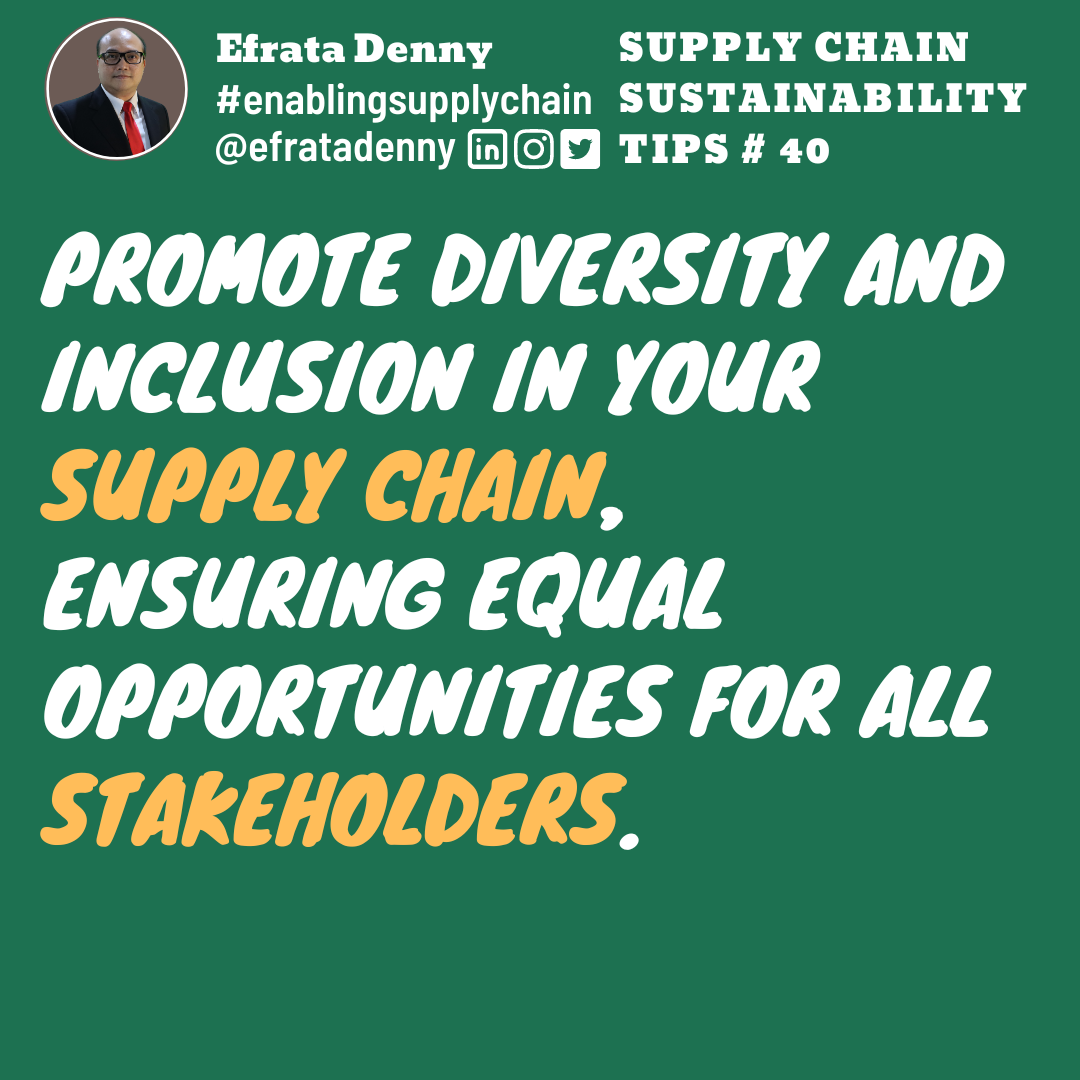
In today’s interconnected world, promoting diversity and inclusion is not only the right thing to do but also crucial for creating a fair and equitable business environment. By embracing diversity and inclusion in your supply chain, you can foster innovation, drive economic growth, and ensure equal opportunities for all stakeholders. In this article, we will explore practical tips to help you build a diverse and inclusive supply chain.

  1. Supplier diversity: Promote supplier diversity by actively seeking out suppliers that embrace diversity and inclusion. Encourage opportunities for underrepresented groups, such as women-owned, or minority-owned businesses. By diversifying your supplier base, you contribute to a more inclusive business ecosystem.
  2. Fair procurement practices: Implement fair procurement processes that prioritize equal opportunities for suppliers, regardless of their size, background, or location. Create a level playing field where all suppliers have the chance to compete and succeed based on their merits and capabilities.
  3. Supplier code of conduct: Develop a supplier code of conduct that explicitly includes diversity and inclusion requirements. Clearly communicate your expectations to suppliers, ensuring that they align with your commitment to diversity and inclusion. This encourages accountability and promotes consistent values throughout the supply chain.
  4. Diversity training: Provide diversity and inclusion training for employees and suppliers. Promote awareness, sensitivity, and understanding of different cultures, perspectives, and identities. By fostering a more inclusive mindset, you create an environment that values diversity and promotes collaboration.
  5. Equal employment opportunities: Advocate for equal employment opportunities within your supply chain. Encourage diverse hiring practices and create inclusive workplaces that are free from discrimination. Embrace diversity in your workforce, recognizing the value of diverse perspectives and experiences.
  6. Transparent reporting: Regularly report on your diversity and inclusion efforts. Highlight progress and areas for improvement, fostering transparency and accountability. Sharing this information demonstrates your commitment to diversity and inclusion and encourages continuous improvement.
  7. Collaboration and partnerships: Collaborate with organizations, NGOs, and industry networks that focus on diversity and inclusion. By exchanging best practices and driving collective efforts, you can contribute to a broader movement for equality in the business community. Together, we can create lasting change.

Embracing diversity and inclusion in your supply chain is not only a moral imperative but also a strategic advantage. By prioritizing diversity, equal opportunities, and inclusivity, you foster an environment where everyone’s unique contributions are celebrated and valued. Promoting supplier diversity, implementing fair procurement practices, developing a supplier code of conduct, providing diversity training, advocating for equal employment opportunities, practicing transparent reporting, and collaborating with like-minded organizations are essential steps towards building an inclusive supply chain. Let’s work together to foster diversity, empower underrepresented groups, and create a brighter future for everyone!

Share this:

  • Share on Facebook (Opens in new window) Facebook
  • Share on X (Opens in new window) X
  • Share on LinkedIn (Opens in new window) LinkedIn
  • Email a link to a friend (Opens in new window) Email
  • Share on Tumblr (Opens in new window) Tumblr
  • Share on Pinterest (Opens in new window) Pinterest
Like Loading...

Tracking and Reducing Packaging Waste: A Sustainable Supply Chain Goal

Posted by efratadenny on 6 July 2023
Posted in: Supply Chain, Sustainability. Tagged: enablingsupplychain, Supply Chain, Supply Chain Management, Sustainability, Sustainable. Leave a comment

In our pursuit of building an environmentally responsible supply chain, it is essential to develop systems that track and reduce packaging waste. By implementing sustainable packaging practices, we can minimize our environmental footprint and contribute to a greener future. In this article, we will explore practical tips to help you make a positive impact and achieve sustainability goals in packaging.

  1. Packaging audit: Begin by conducting a comprehensive audit of your packaging materials and processes. This will help identify areas of waste and inefficiency, enabling you to develop targeted strategies for improvement. Evaluate the types of packaging used, quantities, and any excessive or unnecessary materials.
  2. Right-sizing: Optimize packaging sizes to minimize material usage while ensuring product protection. By right-sizing packaging, you can reduce the amount of waste generated and optimize space utilization during transportation and storage. Choose lightweight yet durable materials to further enhance efficiency.
  3. Sustainable materials: Shift towards using eco-friendly packaging materials that have a lower environmental impact. Explore options such as recycled, biodegradable, or compostable alternatives. Prioritize materials that can be easily recycled within existing waste management systems, promoting a circular economy.
  4. Supplier collaboration: Collaborate with your suppliers to explore innovative packaging solutions and encourage them to adopt sustainable packaging practices. Together, you can drive positive change throughout the supply chain and promote sustainable practices from the source to the end-user.
  5. Packaging design: Incorporate design principles that prioritize ease of recycling. Consider using mono-materials that simplify the recycling process. Reduce the number of layers or components in packaging design, as complex packaging can be challenging to recycle. By making recycling easier, you enhance the chances of packaging materials being repurposed.
  6. Returnable and reusable packaging: Explore opportunities to implement returnable or reusable packaging options. By utilizing returnable packaging solutions, you can significantly reduce waste generation and promote the principles of the circular economy. Encourage customers to return or reuse packaging, further extending its lifespan.
  7. Recycling infrastructure: Support the development of recycling infrastructure by partnering with local recycling facilities and organizations. Educate consumers about proper disposal and recycling practices, enabling them to play an active role in reducing packaging waste. Promote awareness and provide clear instructions on recycling symbols and collection points.

By developing a system to track and reduce packaging waste, we can make substantial progress towards a more sustainable supply chain. Conducting packaging audits, right-sizing materials, embracing sustainable alternatives, collaborating with suppliers, optimizing packaging design, implementing returnable or reusable options, and supporting recycling infrastructure are all key steps towards achieving packaging sustainability goals. Let’s prioritize sustainable packaging practices, conserve resources, and work together for a greener future!

Share this:

  • Share on Facebook (Opens in new window) Facebook
  • Share on X (Opens in new window) X
  • Share on LinkedIn (Opens in new window) LinkedIn
  • Email a link to a friend (Opens in new window) Email
  • Share on Tumblr (Opens in new window) Tumblr
  • Share on Pinterest (Opens in new window) Pinterest
Like Loading...

Choosing Wisely: Evaluating Transportation Modes for a Greener Future

Posted by efratadenny on 5 July 2023
Posted in: Supply Chain, Sustainability. Tagged: enablingsupplychain, Supply Chain, Supply Chain Management, Sustainability, Sustainable. Leave a comment

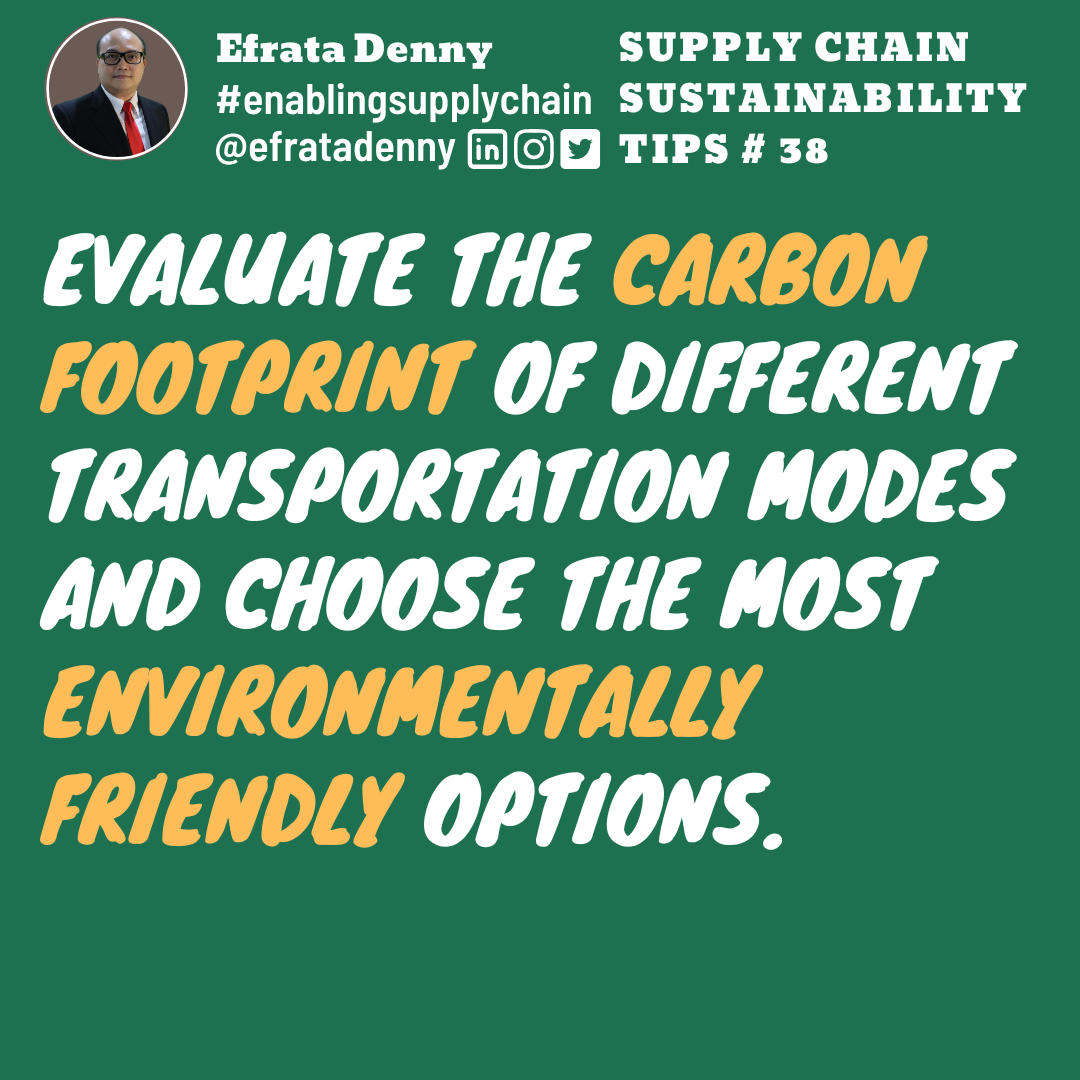
As we strive for a more sustainable future, it is essential to evaluate the carbon footprints of different transportation modes. By making conscious choices, we can significantly reduce our environmental impact and contribute to a greener world. In this article, we will explore practical tips to help you select environmentally friendly transportation options.

  1. Calculate emissions: Begin by assessing the carbon emissions associated with different transportation modes. Consider factors such as distance, fuel consumption, and load capacity. This evaluation will provide a baseline for comparing the environmental impact of various options.
  2. Prioritize low-carbon options: Give preference to transportation modes with lower carbon footprints. Rail or sea freight often emit fewer greenhouse gases compared to air or road transportation. By choosing these alternatives when feasible, you can significantly reduce carbon emissions.
  3. Efficient route planning: Optimize transportation routes to minimize distance traveled. By reducing the distance, you can lower fuel consumption and subsequently decrease carbon emissions. Efficient route planning also helps optimize delivery schedules and improve overall logistics efficiency.
  4. Multi-modal solutions: Consider combining different transportation modes to optimize efficiency and minimize environmental impact. By utilizing rail or water transport in conjunction with road or air transport, you can capitalize on the strengths of each mode while reducing carbon emissions.
  5. Encourage fuel efficiency: Collaborate with transportation partners to prioritize fuel-efficient practices. This includes using energy-efficient vehicles and adopting eco-driving techniques. By encouraging fuel efficiency throughout the supply chain, you can reduce carbon emissions and promote sustainable transportation practices.
  6. Carbon offset programs: Participating in carbon offset programs can help compensate for unavoidable emissions. These programs support projects that reduce or capture carbon elsewhere, balancing out the environmental impact of transportation. By engaging in such initiatives, you contribute to global efforts in fighting climate change.
  7. Innovate and explore: Stay informed about emerging technologies and innovative solutions in transportation. Electric or hydrogen-powered vehicles, for example, are becoming increasingly viable alternatives that can significantly reduce carbon emissions. By embracing such innovations, we can pave the way for a greener and more sustainable future.

By evaluating the carbon footprint of transportation modes and making conscious choices, we can play a vital role in building a greener future. Calculating emissions, prioritizing low-carbon options, efficient route planning, multi-modal solutions, encouraging fuel efficiency, participating in carbon offset programs, and embracing innovation are all crucial steps towards sustainable transportation. Let’s choose wisely and work together for a greener and more sustainable world!

Share this:

  • Share on Facebook (Opens in new window) Facebook
  • Share on X (Opens in new window) X
  • Share on LinkedIn (Opens in new window) LinkedIn
  • Email a link to a friend (Opens in new window) Email
  • Share on Tumblr (Opens in new window) Tumblr
  • Share on Pinterest (Opens in new window) Pinterest
Like Loading...

Embracing Safety: Promoting Safer Alternatives and Reducing Hazardous Materials

Posted by efratadenny on 4 July 2023
Posted in: Supply Chain, Sustainability. Tagged: enablingsupplychain, Supply Chain, Supply Chain Management, Sustainability, Sustainable. Leave a comment

In today’s world, it is crucial to prioritize safety and minimize the use of hazardous materials to protect both the environment and human health. By implementing measures that promote safer alternatives, businesses can contribute to a more sustainable future. In this article, we will explore practical tips to reduce the use of hazardous materials and embrace safer alternatives.

  1. Material substitution: Identify hazardous materials used in your processes and explore safer alternatives that meet regulatory requirements and performance standards. By researching and adopting substitutes, you can reduce the risks associated with hazardous materials.
  2. Supplier collaboration: Engage with your suppliers to understand the composition of materials and encourage them to provide safer alternatives. By promoting responsible sourcing practices, you can create a supply chain that prioritizes safety and sustainability.
  3. Green chemistry principles: Embrace green chemistry principles to design products and processes that are inherently safer. By minimizing the use and generation of hazardous substances, you can reduce environmental and health risks.
  4. Employee training: Provide comprehensive training to employees on the proper handling, storage, and disposal of hazardous materials. By promoting a culture of safety and awareness, you can minimize accidents and ensure responsible practices.
  5. Waste management: Establish proper waste management systems to ensure the safe disposal or recycling of hazardous materials. Complying with environmental regulations is crucial to prevent contamination and protect ecosystems.
  6. Regulatory compliance: Stay updated on relevant regulations and standards related to hazardous materials. By maintaining compliance and adopting best practices, you can effectively manage risks and prioritize safety.
  7. Transparent labeling: Clearly label products and materials to inform users about their potential hazards. Responsible labeling promotes awareness, enabling proper use and handling.

By implementing measures to reduce the use of hazardous materials and promoting safer alternatives, businesses can protect the environment, safeguard human health, and contribute to a more sustainable future. Material substitution, supplier collaboration, green chemistry principles, employee training, waste management, regulatory compliance, and transparent labeling are all essential steps in prioritizing safety and sustainability. Let’s embrace safety together and work towards a safer and greener world!

Share this:

  • Share on Facebook (Opens in new window) Facebook
  • Share on X (Opens in new window) X
  • Share on LinkedIn (Opens in new window) LinkedIn
  • Email a link to a friend (Opens in new window) Email
  • Share on Tumblr (Opens in new window) Tumblr
  • Share on Pinterest (Opens in new window) Pinterest
Like Loading...

Posts navigation

← Older Entries
Newer Entries →
  • Yes You Can Search

  • Yes This is Calendar

    February 2026
    M T W T F S S
     1
    2345678
    9101112131415
    16171819202122
    232425262728  
    « Sep    
  • Yes These are Archives

  • Yes Recent Posts

    • The Future of Supply Chain: How AI and Automation Are Revolutionizing the Industry
    • Top 10 Supply Chain Innovations to Watch in 2024
    • The Rise of Sustainable Supply Chains: Why Going Green is Now a Business Imperative
    • The Great Debate: Centralized vs. Decentralized Supply Chains—Which is Better for 2024?
    • The Paradox of Supply Chain and Logistics
    • Agility Unleashed: The Power of Continuous Evaluation in Procurement Strategy
    • Cost Clarity: Mastering Total Cost of Acquisition for Procurement Excellence
    • Strategic Sourcing Mastery: Unleashing Procurement Excellence through Consolidated Purchasing
    • Unleashing Operational Excellence Through Just-in-Time (JIT) Inventory Management
    • Revolutionizing Procurement: The Strategic Impact of Harnessing Reverse Auctions for Maximum Cost Savings
  • Yes Follow Me

    Post a Day 2012 Twitter EfrataDenny
  • Yes This is My Twitter

    Tweets by efratadenny
  • Yes Advertising

    Roppopo.com
  • Yes This is Category

    Australia Bali Bandung China Collection Food France Indonesia Intermezzo Jakarta Kraft Foods Leadership Lighting Experiences Liquidart Manado Management Model Online Store Photography Portfolio Press Procurement Still Life Supply Chain Sustainability Traveling Underwater Wines Yes This is Me
  • Enter your email address to follow this blog and receive notifications of new posts by email.

    Join 986 other subscribers
  • Flickr Photos

    Last Supper Wood EngravingChristmas SockChristmas Bell
    More Photos
  • Recent Comments

    Bogdan Kolos's avatarBogdan Kolos on The Power of Strong Supplier R…
    Reighne Sq's avatarReighne Sq on Weekly Photo Challenge: One Sh…
    Shubham's avatarShubham on Long Tail and Short Tail Red…
    Terrence M's avatarTerrence M on Fettuccine Carbonara
    Ivan's avatarIvan on Maria Clara Sangria Red W…
    wahyu jatmiko krisdiyanto's avatarwahyu jatmiko krisdi… on Mie Bakso
    Weekly Photo Challen… on Weekly Photo Challenge: F…
    bali ratih's avatarbali ratih on Diving at Benoa
    Berita Hari Ini's avatarBerita Hari Ini on Miss Indonesia will increase W…
    geraldine's avatargeraldine on Maria Clara Sangria Red W…
    Chika Lesmana's avatarChika Lesmana on Shanghai Ice
    Chika Lesmana's avatarChika Lesmana on Shanghai Ice
    ipah kholipah's avataripah kholipah on Shanghai Ice
    Evi's avatarEvi on Platinum Hill Limited Edition…
    renxkyoko's avatarrenxkyoko on Sirloin Steak
  • Yes Page Info

    Yahoo bot last visit Msn bot last visit Google PageRank Checker

    The best of travel stories in and around Singapore TravelerVoice Bloggers - Meet Millions of Bloggers Personal Blogs visitor counters
  • Yes Facebook

    Yes Facebook
Blog at WordPress.com.
Efrata Denny
Blog at WordPress.com.
Privacy & Cookies: This site uses cookies. By continuing to use this website, you agree to their use.
To find out more, including how to control cookies, see here: Cookie Policy
  • Subscribe Subscribed
    • Efrata Denny
    • Join 966 other subscribers
    • Already have a WordPress.com account? Log in now.
    • Efrata Denny
    • Subscribe Subscribed
    • Sign up
    • Log in
    • Report this content
    • View site in Reader
    • Manage subscriptions
    • Collapse this bar
 

Loading Comments...
 

    %d