Efrata Denny

Personal Blog contains Wines, Foods, Traveling, and Photography

  • Home
  • All About Me
    • Yes This is Me
    • Private Message
    • Guest Book
    • Collection
      • Cigars
      • IntermezZo
      • Liquors
      • Sketch
      • Zombie Story
    • Friends
    • Portfolio
      • Kraft Foods
      • Arnott’s
      • Glaxo Smith Kline
      • Online Store
    • Press
  • Wines
    • Argentina
    • Australia
    • Austria
    • Chile
    • France
    • Indonesia
    • Israel
    • Italia
    • Portugal
    • South Africa
    • Spain
    • USA
    • Vietnam
  • Food
  • Traveling
    • Australia
    • China
    • Hong Kong
    • Indonesia
    • Macau
    • Malaysia
    • Philippines
    • Singapore
    • Thailand
    • Vietnam
  • Photography
    • Model
    • Still Life
    • Liquidart
    • Underwater
  • Awards
  • Supply Chain
    • Sustainability
    • Workshop

Boost Your Supply Chain Efficiency with Real-time Inventory Tracking!

Posted by efratadenny on 6 August 2023
Posted in: Management, Supply Chain. Tagged: enablingsupplychain, Management, Supply Chain, Supply Chain Management. Leave a comment

In today’s fast-paced and competitive business landscape, efficient supply chain management is the key to staying ahead of the competition. One critical aspect of a well-optimized supply chain is real-time inventory tracking. By implementing supply chain visibility tools, businesses can gain invaluable insights into their stock levels, ensuring smooth operations and enhanced efficiency. In this blog post, we’ll explore the benefits of real-time inventory tracking and how it can revolutionize your supply chain management.

  1. Real-time Insights on Stock Levels

One of the primary benefits of utilizing supply chain visibility tools is gaining real-time insights into your inventory levels. Traditional inventory management systems often rely on periodic manual checks or outdated data, leading to inaccuracies and costly mistakes. With real-time tracking, you can monitor your stock levels in real-time, enabling you to make data-driven decisions promptly. Whether it’s a sudden surge in demand or a dip in stock levels, having up-to-date information allows you to respond quickly and efficiently.

2. Enhanced Inventory Accuracy

Maintaining accurate inventory records can be challenging, especially for businesses dealing with a high volume of products. Errors in inventory data can lead to overstocking, stockouts, and inefficiencies in your supply chain. Supply chain visibility tools utilize advanced technology, such as RFID tags, barcodes, and IoT devices, to update inventory information automatically. This accuracy ensures that you always know the exact quantity and location of your products, minimizing costly errors and optimizing stock levels.

3. Quick Identification of Bottlenecks

In traditional supply chains, identifying bottlenecks can be a time-consuming process. These bottlenecks can lead to delays and disruptions, affecting your overall productivity. With real-time inventory tracking, you can identify potential bottlenecks as they occur, allowing you to take proactive measures to address them promptly. This agility enables you to streamline your supply chain operations, ensuring smoother and faster workflows.

4. Streamlined Order Fulfillment

Efficient order fulfillment is essential for customer satisfaction and loyalty. Real-time inventory tracking empowers your team to process orders quickly and accurately. When customers place orders, you can immediately check the availability of products and provide accurate delivery timelines. This not only enhances customer experience but also helps build a reputation for reliable and prompt service.

5. Reduced Carrying Costs

Excessive inventory can tie up capital and result in increased carrying costs. On the other hand, inadequate inventory can lead to missed sales opportunities and dissatisfied customers. Supply chain visibility tools enable you to strike the right balance by optimizing inventory levels. With accurate insights into demand patterns and stock levels, you can reduce excess inventory and carrying costs while maintaining enough stock to meet customer demands.

In today’s technology-driven world, real-time inventory tracking has become a game-changer for supply chain management. By implementing supply chain visibility tools, businesses can enjoy a plethora of benefits, including real-time insights on stock levels, enhanced inventory accuracy, quick identification of bottlenecks, streamlined order fulfillment, and reduced carrying costs. Embracing the power of supply chain visibility is no longer an option but a necessity for businesses seeking to stay competitive and efficient.

So, don’t let blind spots slow you down! Invest in supply chain visibility tools and take control of your inventory management today! By leveraging advanced technology, you can propel your supply chain efficiency to new heights and secure a successful future for your business.

“Implement supply chain visibility tools to track and monitor your inventory in real-time.”

Efrata Denny

Share this:

  • Share on Facebook (Opens in new window) Facebook
  • Share on X (Opens in new window) X
  • Share on LinkedIn (Opens in new window) LinkedIn
  • Email a link to a friend (Opens in new window) Email
  • Share on Tumblr (Opens in new window) Tumblr
  • Share on Pinterest (Opens in new window) Pinterest
Like Loading...

Collaboration for Sustainable Standards: Paving the Way for a Greener Future

Posted by efratadenny on 17 July 2023
Posted in: Supply Chain, Sustainability. Tagged: enablingsupplychain, Supply Chain, Supply Chain Management, Sustainability, Sustainable. Leave a comment

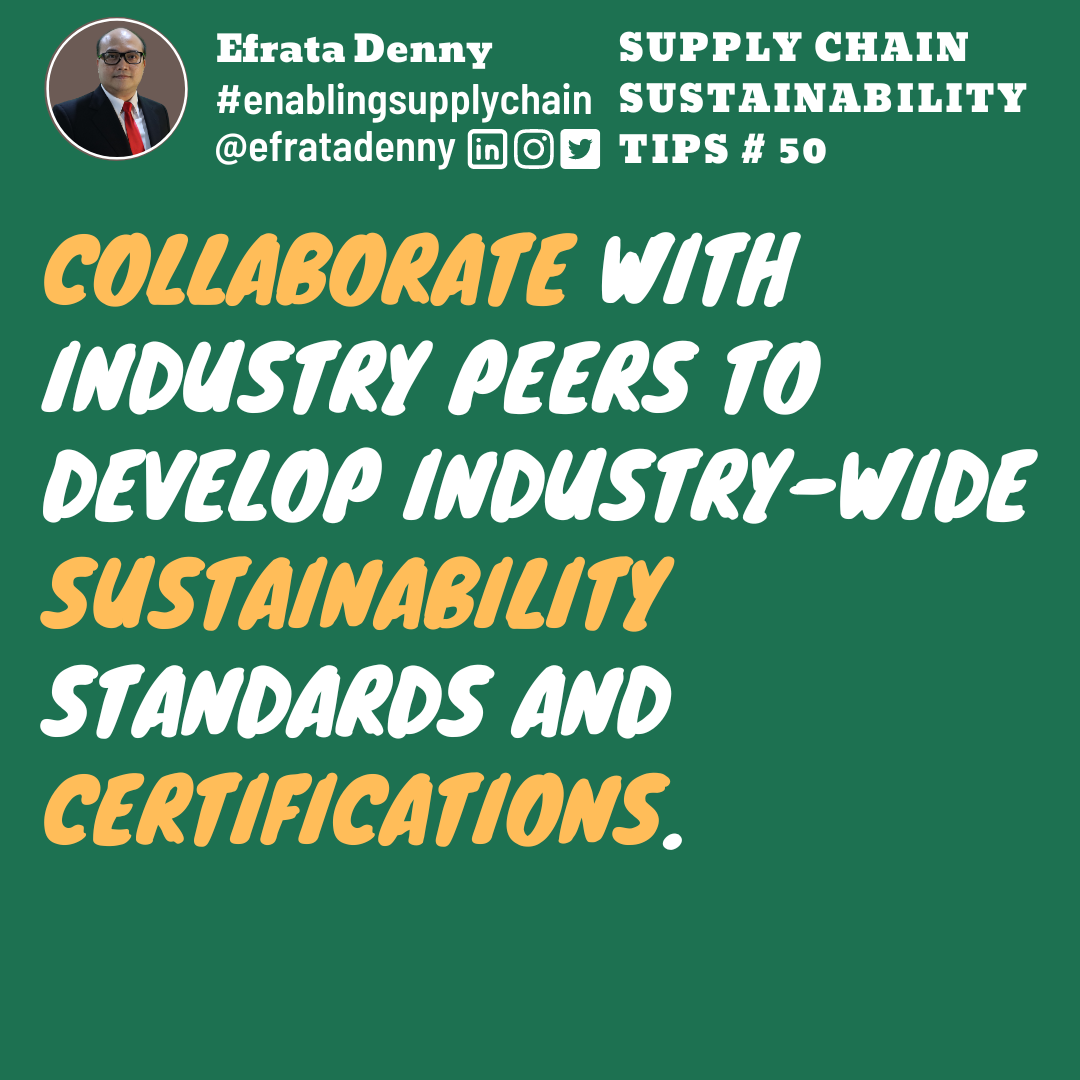
In the pursuit of a sustainable future, collaboration and collective action are essential. By joining forces with industry peers to develop industry-wide sustainability standards and certifications, organizations can drive positive change, foster innovation, and create a more sustainable and responsible business ecosystem. In this article, we will explore the power of collaboration in shaping the future and provide tips on how to make a meaningful impact through collective efforts.

  1. Join industry networks: Engage with industry associations, networks, and initiatives that prioritize sustainability. By actively participating in these networks, organizations can foster collaboration, share knowledge and experiences, and collectively work towards the development of sustainable standards.
  2. Collective expertise: Pool resources and expertise with industry peers to develop robust sustainability standards and certifications. By combining knowledge and experience, organizations can address key environmental and social challenges more effectively, ensuring that standards are comprehensive and impactful.
  3. Knowledge exchange: Participate in industry conferences, workshops, and forums to exchange best practices, share insights, and inspire innovative solutions. These platforms provide opportunities to learn from industry leaders, explore emerging trends, and foster cross-sector collaboration.
  4. Collaborative projects: Initiate or participate in collaborative projects with industry peers to tackle shared sustainability challenges. By working together, organizations can leverage collective resources, share risks, and drive significant impact through collaborative solutions.
  5. Stakeholder involvement: Engage stakeholders, including suppliers, customers, and NGOs, in the development of industry-wide sustainability standards. Involving diverse perspectives ensures inclusivity and leads to standards that address the needs and concerns of all stakeholders involved.
  6. Harmonization efforts: Work together with industry peers to align sustainability standards and certifications. By promoting consistency and comparability across the sector, organizations can reduce confusion, facilitate adoption, and drive greater impact at scale.
  7. Advocate for adoption: Encourage widespread adoption of industry-wide sustainability standards and certifications by highlighting their benefits and sharing success stories. By showcasing the positive outcomes and value they bring, organizations can inspire others to embrace sustainable practices.

Collaboration is a powerful force in shaping a more sustainable future. By collaborating with industry peers, organizations can drive the development of industry-wide sustainability standards and certifications, foster innovation, and accelerate the transition to a greener business landscape. Let us unite our efforts, share knowledge, and inspire others to join the journey towards a sustainable and responsible future. Together, we can make a lasting impact and create a world we can be proud to pass on to future generations.

Share this:

  • Share on Facebook (Opens in new window) Facebook
  • Share on X (Opens in new window) X
  • Share on LinkedIn (Opens in new window) LinkedIn
  • Email a link to a friend (Opens in new window) Email
  • Share on Tumblr (Opens in new window) Tumblr
  • Share on Pinterest (Opens in new window) Pinterest
Like Loading...

Embracing Continuous Improvement: Driving Sustainability Forward

Posted by efratadenny on 16 July 2023
Posted in: Supply Chain, Sustainability. Tagged: enablingsupplychain, Supply Chain, Supply Chain Management, Sustainability, Sustainable. Leave a comment

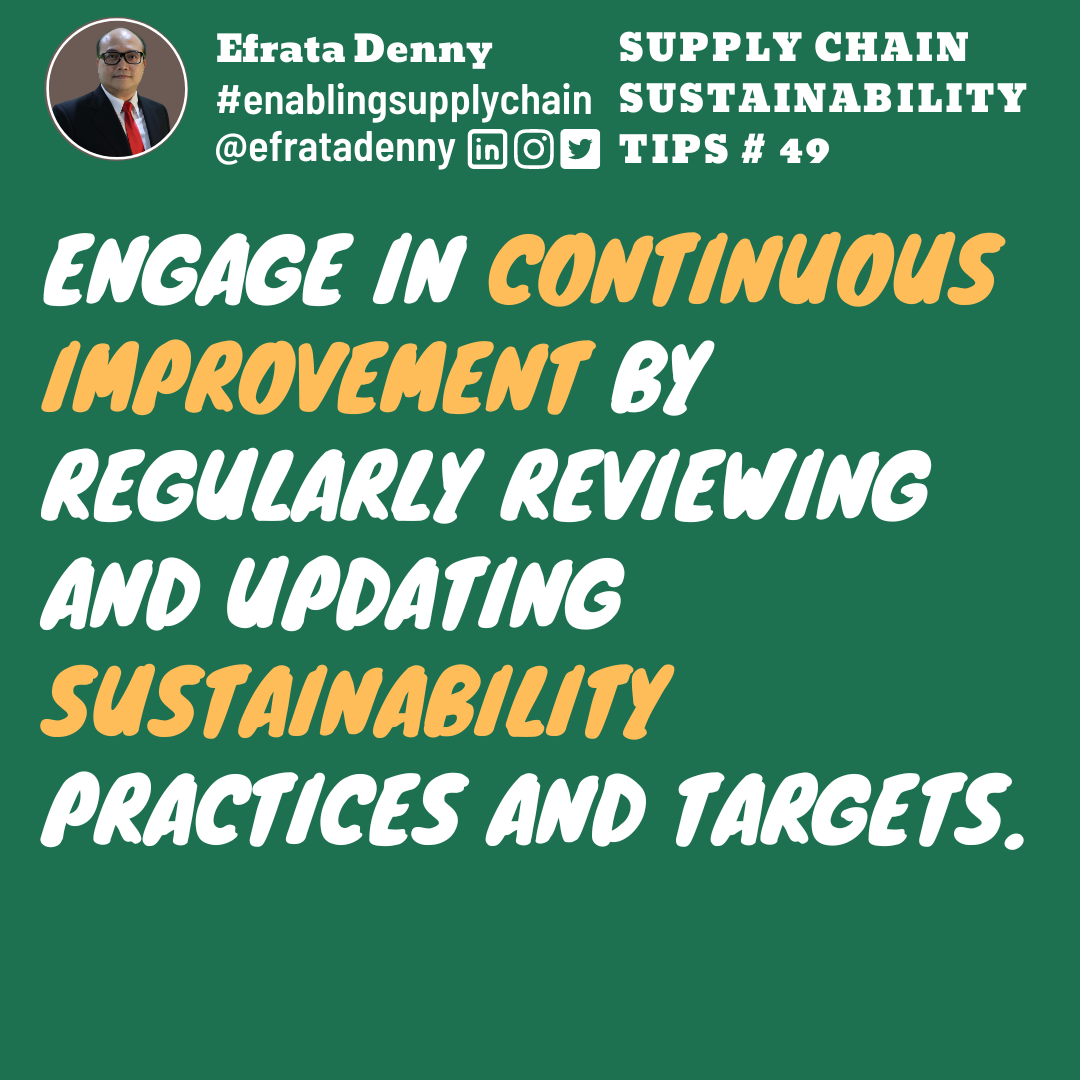
In a rapidly changing world, embracing continuous improvement is essential to elevate sustainability practices and make a lasting impact. Regularly reviewing and updating sustainability targets and practices allows organizations to adapt, innovate, and drive positive change. In this article, we will explore key tips for embarking on a sustainability journey rooted in continuous improvement, ensuring that organizations can effectively navigate challenges, foster collaboration, and create a greener future.

  1. Evaluation and assessment: Regularly evaluate sustainability practices by measuring progress against set targets and identifying areas for improvement. This process enables organizations to understand their current performance, assess the effectiveness of implemented strategies, and identify opportunities for growth.
  2. Stakeholder engagement: Engage with stakeholders, including employees, suppliers, and customers, to gather feedback and insights. By involving stakeholders in sustainability initiatives, organizations foster a collaborative approach, ensure diverse perspectives are considered, and increase the chances of successful implementation.
  3. Benchmarking: Benchmark sustainability performance against industry peers and best-in-class organizations. By analyzing the practices of leaders in sustainability, organizations can identify areas for improvement, learn from successful strategies, and push the boundaries of what is possible in their industry.
  4. Innovation and research: Stay informed about the latest sustainability trends, technologies, and research. Embracing innovation allows organizations to explore new solutions, adopt emerging practices, and leverage cutting-edge technologies to drive positive change and stay ahead of sustainability challenges.
  5. Goal setting: Set ambitious yet achievable sustainability goals aligned with science-based targets. These goals should address priority areas for your organization and industry, ensuring a focused approach that aligns with global sustainability objectives.
  6. Collaboration and partnerships: Collaborate with like-minded organizations, industry networks, and sustainability experts. By joining forces, organizations can share knowledge, exchange best practices, and drive collective action, amplifying their impact and accelerating progress towards sustainability goals.
  7. Transparent reporting: Communicate sustainability progress through regular reporting. Transparent reporting showcases successes, highlights challenges, and outlines future commitments. It builds trust with stakeholders and holds organizations accountable for their sustainability efforts.

Embracing continuous improvement is a fundamental pillar of driving sustainability forward. By evaluating practices, engaging stakeholders, benchmarking performance, fostering innovation, setting ambitious goals, collaborating with partners, and reporting transparently, organizations can make a lasting impact on the journey towards a greener world. Let us commit to ongoing learning, innovation, and collaboration as we strive to build a more sustainable future for generations to come.

Share this:

  • Share on Facebook (Opens in new window) Facebook
  • Share on X (Opens in new window) X
  • Share on LinkedIn (Opens in new window) LinkedIn
  • Email a link to a friend (Opens in new window) Email
  • Share on Tumblr (Opens in new window) Tumblr
  • Share on Pinterest (Opens in new window) Pinterest
Like Loading...

Encouraging Water Efficiency: A Collective Effort to Conserve and Protect

Posted by efratadenny on 15 July 2023
Posted in: Supply Chain, Sustainability. Tagged: enablingsupplychain, Supply Chain, Supply Chain Management, Sustainability, Sustainable. Leave a comment

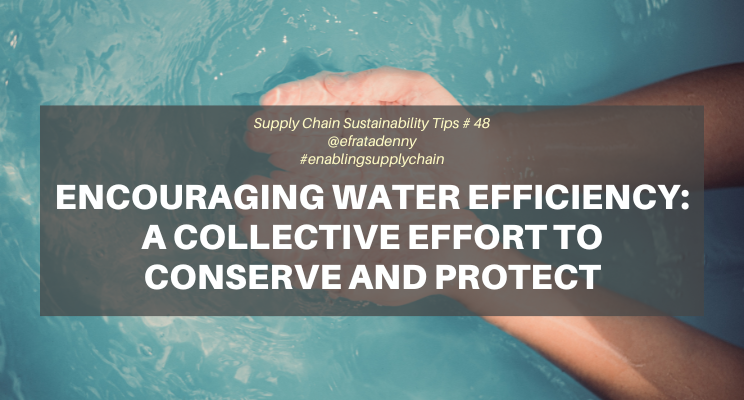
Water is a vital resource that sustains life and ecosystems on our planet. Encouraging suppliers to adopt water-efficient practices in their manufacturing processes is crucial for conserving this precious resource and promoting sustainability. By implementing targeted strategies and fostering collaboration, we can make a positive impact and build a water-wise supply chain. In this article, we will explore key tips to encourage water efficiency among suppliers and highlight the importance of collective action in conserving and protecting our water resources.

  1. Supplier engagement: Engaging in open dialogues with suppliers is the first step toward raising awareness about the importance of water efficiency. By discussing the significance of responsible water management and sharing insights on potential solutions and best practices, we can foster a sense of shared responsibility and inspire action.
  2. Water audits: Encourage suppliers to conduct water audits to assess their current water consumption and identify areas for improvement. These audits help to establish a baseline, set targets for reducing water usage, and prioritize efficiency measures in manufacturing processes.
  3. Process optimization: Collaborate closely with suppliers to optimize manufacturing processes and reduce water consumption. By exploring innovative techniques, adopting closed-loop systems, and integrating water-saving technologies, suppliers can minimize water usage, reduce wastewater generation, and improve overall operational efficiency.
  4. Equipment upgrades: Encourage suppliers to invest in water-efficient technologies and equipment. Upgrades such as low-flow nozzles, water recycling systems, or closed-loop cooling systems can significantly reduce water consumption while maintaining operational effectiveness.
  5. Education and training: Provide educational resources and training opportunities to suppliers, empowering them with knowledge on water-efficient practices. By equipping suppliers with the necessary tools and insights, we can encourage the adoption of sustainable approaches and foster a culture of responsible water management.
  6. Monitoring and reporting: Implement mechanisms to track and monitor water consumption within the supply chain. By establishing clear metrics and reporting frameworks, we can measure progress, identify areas for improvement, and ensure accountability for water efficiency goals.
  7. Recognition and incentives: Recognize and reward suppliers that demonstrate outstanding efforts in water efficiency. Celebrating achievements and providing incentives not only acknowledge their commitment but also inspire other suppliers to follow suit, creating a positive ripple effect throughout the supply chain.

Encouraging water efficiency among suppliers is a collective effort that holds immense potential for conserving and protecting our water resources. By engaging in open dialogues, conducting water audits, optimizing processes, upgrading equipment, providing education and training, monitoring progress, and recognizing achievements, we can drive positive change and create a water-wise supply chain. Let’s embrace our shared responsibility, inspire sustainable practices, and work together towards a more water-efficient and sustainable future.

Share this:

  • Share on Facebook (Opens in new window) Facebook
  • Share on X (Opens in new window) X
  • Share on LinkedIn (Opens in new window) LinkedIn
  • Email a link to a friend (Opens in new window) Email
  • Share on Tumblr (Opens in new window) Tumblr
  • Share on Pinterest (Opens in new window) Pinterest
Like Loading...

Green Building Practices: Constructing a Sustainable Future

Posted by efratadenny on 14 July 2023
Posted in: Supply Chain, Sustainability. Tagged: enablingsupplychain, Supply Chain, Supply Chain Management, Sustainability, Sustainable. Leave a comment

In an era where environmental responsibility is paramount, adopting green building practices is essential for reducing energy consumption, minimizing environmental impact, and constructing a more sustainable future. By integrating eco-friendly design principles, renewable energy sources, and sustainable materials, we can create buildings that not only conserve resources but also promote healthier and more comfortable living and working environments. In this article, we will explore key tips for incorporating green building practices and their positive impact on the environment and society.

  1. Energy-efficient design: Integrating energy-efficient design principles is a fundamental aspect of green building practices. By incorporating natural lighting, efficient insulation, and smart HVAC systems, we can minimize energy consumption, reduce greenhouse gas emissions, and enhance indoor comfort. This not only lowers operational costs but also creates healthier spaces for occupants.
  2. Renewable energy sources: Exploring renewable energy options such as solar panels or wind turbines allows buildings to generate clean energy on-site. By embracing renewable energy sources, we reduce our reliance on fossil fuels and decrease our carbon footprint, contributing to a more sustainable and resilient energy future.
  3. Water conservation: Implementing water-efficient fixtures, such as low-flow toilets and sensor-based faucets, helps minimize water usage within buildings. Additionally, considering rainwater harvesting or graywater recycling systems can further reduce the demand on freshwater sources and promote responsible water management practices.
  4. Sustainable materials: Opting for eco-friendly and recycled materials in construction and renovation projects significantly reduces the environmental impact associated with resource extraction and waste generation. Using sustainable materials helps conserve natural resources, reduces pollution, and contributes to a circular economy.
  5. Waste reduction: Implementing comprehensive waste management practices within buildings is crucial for minimizing the amount of waste sent to landfills. Establishing recycling and composting programs encourages responsible waste disposal, promotes resource recovery, and reduces the overall environmental burden.
  6. Green certifications: Pursuing green building certifications such as LEED (Leadership in Energy and Environmental Design) or BREEAM (Building Research Establishment Environmental Assessment Method) validates a building’s sustainability efforts and demonstrates its commitment to environmental stewardship. These certifications provide recognized standards for evaluating the environmental performance of buildings and encourage continuous improvement.
  7. Employee engagement: Engaging employees in sustainable practices is vital for creating a culture of environmental responsibility within buildings. By raising awareness, providing training, and encouraging participation in energy-saving initiatives and eco-friendly behaviors, employees become active participants in achieving sustainability goals, fostering a sense of ownership and pride.

Green building practices offer a powerful opportunity to construct a more sustainable future. By integrating energy-efficient design, utilizing renewable energy sources, conserving water, using sustainable materials, implementing waste reduction strategies, pursuing green certifications, and engaging employees, we can create buildings that are not only environmentally friendly but also promote healthier and more efficient spaces. Embracing green building practices is a significant step toward reducing our environmental footprint and ensuring a sustainable and resilient future for generations to come. Let’s construct a greener world, one building at a time!

Share this:

  • Share on Facebook (Opens in new window) Facebook
  • Share on X (Opens in new window) X
  • Share on LinkedIn (Opens in new window) LinkedIn
  • Email a link to a friend (Opens in new window) Email
  • Share on Tumblr (Opens in new window) Tumblr
  • Share on Pinterest (Opens in new window) Pinterest
Like Loading...

Posts navigation

← Older Entries
Newer Entries →
  • Yes You Can Search

  • Yes This is Calendar

    January 2026
    M T W T F S S
     1234
    567891011
    12131415161718
    19202122232425
    262728293031  
    « Sep    
  • Yes These are Archives

  • Yes Recent Posts

    • The Future of Supply Chain: How AI and Automation Are Revolutionizing the Industry
    • Top 10 Supply Chain Innovations to Watch in 2024
    • The Rise of Sustainable Supply Chains: Why Going Green is Now a Business Imperative
    • The Great Debate: Centralized vs. Decentralized Supply Chains—Which is Better for 2024?
    • The Paradox of Supply Chain and Logistics
    • Agility Unleashed: The Power of Continuous Evaluation in Procurement Strategy
    • Cost Clarity: Mastering Total Cost of Acquisition for Procurement Excellence
    • Strategic Sourcing Mastery: Unleashing Procurement Excellence through Consolidated Purchasing
    • Unleashing Operational Excellence Through Just-in-Time (JIT) Inventory Management
    • Revolutionizing Procurement: The Strategic Impact of Harnessing Reverse Auctions for Maximum Cost Savings
  • Yes Follow Me

    Post a Day 2012 Twitter EfrataDenny
  • Yes This is My Twitter

    Tweets by efratadenny
  • Yes Advertising

    Roppopo.com
  • Yes This is Category

    Australia Bali Bandung China Collection Food France Indonesia Intermezzo Jakarta Kraft Foods Leadership Lighting Experiences Liquidart Manado Management Model Online Store Photography Portfolio Press Procurement Still Life Supply Chain Sustainability Traveling Underwater Wines Yes This is Me
  • Enter your email address to follow this blog and receive notifications of new posts by email.

    Join 986 other subscribers
  • Flickr Photos

    Last Supper Wood EngravingChristmas SockChristmas Bell
    More Photos
  • Recent Comments

    Bogdan Kolos's avatarBogdan Kolos on The Power of Strong Supplier R…
    Reighne Sq's avatarReighne Sq on Weekly Photo Challenge: One Sh…
    Shubham's avatarShubham on Long Tail and Short Tail Red…
    Terrence M's avatarTerrence M on Fettuccine Carbonara
    Ivan's avatarIvan on Maria Clara Sangria Red W…
    wahyu jatmiko krisdiyanto's avatarwahyu jatmiko krisdi… on Mie Bakso
    Weekly Photo Challen… on Weekly Photo Challenge: F…
    bali ratih's avatarbali ratih on Diving at Benoa
    Berita Hari Ini's avatarBerita Hari Ini on Miss Indonesia will increase W…
    geraldine's avatargeraldine on Maria Clara Sangria Red W…
    Chika Lesmana's avatarChika Lesmana on Shanghai Ice
    Chika Lesmana's avatarChika Lesmana on Shanghai Ice
    ipah kholipah's avataripah kholipah on Shanghai Ice
    Evi's avatarEvi on Platinum Hill Limited Edition…
    renxkyoko's avatarrenxkyoko on Sirloin Steak
  • Yes Page Info

    Yahoo bot last visit Msn bot last visit Google PageRank Checker

    The best of travel stories in and around Singapore TravelerVoice Bloggers - Meet Millions of Bloggers Personal Blogs visitor counters
  • Yes Facebook

    Yes Facebook
Blog at WordPress.com.
Efrata Denny
Create a free website or blog at WordPress.com.
Privacy & Cookies: This site uses cookies. By continuing to use this website, you agree to their use.
To find out more, including how to control cookies, see here: Cookie Policy
  • Subscribe Subscribed
    • Efrata Denny
    • Join 966 other subscribers
    • Already have a WordPress.com account? Log in now.
    • Efrata Denny
    • Subscribe Subscribed
    • Sign up
    • Log in
    • Report this content
    • View site in Reader
    • Manage subscriptions
    • Collapse this bar
 

Loading Comments...
 

    %d