Efrata Denny

Personal Blog contains Wines, Foods, Traveling, and Photography

  • Home
  • All About Me
    • Yes This is Me
    • Private Message
    • Guest Book
    • Collection
      • Cigars
      • IntermezZo
      • Liquors
      • Sketch
      • Zombie Story
    • Friends
    • Portfolio
      • Kraft Foods
      • Arnott’s
      • Glaxo Smith Kline
      • Online Store
    • Press
  • Wines
    • Argentina
    • Australia
    • Austria
    • Chile
    • France
    • Indonesia
    • Israel
    • Italia
    • Portugal
    • South Africa
    • Spain
    • USA
    • Vietnam
  • Food
  • Traveling
    • Australia
    • China
    • Hong Kong
    • Indonesia
    • Macau
    • Malaysia
    • Philippines
    • Singapore
    • Thailand
    • Vietnam
  • Photography
    • Model
    • Still Life
    • Liquidart
    • Underwater
  • Awards
  • Supply Chain
    • Sustainability
    • Workshop

Breaking Down Silos: The Power of Cross-Functional Training in Supply Chain Collaboration

Posted by efratadenny on 4 October 2023
Posted in: Management, Supply Chain. Tagged: enablingsupplychain, Management, Supply Chain, Supply Chain Management. Leave a comment

“Implement cross-functional training programs to enhance collaboration and understanding across different departments.”

Efrata Denny

In the intricate world of supply chain management, the journey towards efficiency and seamless operations requires breaking down departmental silos and fostering collaboration across various functions. One effective way to achieve this is through the implementation of cross-functional training programs. By providing team members with insights beyond their immediate roles, these programs create a culture of synergy, understanding, and innovation. In this blog post, we’ll delve into the advantages of cross-functional training and how it can drive collaboration and success in your supply chain.

1. Improved Communication and Teamwork

Cross-functional training programs encourage individuals from different departments to come together, fostering improved communication and teamwork. When team members understand the challenges and perspectives of their colleagues in other areas of the supply chain, they can collaborate more effectively and break down communication barriers. This improved collaboration leads to faster problem-solving and better decision-making.

2. Holistic Understanding of the Supply Chain

A successful supply chain requires a holistic perspective that goes beyond individual departmental goals. Cross-functional training enables team members to gain a comprehensive understanding of the end-to-end supply chain process. This broader view helps employees recognize how their roles contribute to the larger picture and encourages them to align their efforts for the overall success of the supply chain.

3. Flexibility and Adaptability to Changing Demands

In today’s rapidly changing business environment, adaptability is key. Cross-functional training equips team members with a versatile skill set that enables them to step into different roles if needed. This flexibility enhances your supply chain’s ability to respond to shifting demands, unexpected disruptions, or changes in market conditions.

4. Enhanced Problem-Solving Capabilities

Complex supply chain challenges often require a multidisciplinary approach to find effective solutions. Through cross-functional training, individuals develop a diverse skill set and learn to tackle problems from various angles. This diversity of thought enhances problem-solving capabilities and encourages innovative thinking that can lead to breakthrough solutions.

5. Efficient Cross-Departmental Coordination

Cross-functional training nurtures a culture of collaboration, making cross-departmental coordination more efficient. Team members become more aware of each other’s roles, responsibilities, and challenges, making it easier to coordinate efforts and align goals. Efficient coordination streamlines processes, reduces bottlenecks, and enhances the overall flow of operations.

The implementation of cross-functional training programs holds immense potential for transforming your supply chain into a collaborative and high-performing ecosystem. By improving communication, fostering a holistic understanding of the supply chain, enhancing adaptability, boosting problem-solving capabilities, and facilitating efficient cross-departmental coordination, you create a culture that drives success.

So, don’t limit your supply chain’s potential by maintaining departmental silos. Embrace cross-functional training to break down barriers, foster collaboration, and propel your supply chain to new heights of success. By nurturing a collaborative culture, you empower your team to deliver excellence, overcome challenges, and contribute to the sustained growth and prosperity of your supply chain.

Share this:

  • Share on Facebook (Opens in new window) Facebook
  • Share on X (Opens in new window) X
  • Share on LinkedIn (Opens in new window) LinkedIn
  • Email a link to a friend (Opens in new window) Email
  • Share on Tumblr (Opens in new window) Tumblr
  • Share on Pinterest (Opens in new window) Pinterest
Like Loading...

Driving Supply Chain Excellence: The Importance of Monitoring Supplier Performance

Posted by efratadenny on 3 October 2023
Posted in: Management, Supply Chain. Tagged: enablingsupplychain, Management, Supply Chain, Supply Chain Management. Leave a comment

“Continuously monitor and evaluate supplier performance to ensure they meet your quality and delivery standards.”

Efrata Denny

In the fast-paced and competitive business landscape, ensuring supply chain excellence is paramount for success. A critical aspect of achieving this excellence lies in continuously monitoring and evaluating supplier performance. By actively assessing your suppliers’ capabilities, you can maintain high-quality standards and ensure timely delivery of goods and services. In this article, we’ll delve into the advantages of monitoring supplier performance and how it contributes to building a resilient supply chain and delivering exceptional value to customers.

1. Consistent Quality Assurance

Monitoring supplier performance allows you to ensure consistent quality assurance throughout your supply chain. By tracking and evaluating the quality of materials or services provided by suppliers, you can identify deviations and take corrective actions promptly. Consistent quality assurance helps maintain your brand reputation and ensures that customers receive products and services of the highest standards.

2. Timely and Reliable Deliveries

Efficient and reliable deliveries are critical for smooth supply chain operations. Monitoring supplier performance helps you assess their delivery timelines and reliability. By working with suppliers who consistently meet delivery schedules, you can avoid disruptions in your own production or distribution processes. Timely deliveries ensure that your customers receive their orders as promised, enhancing their satisfaction and loyalty.

3. Data-Driven Decision-Making

Monitoring supplier performance provides you with valuable data to inform your decision-making process. By analyzing supplier performance metrics, you can identify trends, patterns, and potential areas for improvement. Data-driven insights help you make informed choices about supplier partnerships, negotiate better terms, and optimize your supply chain for improved efficiency.

4. Identification of Improvement Opportunities

Continuous monitoring and evaluation of supplier performance enable you to identify improvement opportunities. By pinpointing areas where suppliers can enhance their processes, you can provide constructive feedback and collaborate on solutions. This approach fosters a culture of continuous improvement and allows you to work together with suppliers to optimize their performance.

5. Strengthened Supplier Partnerships

Proactive monitoring of supplier performance strengthens your partnerships. By maintaining open communication and offering feedback, you build trust and mutual understanding with your suppliers. A collaborative approach fosters a positive working relationship, leading to better support during challenging times and improved responsiveness to your needs.

In the pursuit of supply chain excellence, monitoring and evaluating supplier performance are indispensable practices. The advantages of consistent quality assurance, timely deliveries, data-driven decision-making, identification of improvement opportunities, and strengthened supplier partnerships all contribute to building a resilient supply chain that delivers exceptional value to customers.

So, don’t compromise on excellence. Continuously monitor and evaluate supplier performance to ensure your supply chain operates at its highest potential. By maintaining high-quality standards and timely deliveries, and fostering collaborative relationships with your suppliers, you create a robust and efficient supply chain that propels your business towards continued success and customer satisfaction.

Share this:

  • Share on Facebook (Opens in new window) Facebook
  • Share on X (Opens in new window) X
  • Share on LinkedIn (Opens in new window) LinkedIn
  • Email a link to a friend (Opens in new window) Email
  • Share on Tumblr (Opens in new window) Tumblr
  • Share on Pinterest (Opens in new window) Pinterest
Like Loading...

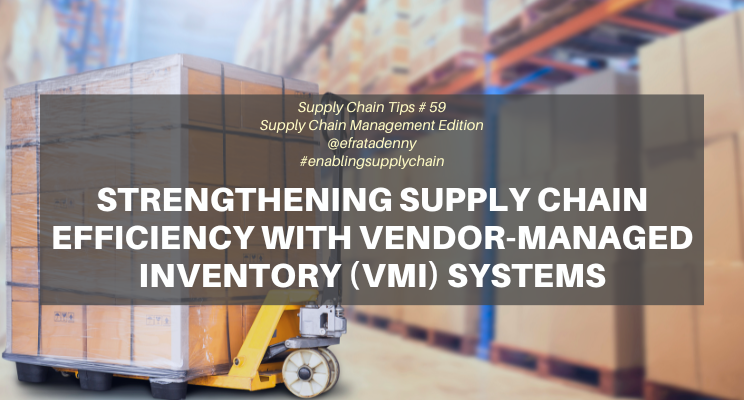
Strengthening Supply Chain Efficiency with Vendor-Managed Inventory (VMI) Systems

Posted by efratadenny on 2 October 2023
Posted in: Management, Supply Chain. Tagged: enablingsupplychain, Management, Supply Chain, Supply Chain Management. Leave a comment

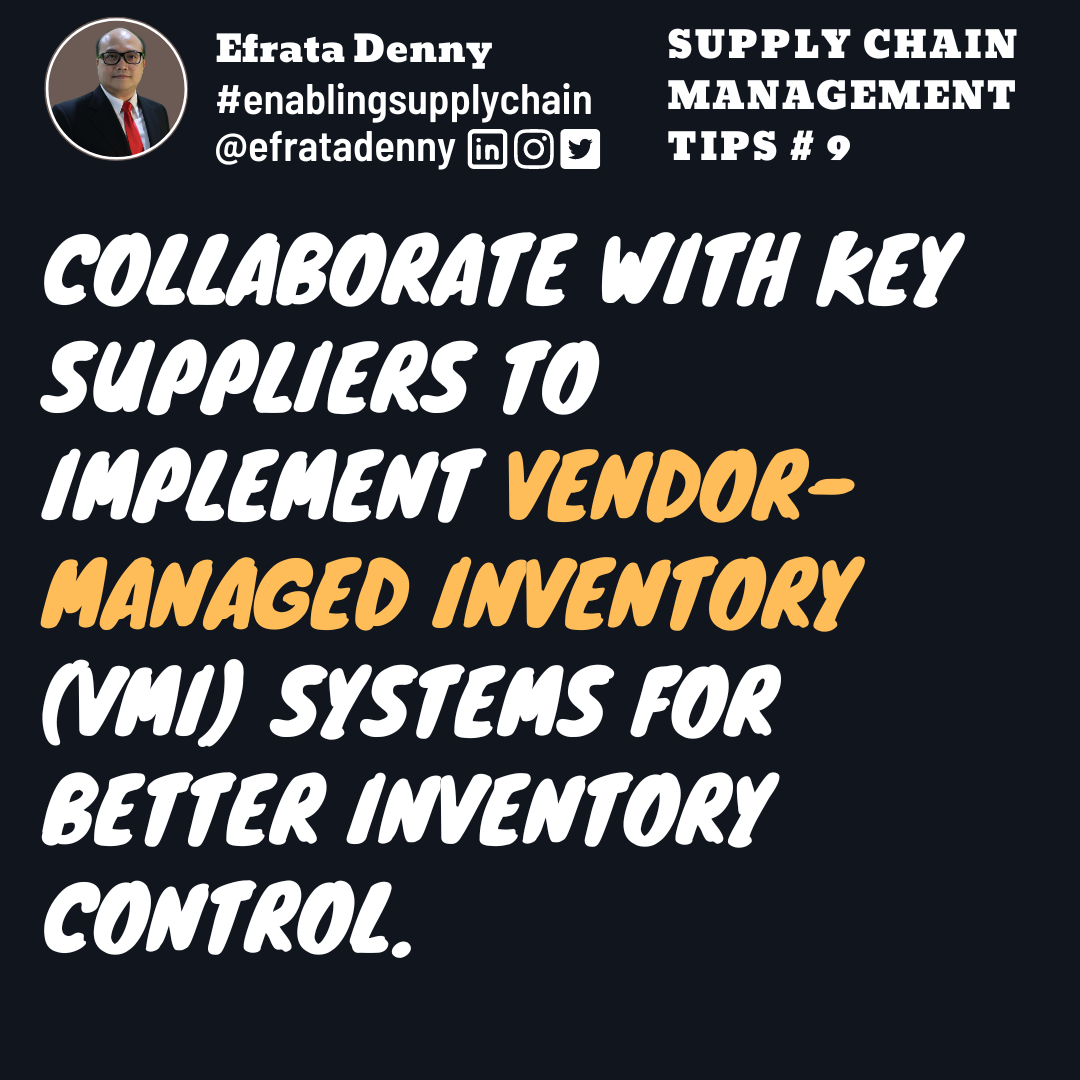
“Collaborate with key suppliers to implement Vendor-Managed Inventory (VMI) systems for better inventory control.”

Efrata Denny

In the quest for a seamless and efficient supply chain, collaboration with key suppliers is a vital aspect that should not be overlooked. One powerful way to enhance inventory control and optimize operations is by implementing Vendor-Managed Inventory (VMI) systems. By working hand-in-hand with your trusted suppliers and empowering them to take an active role in inventory management, you can unlock a host of benefits that drive efficiency and strengthen your supply chain. In this article, we’ll explore the advantages of VMI systems and how they can elevate your supply chain to new heights.

1. Enhanced Visibility into Stock Levels

With VMI systems, suppliers gain real-time visibility into your stock levels and inventory data. This enhanced visibility allows them to proactively monitor your inventory and ensure timely replenishment. By having a comprehensive understanding of your inventory, both you and your suppliers can respond swiftly to changes in demand, minimizing stockouts and improving overall inventory control.

2. Improved Demand Forecasting Accuracy

Collaborating with suppliers through VMI systems fosters a free flow of information and insights. Sharing data about customer demand, market trends, and production capabilities allows for more accurate demand forecasting. This improved forecasting accuracy enables you to align your inventory levels more closely with actual demand, optimizing stock levels and avoiding excess inventory.

3. Efficient Replenishment and Order Management

VMI systems streamline the replenishment process, making it more efficient and seamless. Instead of placing frequent orders, suppliers can automatically replenish your inventory based on predefined triggers or agreed-upon inventory levels. This automated process reduces administrative burden and allows you to focus on core business activities while ensuring a steady supply of goods.

4. Reduced Stockouts and Overstocking

One of the primary advantages of VMI systems is the reduction of stockouts and overstocking. With real-time inventory visibility and accurate demand forecasting, both you and your suppliers can maintain optimal inventory levels. This equilibrium minimizes the risk of stockouts, ensuring that you can meet customer demands promptly, while also preventing the holding of excessive inventory that ties up capital.

5. Strengthened Supplier Relationships

Collaborating on inventory management through VMI systems fosters stronger supplier relationships. The shared responsibility and transparency build trust and mutual understanding between you and your suppliers. A strong and collaborative supplier relationship can lead to better terms, improved responsiveness, and enhanced support during challenging times.

In the pursuit of supply chain excellence, collaboration with suppliers through Vendor-Managed Inventory (VMI) systems is a strategic move. The benefits of enhanced visibility, improved demand forecasting accuracy, efficient replenishment, reduced stockouts, and strengthened supplier relationships can significantly impact your supply chain’s efficiency and competitiveness.

So, don’t go it alone—embrace the power of VMI systems and empower your suppliers to play an active role in inventory management. With VMI, you can achieve optimal inventory control, streamline operations, and elevate your supply chain to new heights of efficiency and effectiveness. By forging strong partnerships with your suppliers, you create a synchronized and resilient supply chain that propels your business towards continued success and growth.

Share this:

  • Share on Facebook (Opens in new window) Facebook
  • Share on X (Opens in new window) X
  • Share on LinkedIn (Opens in new window) LinkedIn
  • Email a link to a friend (Opens in new window) Email
  • Share on Tumblr (Opens in new window) Tumblr
  • Share on Pinterest (Opens in new window) Pinterest
Like Loading...

Streamlining Success: The Power of Lean Inventory Management

Posted by efratadenny on 1 October 2023
Posted in: Management, Supply Chain. Tagged: enablingsupplychain, Management, Supply Chain, Supply Chain Management. Leave a comment

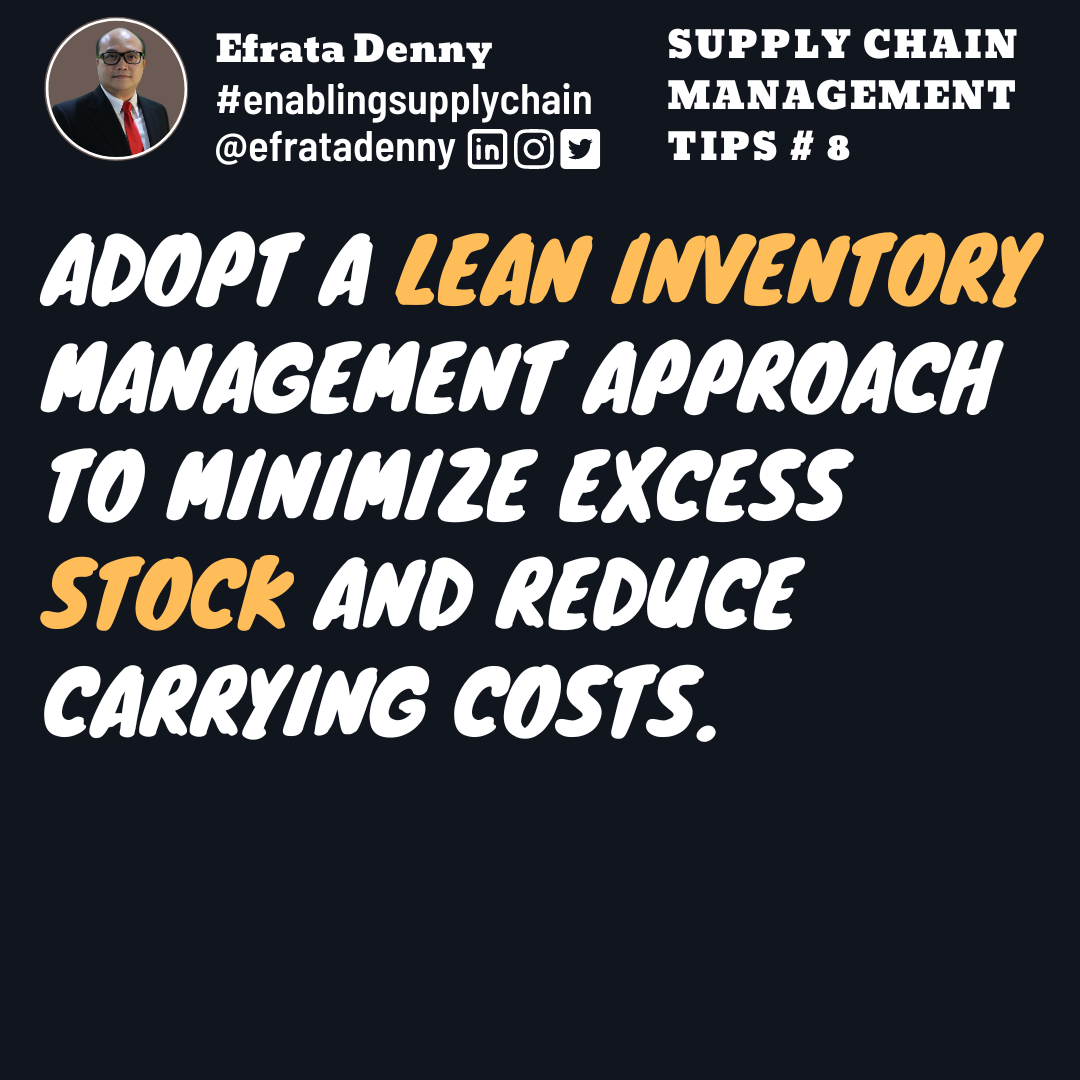
“Adopt a lean inventory management approach to minimize excess stock and reduce carrying costs.”

Efrata Denny

In the dynamic world of supply chain management, efficiency and cost-effectiveness are crucial for business success. Adopting a lean inventory management approach can be a game-changer, enabling businesses to strike the perfect balance between supply and demand, reduce waste, and maximize profitability. In this blog post, we’ll explore the advantages of lean inventory management and how it can drive efficiency, cut costs, and propel your business to new heights.

1. Minimized Excess Stock and Obsolescence

Excess stock and obsolescence can lead to significant financial losses. Embracing lean inventory management allows you to keep a close eye on demand patterns and optimize your stock levels accordingly. By aligning inventory levels with actual demand, you minimize the risk of overstocking and reduce the likelihood of holding obsolete items, ensuring that your inventory remains fresh and relevant.

2. Reduced Carrying Costs

Carrying costs can eat into your profits and tie up valuable capital. A lean inventory management approach helps you reduce carrying costs by optimizing inventory levels and turning over stock more efficiently. By holding only the necessary inventory, you free up resources that can be better utilized in other aspects of your business, ultimately contributing to improved financial health.

3. Faster Inventory Turnover

A lean inventory management strategy ensures that inventory turnover happens more swiftly. As you maintain optimal stock levels and respond to actual demand, products move through your supply chain faster. This improved inventory turnover not only boosts cash flow but also reduces the risk of holding outdated or perishable items.

4. Improved Cash Flow

Efficient inventory management directly impacts your cash flow. By minimizing excess stock and carrying costs, you release capital that can be reinvested in other areas of your business. Improved cash flow provides you with the financial flexibility to seize new opportunities and navigate through challenging times.

5. Increased Operational Efficiency

Lean inventory management streamlines your supply chain processes, leading to increased operational efficiency. With the right amount of inventory on hand, you can optimize order fulfillment and reduce lead times. This efficiency translates to a more responsive and agile supply chain, enhancing customer satisfaction and loyalty.

In the competitive landscape of supply chain management, adopting a lean inventory management approach is a strategic move. By minimizing excess stock and obsolescence, reducing carrying costs, accelerating inventory turnover, improving cash flow, and increasing operational efficiency, you pave the way for streamlined success. Embracing lean principles enables you to optimize inventory, increase efficiency, and cut costs, all of which are essential for achieving business success and maintaining a competitive edge.

So, don’t let excess stock weigh you down. Embrace the power of lean inventory management to optimize your supply chain, maximize profitability, and drive business success. By striking the right balance between supply and demand, you can create a lean and agile supply chain that propels your business towards continued growth and prosperity.

Share this:

  • Share on Facebook (Opens in new window) Facebook
  • Share on X (Opens in new window) X
  • Share on LinkedIn (Opens in new window) LinkedIn
  • Email a link to a friend (Opens in new window) Email
  • Share on Tumblr (Opens in new window) Tumblr
  • Share on Pinterest (Opens in new window) Pinterest
Like Loading...

Anticipating Customer Needs: The Power of Demand Forecasting in Supply Chain Management

Posted by efratadenny on 30 September 2023
Posted in: Management, Supply Chain. Tagged: enablingsupplychain, Management, Supply Chain, Supply Chain Management. Leave a comment

“Implement a demand forecasting system to better anticipate customer needs and plan your inventory levels.”

Efrata Denny

In the fast-paced and ever-changing world of supply chain management, understanding customer demand is crucial for success. Anticipating customer needs and planning inventory levels are key factors that can give businesses a competitive edge. By implementing advanced demand forecasting systems, you can accurately predict customer demands, optimize inventory, and ensure you are always prepared to meet the market’s requirements. In this article, we’ll delve into the benefits of demand forecasting and how it can elevate your supply chain to new heights.

  1. Accurate Prediction of Customer Demand

Demand forecasting leverages historical data, market trends, and customer insights to make accurate predictions about future demand. By analyzing this information, you can understand customer behavior and preferences, allowing you to proactively align your supply chain with the expected demand. This accuracy reduces the risk of overstocking or stockouts, enabling you to maintain optimal inventory levels.

2. Right-Sized Inventory Levels

Having the right amount of inventory is a delicate balance that directly impacts your bottom line. Demand forecasting helps you optimize your inventory levels, ensuring you have enough stock to meet customer demand without carrying excessive inventory that ties up capital. Right-sized inventory levels reduce carrying costs and improve cash flow, contributing to a healthier and more efficient supply chain.

3. Improved Order Fulfillment

Demand forecasting allows you to plan ahead and prepare for anticipated demand spikes. By being proactive in your approach, you can streamline your order fulfillment process and ensure timely deliveries. This improved order fulfillment not only delights customers but also enhances your reputation for reliability and responsiveness.

4. Minimized Stockouts and Excess Stock

Stockouts and excess stock are common challenges in supply chain management. Demand forecasting minimizes the risk of stockouts by ensuring you have sufficient inventory to meet demand. Conversely, it helps prevent excess stock, which can lead to unnecessary costs and waste. Striking the right balance ensures you can fulfill orders efficiently while avoiding unnecessary inventory holding expenses.

5. Enhanced Customer Satisfaction

In the customer-centric business landscape, exceptional customer experiences are paramount. Demand forecasting enables you to be proactive in meeting customer needs, ensuring products are available when and where they are required. Consistently meeting customer demands enhances satisfaction, fosters loyalty, and builds a loyal customer base.

In today’s competitive market, demand forecasting has become a critical tool for supply chain success. By accurately predicting customer demands and optimizing inventory levels, businesses can position themselves for success in a dynamic and ever-changing marketplace. Leveraging advanced forecasting systems empowers you to anticipate customer needs, minimize stockouts and excess stock, improve order fulfillment, and deliver exceptional customer experiences.

So, don’t leave customer demand to chance. Embrace demand forecasting to align your supply chain with market dynamics and gain a competitive advantage. By accurately anticipating customer needs and optimizing your inventory, you can stay one step ahead and deliver a supply chain that exceeds customer expectations while maximizing operational efficiency.

Share this:

  • Share on Facebook (Opens in new window) Facebook
  • Share on X (Opens in new window) X
  • Share on LinkedIn (Opens in new window) LinkedIn
  • Email a link to a friend (Opens in new window) Email
  • Share on Tumblr (Opens in new window) Tumblr
  • Share on Pinterest (Opens in new window) Pinterest
Like Loading...

Posts navigation

← Older Entries
Newer Entries →
  • Yes You Can Search

  • Yes This is Calendar

    January 2026
    M T W T F S S
     1234
    567891011
    12131415161718
    19202122232425
    262728293031  
    « Sep    
  • Yes These are Archives

  • Yes Recent Posts

    • The Future of Supply Chain: How AI and Automation Are Revolutionizing the Industry
    • Top 10 Supply Chain Innovations to Watch in 2024
    • The Rise of Sustainable Supply Chains: Why Going Green is Now a Business Imperative
    • The Great Debate: Centralized vs. Decentralized Supply Chains—Which is Better for 2024?
    • The Paradox of Supply Chain and Logistics
    • Agility Unleashed: The Power of Continuous Evaluation in Procurement Strategy
    • Cost Clarity: Mastering Total Cost of Acquisition for Procurement Excellence
    • Strategic Sourcing Mastery: Unleashing Procurement Excellence through Consolidated Purchasing
    • Unleashing Operational Excellence Through Just-in-Time (JIT) Inventory Management
    • Revolutionizing Procurement: The Strategic Impact of Harnessing Reverse Auctions for Maximum Cost Savings
  • Yes Follow Me

    Post a Day 2012 Twitter EfrataDenny
  • Yes This is My Twitter

    Tweets by efratadenny
  • Yes Advertising

    Roppopo.com
  • Yes This is Category

    Australia Bali Bandung China Collection Food France Indonesia Intermezzo Jakarta Kraft Foods Leadership Lighting Experiences Liquidart Manado Management Model Online Store Photography Portfolio Press Procurement Still Life Supply Chain Sustainability Traveling Underwater Wines Yes This is Me
  • Enter your email address to follow this blog and receive notifications of new posts by email.

    Join 986 other subscribers
  • Flickr Photos

    Last Supper Wood EngravingChristmas SockChristmas Bell
    More Photos
  • Recent Comments

    Bogdan Kolos's avatarBogdan Kolos on The Power of Strong Supplier R…
    Reighne Sq's avatarReighne Sq on Weekly Photo Challenge: One Sh…
    Shubham's avatarShubham on Long Tail and Short Tail Red…
    Terrence M's avatarTerrence M on Fettuccine Carbonara
    Ivan's avatarIvan on Maria Clara Sangria Red W…
    wahyu jatmiko krisdiyanto's avatarwahyu jatmiko krisdi… on Mie Bakso
    Weekly Photo Challen… on Weekly Photo Challenge: F…
    bali ratih's avatarbali ratih on Diving at Benoa
    Berita Hari Ini's avatarBerita Hari Ini on Miss Indonesia will increase W…
    geraldine's avatargeraldine on Maria Clara Sangria Red W…
    Chika Lesmana's avatarChika Lesmana on Shanghai Ice
    Chika Lesmana's avatarChika Lesmana on Shanghai Ice
    ipah kholipah's avataripah kholipah on Shanghai Ice
    Evi's avatarEvi on Platinum Hill Limited Edition…
    renxkyoko's avatarrenxkyoko on Sirloin Steak
  • Yes Page Info

    Yahoo bot last visit Msn bot last visit Google PageRank Checker

    The best of travel stories in and around Singapore TravelerVoice Bloggers - Meet Millions of Bloggers Personal Blogs visitor counters
  • Yes Facebook

    Yes Facebook
Blog at WordPress.com.
Efrata Denny
Create a free website or blog at WordPress.com.
Privacy & Cookies: This site uses cookies. By continuing to use this website, you agree to their use.
To find out more, including how to control cookies, see here: Cookie Policy
  • Subscribe Subscribed
    • Efrata Denny
    • Join 966 other subscribers
    • Already have a WordPress.com account? Log in now.
    • Efrata Denny
    • Subscribe Subscribed
    • Sign up
    • Log in
    • Report this content
    • View site in Reader
    • Manage subscriptions
    • Collapse this bar
 

Loading Comments...
 

    %d