Efrata Denny

Personal Blog contains Wines, Foods, Traveling, and Photography

  • Home
  • All About Me
    • Yes This is Me
    • Private Message
    • Guest Book
    • Collection
      • Cigars
      • IntermezZo
      • Liquors
      • Sketch
      • Zombie Story
    • Friends
    • Portfolio
      • Kraft Foods
      • Arnott’s
      • Glaxo Smith Kline
      • Online Store
    • Press
  • Wines
    • Argentina
    • Australia
    • Austria
    • Chile
    • France
    • Indonesia
    • Israel
    • Italia
    • Portugal
    • South Africa
    • Spain
    • USA
    • Vietnam
  • Food
  • Traveling
    • Australia
    • China
    • Hong Kong
    • Indonesia
    • Macau
    • Malaysia
    • Philippines
    • Singapore
    • Thailand
    • Vietnam
  • Photography
    • Model
    • Still Life
    • Liquidart
    • Underwater
  • Awards
  • Supply Chain
    • Sustainability
    • Workshop

Nurturing Excellence: Building a Continuous Improvement Culture in Your Supply Chain

Posted by efratadenny on 14 October 2023
Posted in: Management, Supply Chain. Tagged: enablingsupplychain, Management, Supply Chain, Supply Chain Management. Leave a comment

“Implement a continuous improvement culture to foster innovation and drive efficiency gains in your supply chain.”

Efrata Denny

In the fast-paced and ever-evolving landscape of supply chain management, the pursuit of excellence is an ongoing journey. Staying ahead requires more than just embracing current practices—it demands a culture of continuous improvement that fosters innovation, drives efficiency gains, and propels the organization toward sustained success. In this article, we’ll delve into the significance of a continuous improvement culture in the supply chain, its advantages, and how organizations can nurture and harness this culture to achieve remarkable advancements.

1. The Power of Continuous Improvement

A culture of continuous improvement embodies the philosophy that every aspect of an organization can be enhanced. In the context of the supply chain, this means consistently seeking innovative solutions, refining processes, and optimizing operations. This culture empowers team members to view challenges as opportunities for growth, driving the organization to new heights.

2. Embracing Innovation and Creativity

Innovation is the hallmark of progress. By cultivating a culture that encourages experimentation and creative problem-solving, organizations tap into the wealth of ideas and perspectives within their teams. This environment nurtures novel approaches to longstanding challenges and fuels the generation of new solutions that drive efficiency.

3. Streamlined Processes and Reduced Waste

Efficiency gains are a natural outcome of a continuous improvement culture. By scrutinizing existing processes, team members can identify bottlenecks, eliminate redundancies, and reduce waste. As improvements accumulate, the supply chain becomes leaner, more agile, and better positioned to respond to market dynamics.

4. Data-Driven Decision-Making

Continuous improvement is not fueled by guesswork but by data-driven insights. A culture that values measurement, analysis, and informed decision-making ensures that changes are based on evidence and yield measurable results. This approach also enhances accountability and transparency across the organization.

5. Empowerment and Adaptation

A continuous improvement culture empowers employees at all levels to contribute to the organization’s growth. Team members feel valued and are more likely to proactively suggest improvements, leading to a sense of ownership and shared commitment to success. Additionally, in a world of rapid change, an adaptable culture ensures that the organization is well-prepared to respond to shifts in market demands.

In the journey toward supply chain excellence, a continuous improvement culture stands as a cornerstone. It goes beyond a mere set of tools or methodologies—it’s a mindset that permeates the organization, driving innovation, efficiency gains, and transformative growth. By fostering this culture, organizations create an environment where team members are empowered to think critically, challenge the status quo, and contribute to a more agile, innovative, and successful supply chain.

So, don’t settle for complacency. Implement a continuous improvement culture that not only celebrates successes but actively seeks them, transforming your supply chain into a dynamic force for innovation, efficiency, and enduring success.

Share this:

  • Share on Facebook (Opens in new window) Facebook
  • Share on X (Opens in new window) X
  • Share on LinkedIn (Opens in new window) LinkedIn
  • Email a link to a friend (Opens in new window) Email
  • Share on Tumblr (Opens in new window) Tumblr
  • Share on Pinterest (Opens in new window) Pinterest
Like Loading...

Navigating New Paths: Collaborating for Cost Optimization in Supply Chain Logistics

Posted by efratadenny on 13 October 2023
Posted in: Management, Supply Chain. Tagged: enablingsupplychain, Management, Supply Chain, Supply Chain Management. Leave a comment

“Collaborate with logistics partners to explore alternative transportation modes and routes for cost optimization.”

Efrata Denny

In the dynamic realm of supply chain management, the pursuit of cost optimization is a perpetual journey. Amid ever-evolving market dynamics and customer expectations, organizations seek ways to streamline operations and enhance profitability. One strategic avenue that holds immense potential for cost savings is collaborating with logistics partners to explore alternative transportation modes and routes. This collaborative approach not only unlocks new cost optimization opportunities but also fosters innovation and resilience. In this article, we will delve into the significance of collaboration in logistics, the benefits of exploring alternative transportation modes and routes, and how it can drive success in supply chain operations.

1. Collaboration as the Cornerstone

Collaboration is the catalyst that fuels supply chain success. In the pursuit of cost optimization, close collaboration with logistics partners is paramount. By joining forces, organizations can leverage each other’s strengths, expertise, and resources to uncover innovative solutions that wouldn’t be possible in isolation.

2. Exploring Alternative Transportation Modes

The traditional approach to transportation often involves road freight, but alternatives like rail, intermodal, or even water transportation can offer substantial advantages. Collaborating with logistics partners to explore these alternatives opens doors to cost savings, improved transit times, reduced congestion, and reduced carbon footprint, contributing to sustainability goals.

3. Optimizing Routes for Efficiency

Routes that are shorter, less congested, or strategically planned can significantly impact transportation costs. Collaborative route optimization considers factors like distance, road conditions, traffic patterns, and delivery schedules. This approach not only cuts costs but also enhances delivery reliability and customer satisfaction.

4. Diverse Benefits of Collaboration

The benefits of collaborating on alternative transportation modes and routes extend beyond cost optimization. Diversification reduces risk by mitigating reliance on a single mode of transportation. Moreover, choosing environmentally friendly options aligns with corporate social responsibility (CSR) initiatives and enhances brand reputation.

5. Enhanced Flexibility and Resilience

Supply chains are susceptible to disruptions, from natural disasters to labor strikes. Collaborating to explore alternative transportation options provides a level of flexibility that can be crucial during times of disruption. Quick adaptation to unforeseen circumstances becomes more feasible with a diversified transportation strategy.

In the journey toward cost optimization, collaboration with logistics partners to explore alternative transportation modes and routes is a strategic imperative. The advantages span from cost savings and reduced environmental impact to improved flexibility and resilience in the face of disruptions. By embracing collaboration, organizations demonstrate a commitment to innovation, sustainability, and operational excellence.

So, don’t hesitate to venture beyond the conventional. Collaborate with logistics partners to explore new transportation avenues, unearth cost optimization opportunities, and steer your supply chain toward success with innovation, efficiency, and collaboration at its core.

Share this:

  • Share on Facebook (Opens in new window) Facebook
  • Share on X (Opens in new window) X
  • Share on LinkedIn (Opens in new window) LinkedIn
  • Email a link to a friend (Opens in new window) Email
  • Share on Tumblr (Opens in new window) Tumblr
  • Share on Pinterest (Opens in new window) Pinterest
Like Loading...

Elevating Decision-Making with a Supply Chain Control Tower: Achieving End-to-End Visibility

Posted by efratadenny on 12 October 2023
Posted in: Management, Supply Chain. Tagged: enablingsupplychain, Management, Supply Chain, Supply Chain Management. Leave a comment

“Consider implementing a supply chain control tower to gain end-to-end visibility and improve decision-making.”

Efrata Denny

In the rapidly evolving landscape of supply chain management, achieving comprehensive visibility and informed decision-making is the cornerstone of success. The intricate web of global operations requires a strategic approach that transcends isolated views and empowers organizations to see the big picture. A supply chain control tower, often referred to as the “nerve center” of supply chain operations, provides the end-to-end visibility and real-time insights needed for proactive decision-making. In this article, we will explore the significance of a supply chain control tower and how it empowers organizations to make better decisions and drive operational excellence.

1. End-to-End Visibility Across the Supply Chain

A supply chain control tower offers a panoramic view of your entire supply chain ecosystem. From suppliers to customers, it provides real-time insights into the movement of goods, inventory levels, production status, and distribution processes. This visibility transcends functional silos, enabling you to identify bottlenecks, anticipate disruptions, and optimize operations holistically.

2. Data-Driven Insights and Analytics

In the data-driven age, a supply chain control tower acts as a data repository and analytics hub. It consolidates data from various sources and transforms it into actionable insights. These insights empower decision-makers with accurate information to drive strategic choices, identify trends, and align operations with market dynamics.

3. Proactive Monitoring and Issue Resolution

Reactive approaches can lead to operational inefficiencies and missed opportunities. A supply chain control tower enables proactive monitoring by alerting stakeholders to potential disruptions in real-time. This early warning system facilitates timely intervention, minimizes disruptions, and ensures the continuity of operations.

4. Enhanced Coordination and Collaboration

Collaboration across departments and partners is essential for supply chain success. A supply chain control tower acts as a central platform where stakeholders can collaborate, exchange information, and make decisions collectively. This collaborative environment fosters agility, accelerates response times, and aligns actions toward common goals.

5. Improved Operational Efficiency and Customer Satisfaction

Efficiency is at the core of a supply chain control tower’s value proposition. By optimizing processes, reducing lead times, and minimizing inventory holding costs, it contributes to enhanced operational efficiency. This efficiency extends to improved customer satisfaction as on-time deliveries and responsive service become the norm.

In the dynamic landscape of supply chain management, a supply chain control tower is not just an asset—it’s a strategic imperative. The advantages of end-to-end visibility, data-driven insights, proactive monitoring, enhanced collaboration, and improved operational efficiency converge to create a centralized hub for informed decision-making. By implementing a supply chain control tower, you position your organization to navigate complexities with agility, make better decisions, and achieve excellence in your supply chain operations.

So, don’t settle for fragmented visibility. Consider the transformative power of a supply chain control tower to elevate your decision-making capabilities and pave the way for unparalleled operational excellence.

Share this:

  • Share on Facebook (Opens in new window) Facebook
  • Share on X (Opens in new window) X
  • Share on LinkedIn (Opens in new window) LinkedIn
  • Email a link to a friend (Opens in new window) Email
  • Share on Tumblr (Opens in new window) Tumblr
  • Share on Pinterest (Opens in new window) Pinterest
Like Loading...

Building Strong Supplier Partnerships: The Importance of a Robust Supplier Onboarding Process

Posted by efratadenny on 11 October 2023
Posted in: Management, Supply Chain. Tagged: enablingsupplychain, Management, Supply Chain, Supply Chain Management. Leave a comment

“Implement a robust supplier onboarding process to ensure smooth integration and alignment with your requirements.”

Efrata Denny

In the intricate landscape of supply chain management, success hinges on the strength of partnerships. Establishing robust relationships with suppliers is a cornerstone of operational excellence. However, the journey toward a successful partnership begins long before the first transaction—it starts with a well-designed and comprehensive supplier onboarding process. This process sets the tone for seamless integration, clear alignment, and shared objectives. In this article, we will delve into the significance of a robust supplier onboarding process and how it lays the groundwork for fruitful and enduring collaborations.

1. Clear Understanding of Roles and Responsibilities

Supplier onboarding serves as a crucial avenue for establishing clarity regarding roles and responsibilities. Through effective communication and documentation, both parties gain a deep understanding of expectations, deliverables, and contributions. This clarity reduces the likelihood of misunderstandings and sets the foundation for a harmonious partnership.

2. Efficient Integration into Your Supply Chain

A well-structured onboarding process ensures that suppliers seamlessly integrate into your supply chain ecosystem. From sharing technical specifications to outlining logistics and delivery protocols, a comprehensive onboarding process accelerates the learning curve for suppliers and minimizes disruptions during the integration phase.

3. Alignment with Quality and Compliance Standards

Alignment with quality and compliance standards is paramount to supplier success. The onboarding process offers an opportunity to educate suppliers about your organization’s quality requirements, ethical standards, and regulatory compliance. By ensuring alignment from the outset, you establish a foundation of trust and shared values.

4. Smooth Information Exchange and Collaboration

Open communication is the lifeblood of successful partnerships. A robust onboarding process facilitates the exchange of critical information between parties. From data sharing to collaborative tools, the process establishes the framework for ongoing communication, ensuring that both parties remain informed and aligned.

5. Faster Time-to-Value for Both Parties

Time-to-value is a critical metric in supply chain relationships. An efficient onboarding process accelerates the time it takes for both parties to realize tangible benefits from the partnership. By swiftly transitioning from onboarding to productive collaboration, you optimize resources and maximize returns.

The journey toward strong supplier partnerships begins with a well-executed onboarding process. The advantages of clear role definition, efficient integration, alignment with quality standards, smooth collaboration, and accelerated time-to-value converge to create a seamless path toward mutual success. A comprehensive onboarding process not only ensures smooth integration but also cultivates an environment of trust, transparency, and effective communication.

So, don’t leave the foundation of your supplier partnerships to chance. Implement a robust supplier onboarding process to lay the groundwork for strong relationships that drive shared success, continuous improvement, and excellence in your supply chain.

Share this:

  • Share on Facebook (Opens in new window) Facebook
  • Share on X (Opens in new window) X
  • Share on LinkedIn (Opens in new window) LinkedIn
  • Email a link to a friend (Opens in new window) Email
  • Share on Tumblr (Opens in new window) Tumblr
  • Share on Pinterest (Opens in new window) Pinterest
Like Loading...

Nurturing a Greener Future: The Imperative of Sustainability in Supply Chain Practices

Posted by efratadenny on 10 October 2023
Posted in: Management, Supply Chain. Tagged: enablingsupplychain, Management, Supply Chain, Supply Chain Management. Leave a comment

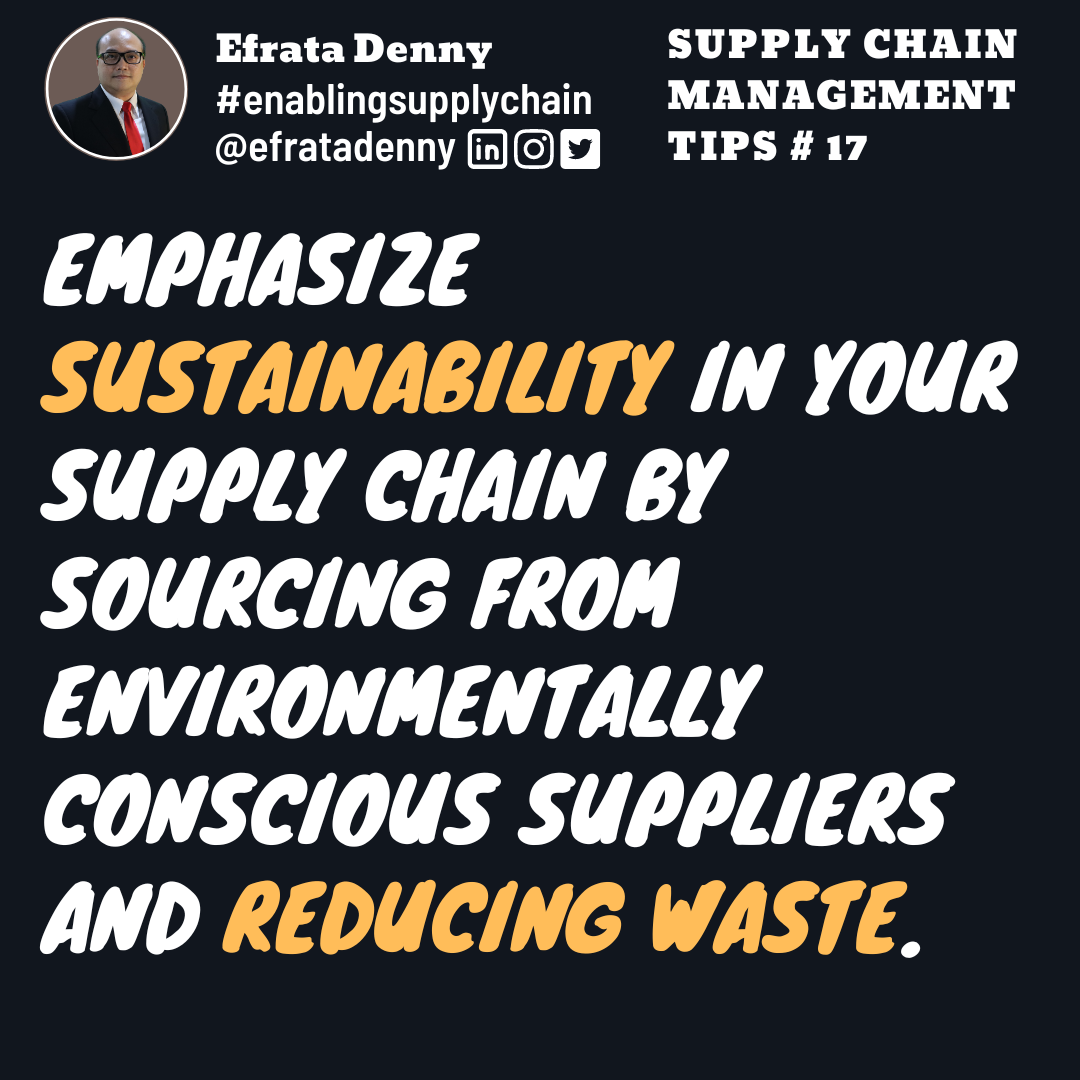
“Emphasize sustainability in your supply chain by sourcing from environmentally conscious suppliers and reducing waste.”

Efrata Denny

In the intricate world of supply chain management, the principles of sustainability have evolved from a trend to a fundamental imperative. As global concerns about environmental impact intensify, businesses are called to action, with sustainability becoming a driving force for operational excellence. Emphasizing eco-conscious practices in your supply chain, from sourcing to waste reduction, not only aligns with responsible business practices but also presents a pathway to a greener and more resilient future. In this article, we’ll explore the advantages of embracing sustainability in your supply chain and how it contributes to a world that thrives environmentally and economically.

1. Reduced Environmental Impact

One of the most compelling reasons to integrate sustainability into your supply chain is the substantial reduction in environmental impact. By partnering with suppliers who prioritize eco-conscious practices—such as responsible sourcing, energy efficiency, and reduced emissions—you actively contribute to mitigating the effects of climate change and conserving precious natural resources.

2. Positive Brand Image and Reputation

Consumers and stakeholders are increasingly drawn to businesses that demonstrate a commitment to sustainability. By emphasizing eco-conscious practices in your supply chain, you enhance your brand’s image and reputation. Consumers are more likely to engage with brands that align with their values, resulting in increased loyalty, preference, and positive word-of-mouth.

3. Cost Savings Through Waste Reduction

Sustainability and cost savings are not mutually exclusive. Waste reduction initiatives, such as minimizing packaging, recycling, and optimizing resource usage, translate into tangible financial benefits. By reducing waste, you cut disposal costs, minimize the need for raw materials, and streamline operations, leading to increased efficiency and reduced expenses.

4. Enhanced Customer Loyalty and Preference

Sustainability resonates deeply with today’s conscious consumers. By adopting eco-conscious practices in your supply chain, you tap into a consumer base that values responsible consumption. This resonance fosters loyalty, preference, and an emotional connection with your brand, creating a lasting bond that transcends transactions.

5. Collaboration with Like-Minded Partners

The journey toward a sustainable supply chain is often a collaborative one. By emphasizing sustainability, you attract partners who share your commitment to eco-conscious practices. Collaborating with like-minded suppliers fosters innovation, knowledge-sharing, and a collective effort to drive positive change.

Emphasizing sustainability in your supply chain transcends being a mere trend—it’s a strategic imperative that aligns with global goals for a more sustainable future. The advantages of reduced environmental impact, positive brand image, cost savings, customer loyalty, and collaborative partnerships converge to create a supply chain that thrives both economically and ecologically.

So, don’t underestimate the power of sustainability. By integrating eco-conscious practices into your supply chain, you become a catalyst for positive change. Together, let’s pave the way for a greener future—one where responsible business practices not only drive success but also leave a positive legacy for generations to come.

Share this:

  • Share on Facebook (Opens in new window) Facebook
  • Share on X (Opens in new window) X
  • Share on LinkedIn (Opens in new window) LinkedIn
  • Email a link to a friend (Opens in new window) Email
  • Share on Tumblr (Opens in new window) Tumblr
  • Share on Pinterest (Opens in new window) Pinterest
Like Loading...

Posts navigation

← Older Entries
Newer Entries →
  • Yes You Can Search

  • Yes This is Calendar

    January 2026
    M T W T F S S
     1234
    567891011
    12131415161718
    19202122232425
    262728293031  
    « Sep    
  • Yes These are Archives

  • Yes Recent Posts

    • The Future of Supply Chain: How AI and Automation Are Revolutionizing the Industry
    • Top 10 Supply Chain Innovations to Watch in 2024
    • The Rise of Sustainable Supply Chains: Why Going Green is Now a Business Imperative
    • The Great Debate: Centralized vs. Decentralized Supply Chains—Which is Better for 2024?
    • The Paradox of Supply Chain and Logistics
    • Agility Unleashed: The Power of Continuous Evaluation in Procurement Strategy
    • Cost Clarity: Mastering Total Cost of Acquisition for Procurement Excellence
    • Strategic Sourcing Mastery: Unleashing Procurement Excellence through Consolidated Purchasing
    • Unleashing Operational Excellence Through Just-in-Time (JIT) Inventory Management
    • Revolutionizing Procurement: The Strategic Impact of Harnessing Reverse Auctions for Maximum Cost Savings
  • Yes Follow Me

    Post a Day 2012 Twitter EfrataDenny
  • Yes This is My Twitter

    Tweets by efratadenny
  • Yes Advertising

    Roppopo.com
  • Yes This is Category

    Australia Bali Bandung China Collection Food France Indonesia Intermezzo Jakarta Kraft Foods Leadership Lighting Experiences Liquidart Manado Management Model Online Store Photography Portfolio Press Procurement Still Life Supply Chain Sustainability Traveling Underwater Wines Yes This is Me
  • Enter your email address to follow this blog and receive notifications of new posts by email.

    Join 986 other subscribers
  • Flickr Photos

    Last Supper Wood EngravingChristmas SockChristmas Bell
    More Photos
  • Recent Comments

    Bogdan Kolos's avatarBogdan Kolos on The Power of Strong Supplier R…
    Reighne Sq's avatarReighne Sq on Weekly Photo Challenge: One Sh…
    Shubham's avatarShubham on Long Tail and Short Tail Red…
    Terrence M's avatarTerrence M on Fettuccine Carbonara
    Ivan's avatarIvan on Maria Clara Sangria Red W…
    wahyu jatmiko krisdiyanto's avatarwahyu jatmiko krisdi… on Mie Bakso
    Weekly Photo Challen… on Weekly Photo Challenge: F…
    bali ratih's avatarbali ratih on Diving at Benoa
    Berita Hari Ini's avatarBerita Hari Ini on Miss Indonesia will increase W…
    geraldine's avatargeraldine on Maria Clara Sangria Red W…
    Chika Lesmana's avatarChika Lesmana on Shanghai Ice
    Chika Lesmana's avatarChika Lesmana on Shanghai Ice
    ipah kholipah's avataripah kholipah on Shanghai Ice
    Evi's avatarEvi on Platinum Hill Limited Edition…
    renxkyoko's avatarrenxkyoko on Sirloin Steak
  • Yes Page Info

    Yahoo bot last visit Msn bot last visit Google PageRank Checker

    The best of travel stories in and around Singapore TravelerVoice Bloggers - Meet Millions of Bloggers Personal Blogs visitor counters
  • Yes Facebook

    Yes Facebook
Blog at WordPress.com.
Efrata Denny
Create a free website or blog at WordPress.com.
Privacy & Cookies: This site uses cookies. By continuing to use this website, you agree to their use.
To find out more, including how to control cookies, see here: Cookie Policy
  • Subscribe Subscribed
    • Efrata Denny
    • Join 966 other subscribers
    • Already have a WordPress.com account? Log in now.
    • Efrata Denny
    • Subscribe Subscribed
    • Sign up
    • Log in
    • Report this content
    • View site in Reader
    • Manage subscriptions
    • Collapse this bar
 

Loading Comments...
 

    %d