Efrata Denny

Personal Blog contains Wines, Foods, Traveling, and Photography

  • Home
  • All About Me
    • Yes This is Me
    • Private Message
    • Guest Book
    • Collection
      • Cigars
      • IntermezZo
      • Liquors
      • Sketch
      • Zombie Story
    • Friends
    • Portfolio
      • Kraft Foods
      • Arnott’s
      • Glaxo Smith Kline
      • Online Store
    • Press
  • Wines
    • Argentina
    • Australia
    • Austria
    • Chile
    • France
    • Indonesia
    • Israel
    • Italia
    • Portugal
    • South Africa
    • Spain
    • USA
    • Vietnam
  • Food
  • Traveling
    • Australia
    • China
    • Hong Kong
    • Indonesia
    • Macau
    • Malaysia
    • Philippines
    • Singapore
    • Thailand
    • Vietnam
  • Photography
    • Model
    • Still Life
    • Liquidart
    • Underwater
  • Awards
  • Supply Chain
    • Sustainability
    • Workshop

Unleash the Power of Efficient Inventory Management: Elevating Cash Flow Through Optimal Inventory Turnover

Posted by efratadenny on 24 October 2023
Posted in: Management, Supply Chain. Tagged: enablingsupplychain, Management, Supply Chain, Supply Chain Management. Leave a comment

“Continuously monitor and optimize your inventory turnover ratio to improve cash flow.” – Efrata Denny

In the ever-evolving landscape of supply chain management, achieving optimal cash flow is not just a financial objective; it’s a strategic imperative that can make or break an organization’s growth trajectory. At the heart of this objective lies the concept of inventory turnover—an essential metric that measures how efficiently a company manages its inventory. Imagine a finely tuned engine, where the components work seamlessly to keep the machine running smoothly. Similarly, in the realm of supply chains, inventory turnover is the engine that drives not only operational efficiency but also cash flow optimization.

Understanding Inventory Turnover

Inventory turnover, also known as inventory turnover ratio, is a critical performance metric that signifies the number of times a company’s inventory is sold and replaced over a specific period, usually a year. It’s calculated by dividing the cost of goods sold (COGS) by the average inventory value during that period. A higher inventory turnover ratio indicates that inventory is being managed effectively, while a lower ratio suggests that excess inventory might be tying up resources.

The Art of Balancing Inventory

Striking the right balance between having enough inventory to meet customer demands and avoiding excessive stock that ties up capital is an art that demands precision. An excessively high inventory turnover may lead to stockouts, missed sales opportunities, and dissatisfied customers. On the other hand, too low of an inventory turnover can result in high carrying costs, increased risk of obsolescence, and reduced cash flow.

Boosting Cash Flow through Inventory Turnover

Efficient inventory management translates directly into improved cash flow. When inventory turnover is optimized, the following benefits come into play:

  1. Working Capital Management: A higher inventory turnover ratio means that the working capital invested in inventory is returned faster, freeing up funds for other business needs.
  2. Reduced Carrying Costs: Excess inventory incurs storage, handling, and insurance costs. Optimizing turnover reduces the amount of capital tied up in inventory, thus minimizing these carrying costs.
  3. Responsiveness to Demand: An agile supply chain that responds quickly to market demands, powered by optimized inventory turnover, ensures that products are available when and where customers want them.
  4. Streamlined Inventory Control: Effective inventory turnover requires constant vigilance and management. This practice, in turn, streamlines inventory control and planning, making the supply chain more agile and efficient.
  5. Informed Decision-Making: Monitoring and analyzing inventory turnover data provide insights into product performance, demand trends, and market preferences, enabling data-driven decision-making.

Strategies for Optimizing Inventory Turnover

  1. Demand Forecasting: Accurate demand forecasting helps align inventory levels with expected customer orders, reducing the risk of overstocking or stockouts.
  2. Effective Inventory Management Systems: Implementing advanced inventory management systems helps track inventory levels in real-time, ensuring timely replenishment and preventing stockouts.
  3. Supplier Collaboration: Collaborating closely with suppliers allows for just-in-time deliveries, reducing the need for excessive inventory on hand.
  4. Segmentation and Prioritization: Categorize products based on demand patterns and prioritize inventory turnover efforts accordingly.
  5. Regular Monitoring and Analysis: Continuously monitor inventory turnover ratios, identify trends, and adjust strategies based on market shifts.

Striking the Right Balance

While it’s essential to aim for an optimal inventory turnover ratio, achieving the right balance requires a deep understanding of your specific industry, market dynamics, and customer behavior. Your inventory turnover ratio should align with your organization’s strategic goals and supply chain objectives. It’s also important to note that while a higher turnover ratio is generally preferred, excessively high ratios might hint at supply chain inefficiencies or product availability issues.

Efficient inventory management, epitomized by a well-calibrated inventory turnover ratio, is a cornerstone of supply chain excellence. It’s a delicate dance between anticipating customer demand, minimizing excess stock, and ensuring that the cash flows where it’s needed most. By continuously monitoring and optimizing your inventory turnover ratio, you empower your supply chain with the agility, responsiveness, and financial flexibility required to thrive in today’s competitive business landscape. So, embrace the power of efficient inventory management, unlock the potential for improved cash flow, and steer your organization towards sustainable growth and success!


Share this:

  • Share on Facebook (Opens in new window) Facebook
  • Share on X (Opens in new window) X
  • Share on LinkedIn (Opens in new window) LinkedIn
  • Email a link to a friend (Opens in new window) Email
  • Share on Tumblr (Opens in new window) Tumblr
  • Share on Pinterest (Opens in new window) Pinterest
Like Loading...

Nurturing Success Through Collaboration: Cultivating a Culture of Collective Achievement in Your Supply Chain Network

Posted by efratadenny on 23 October 2023
Posted in: Management, Supply Chain. Tagged: enablingsupplychain, Management, Supply Chain, Supply Chain Management. Leave a comment

“Foster a culture of collaboration and information sharing within your supply chain network.” – Efrata Denny

In the intricate tapestry of supply chain management, the thread that weaves success is collaboration. The world of business has transformed into an interconnected web, where the strength of relationships and the power of collective effort can propel supply chain networks to remarkable heights. Imagine a landscape where partners, suppliers, and stakeholders seamlessly share insights, work towards common goals, and navigate challenges as a united force. This is the vision that a culture of collaboration seeks to achieve within your supply chain network.

The Power of Collaboration

Collaboration, at its essence, is the art of coming together to achieve something that no individual could accomplish alone. When translated into the context of supply chain management, it becomes the key to unlocking untapped potential, fostering innovation, and propelling operations towards excellence. In today’s fast-paced and interconnected world, where supply chains span the globe and complexities abound, the ability to collaborate efficiently is not just a nice-to-have—it’s a strategic imperative.

The Path to Success

Cultivating a culture of collaboration requires intentional effort and a commitment to breaking down silos and fostering an environment of open communication. It begins with recognizing that every member of your supply chain network, from suppliers to distributors, plays an integral role in the shared success story. By nurturing a sense of partnership and unity, you create a safe space for the exchange of ideas, experiences, and best practices. This open dialogue is where innovation is born, and challenges are met with a collective spirit.

Benefits that Resonate

The advantages of embracing a culture of collaboration resonate across every facet of the supply chain network:

  1. Deepened Relationships and Strategic Partnerships: A collaborative environment encourages the development of meaningful relationships based on trust and mutual respect. These connections evolve into strategic partnerships that form the backbone of a resilient and agile supply chain network.
  2. Enhanced Innovation and Creative Problem-Solving: The synergy generated through collaboration sparks innovative ideas and creative problem-solving. Diverse minds working together can see patterns and opportunities that might otherwise remain hidden.
  3. Streamlined Processes and Heightened Efficiency: When information flows seamlessly, processes become more transparent and efficient. Bottlenecks and inefficiencies are more readily identified and addressed, leading to improved operational outcomes.
  4. Amplified Visibility and Cross-Functional Insights: Collaboration facilitates the exchange of insights and expertise across various functions within the supply chain. This enhanced visibility enables faster decision-making and more informed strategies.
  5. Empowered Teams and Increased Motivation: In a collaborative environment, team members feel valued and empowered. This boosts motivation and engagement, resulting in higher productivity and a positive work culture.

Nurturing a Collaborative Culture

Creating a culture of collaboration involves a multi-faceted approach:

  1. Leadership Commitment: Leaders should lead by example, showing a genuine commitment to collaboration and creating an environment that encourages it.
  2. Communication Channels: Establish transparent and open channels for communication, ensuring that insights and updates flow freely across the network.
  3. Shared Goals: Align all stakeholders around shared goals, reinforcing the idea that success is a collective achievement.
  4. Recognition and Rewards: Celebrate collaboration successes and recognize those who actively contribute to the culture.
  5. Technology Enablement: Leverage digital tools and platforms that facilitate real-time communication and information sharing.

In the dynamic realm of supply chain management, a culture of collaboration isn’t just a strategy—it’s a mindset that underpins every decision and action. When individuals come together with diverse perspectives and a shared purpose, they create a force that transcends boundaries and achieves the extraordinary. Cultivate a culture of collaboration within your supply chain network, and witness the transformative power it brings to your journey of supply chain excellence.

Share this:

  • Share on Facebook (Opens in new window) Facebook
  • Share on X (Opens in new window) X
  • Share on LinkedIn (Opens in new window) LinkedIn
  • Email a link to a friend (Opens in new window) Email
  • Share on Tumblr (Opens in new window) Tumblr
  • Share on Pinterest (Opens in new window) Pinterest
Like Loading...

Embracing Blockchain: Revolutionizing Transparency and Security in Supply Chains

Posted by efratadenny on 22 October 2023
Posted in: Management, Supply Chain. Tagged: enablingsupplychain, Management, Supply Chain, Supply Chain Management. Leave a comment

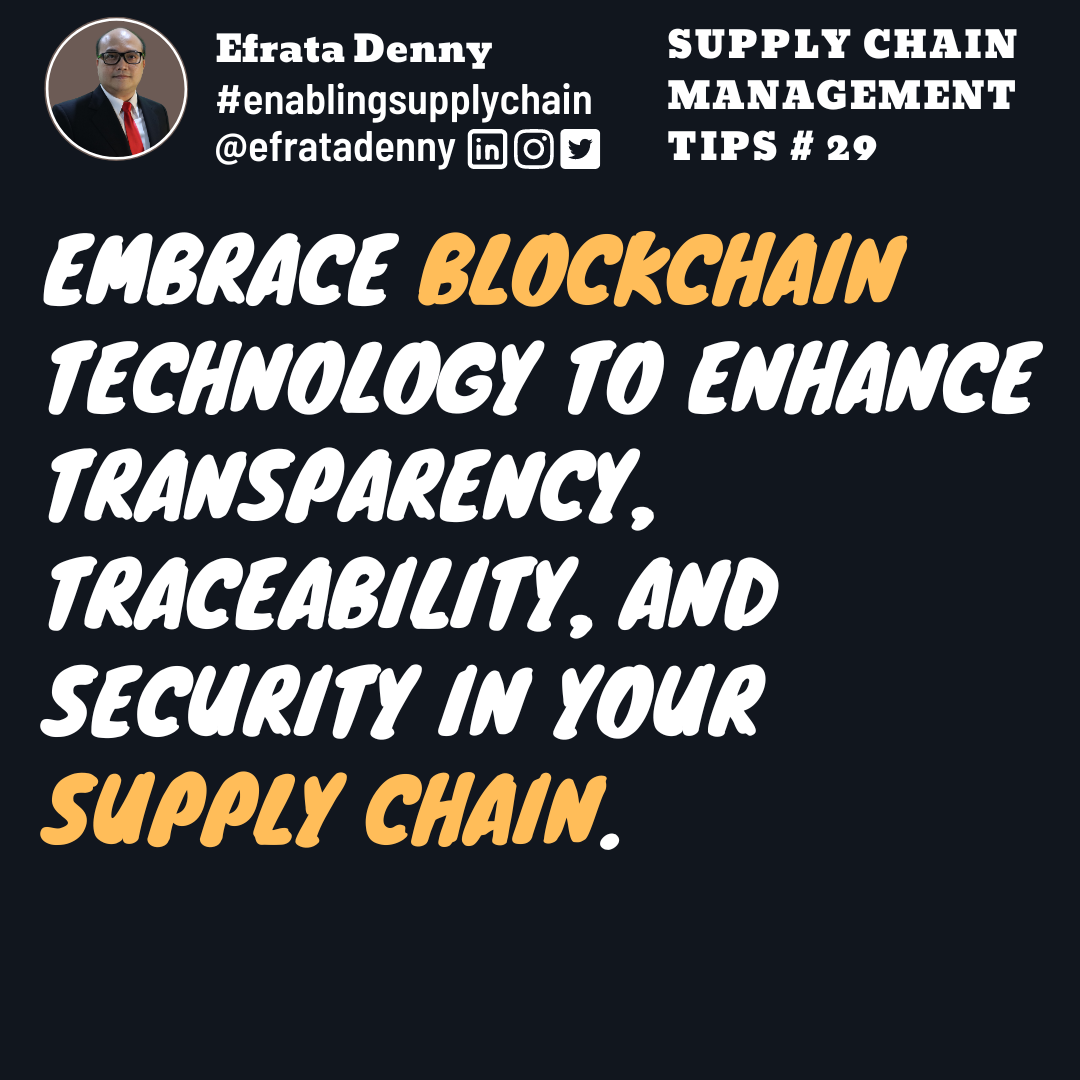
“Embrace blockchain technology to enhance transparency, traceability, and security in your supply chain.” – Efrata Denny

In the dynamic landscape of modern business, transparency, security, and trust form the foundation of successful supply chains. As technology continues to reshape industries, one innovation stands out: blockchain. By embracing blockchain technology, companies have the opportunity to transform their supply chain operations, ushering in a new era of transparency, traceability, and security.

The Power of Blockchain in Supply Chains

Blockchain, often associated with cryptocurrencies like Bitcoin, is a decentralized and tamper-proof digital ledger. This technology offers a secure and transparent way to record transactions, enabling multiple parties to access and verify information without the need for intermediaries. In supply chains, where numerous stakeholders collaborate, blockchain’s potential is immense.

1. Enhanced Transparency and Visibility

Traditional supply chains often suffer from information silos, making it difficult to track products’ journey from origin to destination. Blockchain addresses this challenge by providing a shared ledger accessible to all authorized participants. This ensures that every step, from production to distribution, is recorded and accessible in real time. With a transparent view into the supply chain, companies can identify inefficiencies, reduce delays, and enhance overall operational visibility.

2. Immutable and Auditable Supply Chain Records

In a blockchain, once information is added to the chain, it cannot be altered or deleted. This immutability ensures the integrity of supply chain records. Every transaction, movement, or change of ownership is recorded permanently, creating an auditable history. This feature is particularly beneficial for compliance, quality control, and dispute resolution, as it provides an accurate and tamper-proof record of every interaction.

3. Improved Traceability and Authenticity Verification

Blockchain’s ability to trace the origin and journey of products is a game-changer for industries like food, pharmaceuticals, and luxury goods. By scanning a QR code or using a unique identifier, consumers can verify the authenticity of a product and access detailed information about its origins, manufacturing process, and more. This not only combats counterfeiting but also empowers consumers to make informed purchasing decisions based on verified information.

4. Enhanced Security and Fraud Prevention

Blockchain’s decentralized nature and cryptographic security measures make it highly resistant to hacking and fraud. Transactions are securely encrypted, and data is distributed across the network, reducing the risk of a single point of failure. This heightened security is particularly important in supply chains, where sensitive information, such as payment details and intellectual property, is exchanged between multiple parties.

5. Strengthened Trust Among Stakeholders

In supply chains, trust is essential among participants, including suppliers, manufacturers, distributors, and customers. Blockchain’s transparency and security foster a higher level of trust, as all parties can independently verify the accuracy and authenticity of information. This leads to smoother collaborations, reduced disputes, and enhanced relationships throughout the supply chain network.

Embracing the Future with Blockchain

As companies navigate an increasingly interconnected and complex global marketplace, blockchain technology offers a transformative solution to longstanding supply chain challenges. By embracing blockchain, organizations can elevate transparency, traceability, and security, ultimately building stronger relationships, enhancing operational efficiency, and ensuring a more resilient and trusted supply chain.

In conclusion, the potential of blockchain in supply chains goes beyond buzzwords—it represents a revolutionary shift towards transparency, security, and trust. The journey to blockchain adoption may require investments in technology and collaboration among stakeholders, but the rewards in terms of streamlined operations, reduced risks, and empowered consumers are well worth the effort. So, consider embracing blockchain and unlock the future of your supply chain today!

Share this:

  • Share on Facebook (Opens in new window) Facebook
  • Share on X (Opens in new window) X
  • Share on LinkedIn (Opens in new window) LinkedIn
  • Email a link to a friend (Opens in new window) Email
  • Share on Tumblr (Opens in new window) Tumblr
  • Share on Pinterest (Opens in new window) Pinterest
Like Loading...

Celebrating Diversity: Building a Resilient Supply Chain Through Inclusion

Posted by efratadenny on 21 October 2023
Posted in: Management, Supply Chain. Tagged: enablingsupplychain, Management, Supply Chain, Supply Chain Management. Leave a comment

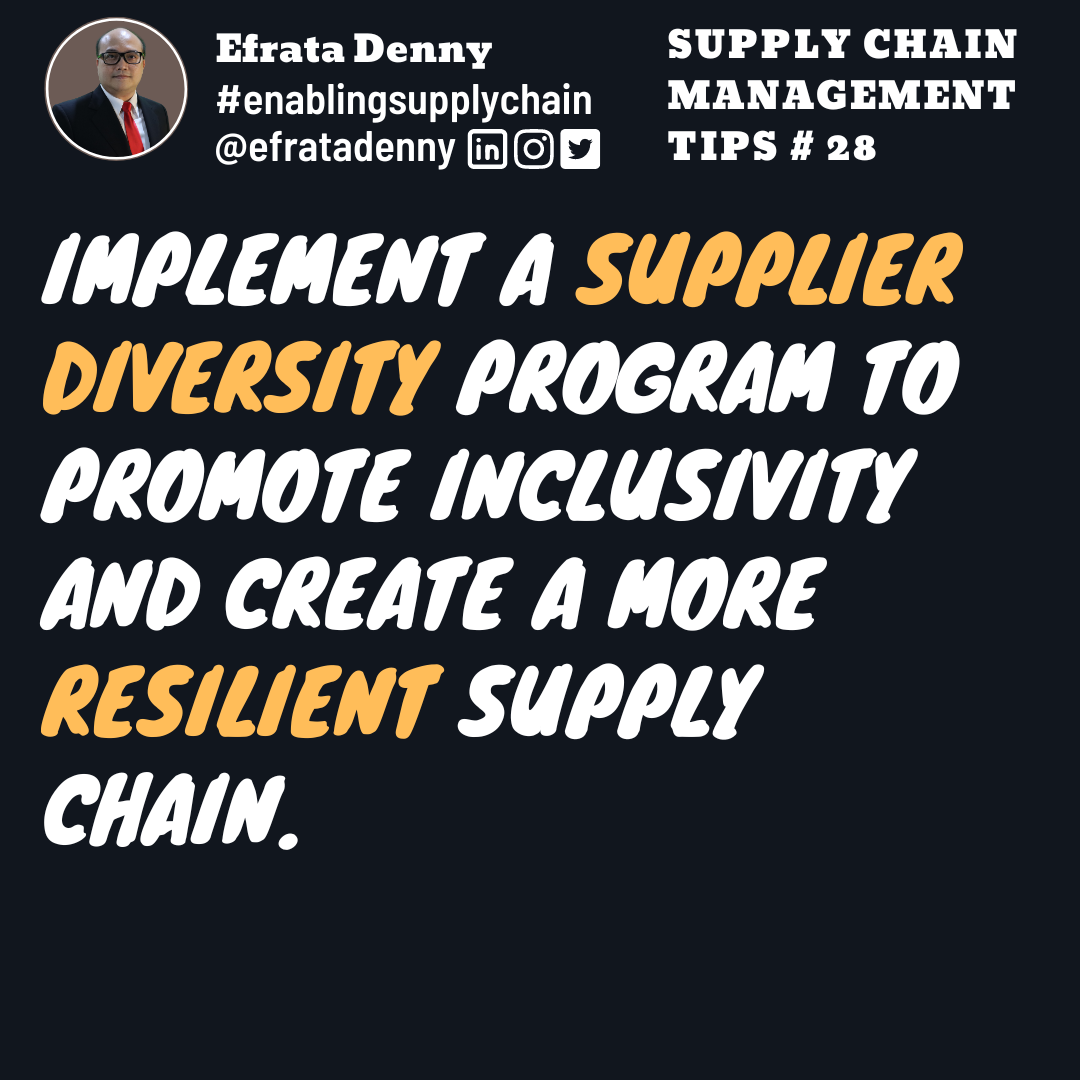
“Implement a supplier diversity program to promote inclusivity and create a more resilient supply chain.” – Efrata Denny

In a rapidly evolving global landscape, businesses are recognizing the imperative of embracing diversity and inclusion in all aspects of their operations. Supplier diversity has emerged as a powerful strategy that not only champions these values but also contributes to the resilience and success of the entire supply chain. Today’s tip focuses on the profound impact of implementing a supplier diversity program, shedding light on the myriad benefits it brings to businesses, suppliers, and the broader community.

The Power of Supplier Diversity

Supplier diversity involves actively seeking out and partnering with businesses that are owned and operated by individuals from traditionally underrepresented groups, including women, minorities, and veterans, among others. The goal is to provide equal opportunities, foster economic empowerment, and create a level playing field for businesses that might face systemic barriers.

1. Empowering Underrepresented Businesses

Supplier diversity programs empower businesses that have historically faced challenges in accessing opportunities. By opening doors to these enterprises, organizations create a more level economic playing field and contribute to local economies. This empowerment isn’t just about business growth—it’s about fostering economic independence and generating positive social impact.

2. Driving Innovation and Creativity

Diversity of thought is a powerful driver of innovation. When businesses collaborate with suppliers from diverse backgrounds, they bring together a variety of perspectives, experiences, and creative insights. This fusion of ideas results in innovative solutions, fresh approaches to challenges, and products that resonate with a broader range of customers.

3. Strengthening Supplier Relationships

Supplier diversity isn’t just a transactional arrangement; it’s about building partnerships. Engaging with a diverse supplier base fosters stronger relationships built on shared values, trust, and mutual support. These partnerships extend beyond business transactions, creating a network of allies that can weather challenges together.

4. Enhancing Supply Chain Resilience

A diverse supplier base enhances supply chain resilience. When businesses rely on a single source for their supplies, they are vulnerable to disruptions caused by factors such as geopolitical events, natural disasters, or market shifts. Diversifying suppliers spreads risk and reduces dependency on any one source, making the supply chain more adaptable and resilient.

5. Positive Societal Impact

Beyond business benefits, supplier diversity contributes to societal progress. Organizations that prioritize diversity and inclusion send a powerful message about their commitment to equitable practices. This not only strengthens their reputation but also has the potential to influence broader social change.

A Holistic Approach

Implementing a supplier diversity program requires a holistic approach. It involves evaluating current suppliers, setting clear diversity goals, actively seeking out diverse suppliers, and fostering long-term relationships. It also involves providing support and resources to help diverse suppliers thrive in a competitive market.

In an era where businesses are expected to be more socially responsible and environmentally conscious, supplier diversity is a pathway to creating a better world. It’s a way to celebrate the richness of human experience, drive innovation, and build a supply chain that can withstand the uncertainties of a rapidly changing world. By integrating supplier diversity into their strategies, businesses not only amplify their chances of success but also contribute to a more inclusive and resilient global marketplace.

Share this:

  • Share on Facebook (Opens in new window) Facebook
  • Share on X (Opens in new window) X
  • Share on LinkedIn (Opens in new window) LinkedIn
  • Email a link to a friend (Opens in new window) Email
  • Share on Tumblr (Opens in new window) Tumblr
  • Share on Pinterest (Opens in new window) Pinterest
Like Loading...

Navigating Uncertainty: The Power of a Resilient Crisis Management Plan

Posted by efratadenny on 20 October 2023
Posted in: Management, Supply Chain. Tagged: enablingsupplychain, Management, Supply Chain, Supply Chain Management. Leave a comment

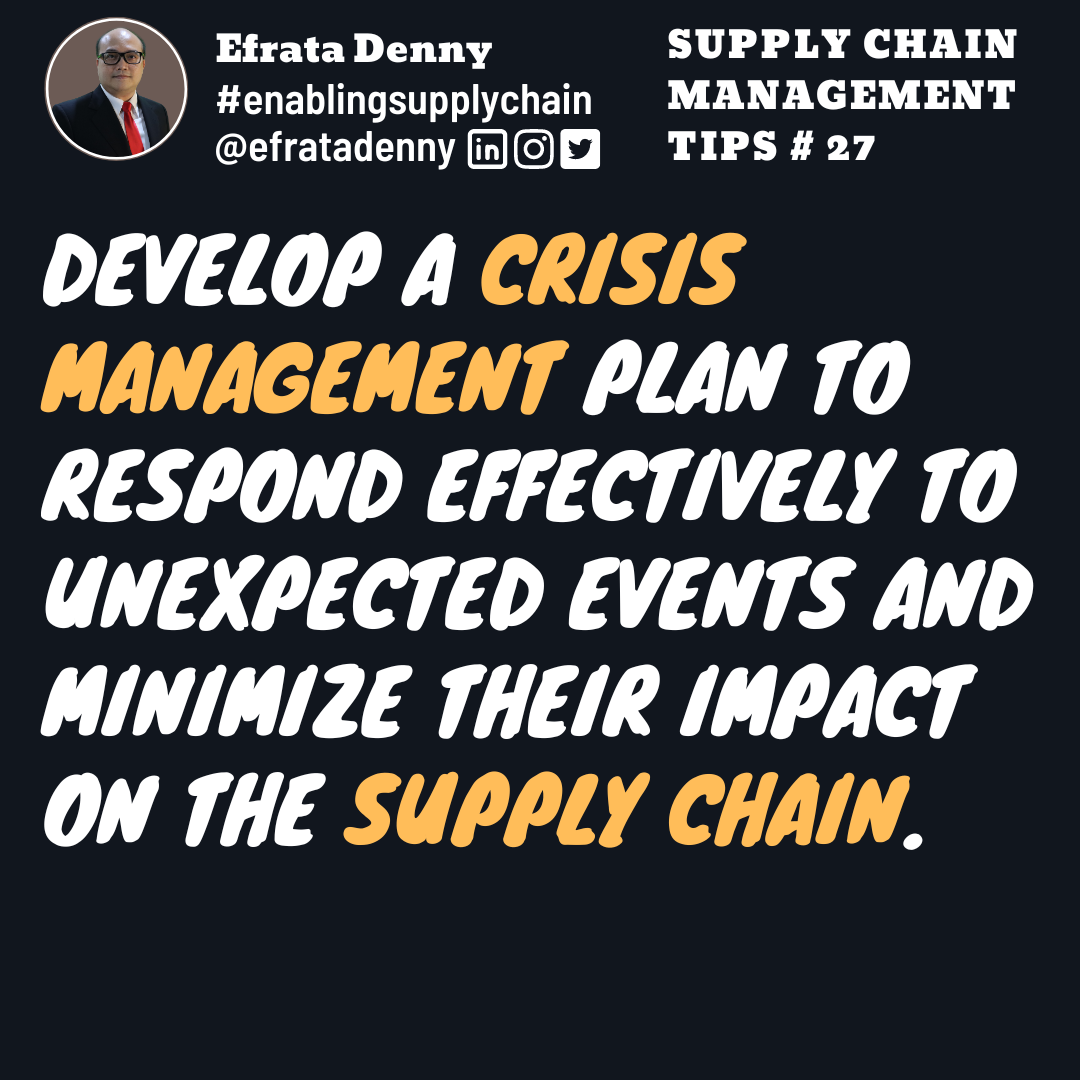
“Develop a crisis management plan to respond effectively to unexpected events and minimize their impact on the supply chain.” – Efrata Denny

In a world where unpredictability is the norm, the importance of being prepared cannot be overstated. Whether it’s a global pandemic, natural disaster, supply chain disruption, or any unexpected event, the ability to respond effectively can determine the survival and success of a business. This tip of the day underscores the significance of developing a robust strategy to respond effectively to unforeseen challenges, safeguard your supply chain, and minimize disruptions that could impact your business’s success.

Understanding Crisis Management: A Holistic Approach

Crisis management involves more than just reacting to emergencies as they arise. It encompasses a comprehensive approach to anticipating, preparing for, and responding to a wide range of potential disruptions. Such disruptions can impact your supply chain, operations, reputation, and overall business continuity. By developing a well-thought-out crisis management plan, you can ensure that your organization is equipped to navigate these challenges with resilience and agility.

The Benefits of a Crisis Management Plan

1. Rapid Emergency Response:

A crisis management plan provides a roadmap for your team to follow in times of crisis. It outlines roles and responsibilities, ensuring that everyone knows their tasks and can respond swiftly and cohesively to emergencies.

2. Minimal Disruption:

One of the primary goals of a crisis management plan is to minimize disruptions to your supply chain and operations. With a plan in place, you can quickly assess the situation, implement necessary measures, and work towards restoring normalcy.

3. Efficient Resource Allocation:

During a crisis, the allocation of resources becomes critical. A well-prepared plan outlines the allocation of personnel, equipment, and funds to ensure that resources are utilized efficiently and effectively.

4. Effective Communication:

Clear and timely communication is paramount in crisis situations. Your plan should include strategies for internal and external communication, keeping stakeholders informed and managing public perception.

5. Reputation Protection:

Maintaining a positive reputation is crucial for business success. A crisis management plan helps you address challenges transparently, demonstrating your commitment to resolving issues and maintaining customer trust.

6. Adaptability to Change:

In a dynamic business landscape, a crisis management plan should be adaptable. It should be regularly reviewed and updated to reflect new risks, emerging challenges, and lessons learned from past experiences.

7. Don’t Wait for Crisis to Strike!

Waiting for a crisis to hit before developing a response plan is a risky approach. Proactivity is key. By investing time and effort into creating a comprehensive crisis management plan, you’re taking a proactive stance to protect your supply chain, your operations, and your overall business resilience. When unexpected challenges arise, you’ll have a clear roadmap to follow, enabling your team to respond effectively and mitigate the impact on your business.

Building a Resilient Future

A well-structured crisis management plan is not just a document; it’s a living strategy that guides your organization through times of uncertainty. It empowers your team, minimizes disruption, and ensures that your supply chain remains robust even in the face of adversity. By emphasizing preparedness, you’re not only safeguarding your business’s future but also demonstrating your commitment to excellence, responsiveness, and customer satisfaction.

In a world where the only constant is change, a resilient crisis management plan is a beacon of stability that can lead your business to success, no matter what challenges arise.

Share this:

  • Share on Facebook (Opens in new window) Facebook
  • Share on X (Opens in new window) X
  • Share on LinkedIn (Opens in new window) LinkedIn
  • Email a link to a friend (Opens in new window) Email
  • Share on Tumblr (Opens in new window) Tumblr
  • Share on Pinterest (Opens in new window) Pinterest
Like Loading...

Posts navigation

← Older Entries
Newer Entries →
  • Yes You Can Search

  • Yes This is Calendar

    January 2026
    M T W T F S S
     1234
    567891011
    12131415161718
    19202122232425
    262728293031  
    « Sep    
  • Yes These are Archives

  • Yes Recent Posts

    • The Future of Supply Chain: How AI and Automation Are Revolutionizing the Industry
    • Top 10 Supply Chain Innovations to Watch in 2024
    • The Rise of Sustainable Supply Chains: Why Going Green is Now a Business Imperative
    • The Great Debate: Centralized vs. Decentralized Supply Chains—Which is Better for 2024?
    • The Paradox of Supply Chain and Logistics
    • Agility Unleashed: The Power of Continuous Evaluation in Procurement Strategy
    • Cost Clarity: Mastering Total Cost of Acquisition for Procurement Excellence
    • Strategic Sourcing Mastery: Unleashing Procurement Excellence through Consolidated Purchasing
    • Unleashing Operational Excellence Through Just-in-Time (JIT) Inventory Management
    • Revolutionizing Procurement: The Strategic Impact of Harnessing Reverse Auctions for Maximum Cost Savings
  • Yes Follow Me

    Post a Day 2012 Twitter EfrataDenny
  • Yes This is My Twitter

    Tweets by efratadenny
  • Yes Advertising

    Roppopo.com
  • Yes This is Category

    Australia Bali Bandung China Collection Food France Indonesia Intermezzo Jakarta Kraft Foods Leadership Lighting Experiences Liquidart Manado Management Model Online Store Photography Portfolio Press Procurement Still Life Supply Chain Sustainability Traveling Underwater Wines Yes This is Me
  • Enter your email address to follow this blog and receive notifications of new posts by email.

    Join 986 other subscribers
  • Flickr Photos

    Last Supper Wood EngravingChristmas SockChristmas Bell
    More Photos
  • Recent Comments

    Bogdan Kolos's avatarBogdan Kolos on The Power of Strong Supplier R…
    Reighne Sq's avatarReighne Sq on Weekly Photo Challenge: One Sh…
    Shubham's avatarShubham on Long Tail and Short Tail Red…
    Terrence M's avatarTerrence M on Fettuccine Carbonara
    Ivan's avatarIvan on Maria Clara Sangria Red W…
    wahyu jatmiko krisdiyanto's avatarwahyu jatmiko krisdi… on Mie Bakso
    Weekly Photo Challen… on Weekly Photo Challenge: F…
    bali ratih's avatarbali ratih on Diving at Benoa
    Berita Hari Ini's avatarBerita Hari Ini on Miss Indonesia will increase W…
    geraldine's avatargeraldine on Maria Clara Sangria Red W…
    Chika Lesmana's avatarChika Lesmana on Shanghai Ice
    Chika Lesmana's avatarChika Lesmana on Shanghai Ice
    ipah kholipah's avataripah kholipah on Shanghai Ice
    Evi's avatarEvi on Platinum Hill Limited Edition…
    renxkyoko's avatarrenxkyoko on Sirloin Steak
  • Yes Page Info

    Yahoo bot last visit Msn bot last visit Google PageRank Checker

    The best of travel stories in and around Singapore TravelerVoice Bloggers - Meet Millions of Bloggers Personal Blogs visitor counters
  • Yes Facebook

    Yes Facebook
Create a free website or blog at WordPress.com.
Efrata Denny
Blog at WordPress.com.
Privacy & Cookies: This site uses cookies. By continuing to use this website, you agree to their use.
To find out more, including how to control cookies, see here: Cookie Policy
  • Subscribe Subscribed
    • Efrata Denny
    • Join 966 other subscribers
    • Already have a WordPress.com account? Log in now.
    • Efrata Denny
    • Subscribe Subscribed
    • Sign up
    • Log in
    • Report this content
    • View site in Reader
    • Manage subscriptions
    • Collapse this bar
 

Loading Comments...
 

    %d