Efrata Denny

Personal Blog contains Wines, Foods, Traveling, and Photography

  • Home
  • All About Me
    • Yes This is Me
    • Private Message
    • Guest Book
    • Collection
      • Cigars
      • IntermezZo
      • Liquors
      • Sketch
      • Zombie Story
    • Friends
    • Portfolio
      • Kraft Foods
      • Arnott’s
      • Glaxo Smith Kline
      • Online Store
    • Press
  • Wines
    • Argentina
    • Australia
    • Austria
    • Chile
    • France
    • Indonesia
    • Israel
    • Italia
    • Portugal
    • South Africa
    • Spain
    • USA
    • Vietnam
  • Food
  • Traveling
    • Australia
    • China
    • Hong Kong
    • Indonesia
    • Macau
    • Malaysia
    • Philippines
    • Singapore
    • Thailand
    • Vietnam
  • Photography
    • Model
    • Still Life
    • Liquidart
    • Underwater
  • Awards
  • Supply Chain
    • Sustainability
    • Workshop

Boost Customer Delight with a Demand-Driven Production System

Posted by efratadenny on 3 November 2023
Posted in: Management, Supply Chain. Tagged: enablingsupplychain, Management, Supply Chain, Supply Chain Management. Leave a comment

“Implement a demand-driven production system to reduce lead times and improve customer responsiveness.” – Efrata Denny

In the fast-paced world of supply chain management, responsiveness is the key to satisfying customers and staying competitive. As the market landscape evolves and customer expectations continue to rise, businesses must find innovative ways to streamline their operations and reduce lead times. One effective approach to achieve this is by implementing a demand-driven production system. This system not only reduces lead times but also enhances customer responsiveness, resulting in increased customer satisfaction and a more agile supply chain.

Understanding the Demand-Driven Approach

A demand-driven production system revolves around the principle of aligning production with actual customer demand. Instead of relying solely on forecasts or pushing products into the market, this approach focuses on pulling products based on real-time customer orders. By closely monitoring customer orders and adjusting production accordingly, businesses can significantly reduce lead times, avoid overproduction, and optimize resource allocation.

The Advantages of a Demand-Driven Production System

  1. Reduced Lead Times: One of the most significant advantages of a demand-driven production system is the reduction in lead times. Traditional production models can result in excess inventory and longer lead times, causing delays and increasing carrying costs. With a demand-driven approach, products are manufactured in response to actual customer orders, allowing for quicker turnaround times and more efficient order fulfillment.
  2. Enhanced Customer Satisfaction: Shorter lead times mean faster delivery to customers, leading to heightened customer satisfaction. Meeting or even exceeding customer expectations regarding delivery times can significantly improve customer loyalty and retention. Happy customers are more likely to become repeat buyers and brand advocates, driving business growth.
  3. Efficient Resource Allocation: Demand-driven production enables businesses to allocate resources more efficiently. Instead of allocating resources based on forecasts that might not accurately predict market demand, resources are directed toward fulfilling actual orders. This reduces waste, optimizes resource utilization, and contributes to cost savings.
  4. Minimized Inventory Holding Costs: Traditional production models often lead to excess inventory, tying up valuable resources and incurring holding costs. Demand-driven production minimizes the need for excess inventory by producing goods as needed, reducing the financial burden associated with inventory storage.
  5. Real-Time Visibility: A demand-driven production system requires real-time visibility into customer orders and market trends. This visibility allows businesses to quickly respond to fluctuations in demand and adjust production accordingly. By having a clear view of what customers want, businesses can make informed decisions that lead to better customer satisfaction and improved operational efficiency.

Implementing a Demand-Driven Production System

Implementing a demand-driven production system involves several key steps:

  1. Demand Forecasting: Accurate demand forecasting is crucial for the success of a demand-driven system. Leverage historical data, market trends, and customer insights to create precise demand forecasts.
  2. Real-Time Data: Establish systems that provide real-time visibility into customer orders, inventory levels, and production processes. This data-driven approach enables informed decision-making and timely adjustments.
  3. Collaboration: Collaborate closely with suppliers, distributors, and other partners to ensure the entire supply chain is aligned with the demand-driven approach. Effective communication is essential to avoid disruptions and delays.
  4. Technology Integration: Utilize technology solutions such as advanced analytics, artificial intelligence, and integrated supply chain software to streamline processes and automate data collection.
  5. Continuous Improvement: Continuously monitor and evaluate the performance of the demand-driven system. Identify areas for improvement and adjust strategies as needed to achieve optimal results.

In today’s competitive business landscape, a demand-driven production system is no longer a luxury but a necessity. The ability to respond rapidly to customer orders, reduce lead times, and enhance overall customer responsiveness can give businesses a significant edge. By aligning production with actual demand and optimizing resources, companies can create a more agile, efficient, and customer-centric supply chain. As customer expectations continue to evolve, embracing a demand-driven approach is a strategic move that can lead to increased customer satisfaction, improved business performance, and sustainable growth.
Share this:

  • Share on Facebook (Opens in new window) Facebook
  • Share on X (Opens in new window) X
  • Share on LinkedIn (Opens in new window) LinkedIn
  • Email a link to a friend (Opens in new window) Email
  • Share on Tumblr (Opens in new window) Tumblr
  • Share on Pinterest (Opens in new window) Pinterest
Like Loading...

Navigating the Future: Ensuring Resilience Through Supply Chain Risk Management Strategy Updates

Posted by efratadenny on 2 November 2023
Posted in: Management, Supply Chain. Tagged: enablingsupplychain, Management, Supply Chain, Supply Chain Management. Leave a comment

“Regularly review and update your supply chain risk management strategy to adapt to changing market conditions.” – Efrata Denny

In the ever-evolving landscape of business, adaptability is not just a desirable trait – it’s an absolute necessity. The ability to pivot, respond, and navigate uncertainties is what separates successful organizations from the rest. One crucial aspect of this adaptability lies in the supply chain risk management strategy. Regularly reviewing and updating your risk management strategy is not just a suggestion; it’s a strategic imperative that can make the difference between thriving and faltering in the face of unforeseen challenges.

Why Regular Review and Update Matter

Market conditions are anything but static. Consumer preferences shift, geopolitical factors come into play, economic fluctuations occur, and unforeseen events disrupt even the most carefully laid plans. In such an environment, relying on a static risk management strategy can be risky in itself. By regularly reviewing and updating your strategy, you’re not just addressing current challenges; you’re also preparing for potential risks on the horizon. It’s about being proactive rather than reactive, giving your organization the best chance to weather storms and emerge stronger.

Proactive Identification and Mitigation of Risks

One of the primary advantages of regular review and update is the ability to proactively identify and mitigate emerging risks. Risks are not always predictable, but a dynamic risk management strategy can help you stay ahead of the curve. This means not only identifying risks but also putting measures in place to minimize their impact. By staying vigilant and responsive, you can prevent risks from escalating into full-blown crises.

Optimized Supply Chain Resilience

The resilience of your supply chain is a testament to its ability to withstand disruptions and bounce back swiftly. A robust risk management strategy plays a pivotal role in enhancing supply chain resilience. Through regular review and updates, you can identify vulnerabilities, assess the effectiveness of existing mitigation measures, and implement new strategies to enhance the overall resilience of your supply chain. This, in turn, ensures that your operations continue smoothly even in the face of adversity.

Minimized Disruptions and Enhanced Customer Satisfaction

Disruptions in the supply chain can have a cascading effect on various aspects of your business. Delays, stockouts, or quality issues can lead to dissatisfied customers and damaged reputation. A risk management strategy that is continually updated helps minimize these disruptions. By being prepared for various scenarios, you can maintain consistent product availability, meet customer expectations, and preserve customer trust. This directly translates to enhanced customer satisfaction and long-term loyalty.

Agility in Response to Market Shifts

Market shifts are inevitable, and your supply chain needs to have the agility to respond effectively. An outdated risk management strategy may not adequately address new market dynamics, leaving your organization vulnerable to sudden changes. Regular updates allow you to align your strategy with current market conditions, adjust your priorities, and pivot your operations as needed. This agility empowers you to seize opportunities and navigate challenges effectively.

Data-Driven Insights for Informed Decisions

In a world driven by data, a data-driven approach to risk management is paramount. Regularly reviewing and updating your strategy enables you to incorporate the latest data and insights into your decision-making process. This means you’re not just relying on historical information but also integrating real-time data to make informed choices. This level of intelligence empowers you to make strategic decisions that have a direct impact on your supply chain’s success.

Building a Resilient Future

As the business landscape continues to evolve, the importance of supply chain resilience cannot be overstated. Regularly reviewing and updating your risk management strategy is not just a best practice – it’s a prerequisite for thriving in uncertainty. By proactively identifying risks, optimizing supply chain resilience, and staying responsive to changing conditions, you’re building a future-ready supply chain that can withstand challenges and seize opportunities. So, embrace the power of adaptation, invest in the continuous improvement of your risk management strategy, and navigate the future with confidence.

Share this:

  • Share on Facebook (Opens in new window) Facebook
  • Share on X (Opens in new window) X
  • Share on LinkedIn (Opens in new window) LinkedIn
  • Email a link to a friend (Opens in new window) Email
  • Share on Tumblr (Opens in new window) Tumblr
  • Share on Pinterest (Opens in new window) Pinterest
Like Loading...

Driving Success Through Collaboration: Uniting with Suppliers for Mutual Growth

Posted by efratadenny on 1 November 2023
Posted in: Management, Supply Chain. Tagged: enablingsupplychain, Management, Supply Chain, Supply Chain Management. Leave a comment

“Collaborate with your suppliers to implement joint improvement initiatives and drive mutual benefits.” – Efrata Denny

In the dynamic landscape of modern supply chains, the power of collaboration cannot be underestimated. As businesses navigate an ever-evolving global marketplace, the importance of strong supplier relationships has become more evident than ever before. In this article, we’ll delve into the profound impact of partnering with suppliers on joint improvement initiatives, shedding light on how this collaborative approach can pave the way for mutual growth, innovation, and lasting success.

The Foundation of Strong Supplier Relationships

At the heart of a successful supply chain lies the relationship between businesses and their suppliers. While the traditional supplier-customer dynamic has often been transactional, the shift towards a more collaborative approach is rapidly gaining traction. This evolution is driven by the realization that true success is not achieved in isolation but through the synergies created by mutually beneficial partnerships.

Collaboration Beyond Transactional Interactions

Beyond mere transactional interactions, collaboration with suppliers involves a deeper level of engagement and shared responsibility. Rather than viewing suppliers as separate entities, this approach integrates them into the fabric of the business, fostering a sense of unity in pursuing common goals. The result is a symbiotic relationship where both parties are invested in each other’s success.

Benefits of Supplier Collaboration

The benefits of supplier collaboration are extensive, touching various aspects of the supply chain and business operations. Here are some key advantages:

  1. Shared Knowledge and Expertise: When suppliers are considered partners, their expertise becomes a valuable resource. Collaborative efforts lead to the exchange of insights and best practices, contributing to continuous improvement and innovation.
  2. Enhanced Product Quality and Value Proposition: Suppliers intimately involved in product development and improvement initiatives can contribute to higher product quality. This translates to an enhanced value proposition for customers and a competitive edge in the market.
  3. Improved Supply Chain Efficiency and Agility: Joint initiatives can streamline processes, reduce bottlenecks, and optimize workflows. This efficiency translates to faster response times, reduced lead times, and improved overall supply chain agility.
  4. Cost Savings and Process Optimization: By pooling resources and expertise, both parties can identify cost-saving opportunities and implement process optimization strategies that positively impact the bottom line.
  5. Sustainability and Responsible Sourcing: Collaborative efforts extend to sustainability initiatives. Working together, businesses and suppliers can ensure responsible sourcing, ethical practices, and reduced environmental impact.

Implementing Joint Improvement Initiatives

The implementation of joint improvement initiatives requires a strategic and structured approach. Here are steps to consider:

  1. Open Communication: Establish transparent and open lines of communication with suppliers. Regular discussions about goals, challenges, and opportunities are crucial.
  2. Shared Goals: Align on common objectives that contribute to the success of both parties. This could involve product quality enhancement, cost reduction, or sustainability initiatives.
  3. Resource Sharing: Pool resources, expertise, and data to identify improvement areas and develop effective strategies.
  4. Continuous Monitoring: Regularly track progress and evaluate the impact of joint initiatives. This data-driven approach helps in making informed decisions.
  5. Feedback Loop: Encourage feedback and insights from both sides. This iterative process promotes learning and ongoing improvement.

Creating Win-Win Partnerships

The essence of collaborative supplier relationships lies in the concept of win-win partnerships. When both businesses benefit, the impact reverberates across the entire supply chain, positively affecting customers, stakeholders, and the market as a whole.

In conclusion, the era of isolated business operations is giving way to a new paradigm of collaboration and partnership. By embracing joint improvement initiatives with suppliers, businesses can unlock a host of benefits, from enhanced product quality and supply chain efficiency to sustainability and shared success. Let’s recognize that together, we can thrive, innovate, and create a future that is not only profitable but also sustainable and socially responsible.

Share this:

  • Share on Facebook (Opens in new window) Facebook
  • Share on X (Opens in new window) X
  • Share on LinkedIn (Opens in new window) LinkedIn
  • Email a link to a friend (Opens in new window) Email
  • Share on Tumblr (Opens in new window) Tumblr
  • Share on Pinterest (Opens in new window) Pinterest
Like Loading...

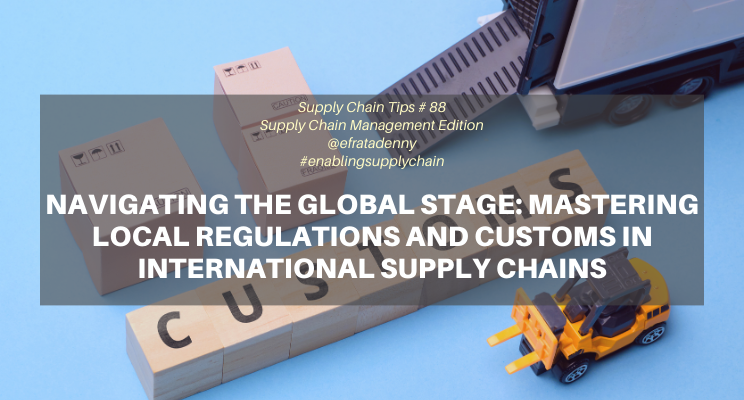
Navigating the Global Stage: Mastering Local Regulations and Customs in International Supply Chains

Posted by efratadenny on 31 October 2023
Posted in: Management, Supply Chain. Tagged: enablingsupplychain, Management, Supply Chain, Supply Chain Management. Leave a comment

“Develop a strong understanding of local regulations and customs requirements in international supply chains.” – Efrata Denny

In the modern business landscape, the world has become a marketplace without boundaries. The promise of reaching new markets, expanding customer bases, and tapping into diverse resources has prompted many businesses to venture into international supply chains. However, along with the allure of global expansion comes a complex web of regulations, laws, and customs that vary from country to country. Navigating these intricacies can be challenging, but with the right knowledge and strategies, you can harness the potential of international trade while mitigating risks.

The Multifaceted World of International Trade

Imagine your business as a globe-trotter, moving seamlessly across continents, cultures, and markets. However, each destination presents its own unique set of entry requirements—customs declarations, tariffs, import and export restrictions, labeling standards, and more. Failing to adhere to these regulations could result in delays, fines, and reputational damage. On the other hand, mastering these requirements opens doors to smoother logistics, quicker border crossings, and enhanced market penetration.

The Power of In-Depth Knowledge

To succeed in international supply chains, knowledge is your most valuable asset. It’s not just about understanding legal jargon; it’s about gaining insights into the nuances of each region’s business practices, cultural norms, and economic landscapes. A product that’s perfectly compliant in one country might raise eyebrows in another due to cultural sensitivities or local regulations. By delving deep into the regulatory environment of each market you operate in, you equip your supply chain with the flexibility and agility needed to adapt to diverse scenarios.

The Path to Compliance and Efficiency

The journey to mastering local regulations and customs starts with proactive research and learning. Engaging with legal experts, partnering with customs brokers, and collaborating with industry associations can provide invaluable guidance. Staying up-to-date with changes in regulations is crucial, as the world of international trade is constantly evolving. Leveraging digital platforms and technology solutions that offer real-time updates on regulatory changes can ensure that you’re always one step ahead.

Advantages of Understanding Local Regulations and Customs

  1. Compliance: Adherence to import/export laws and regulations keeps your operations above board.
  2. Efficiency: In-depth knowledge leads to streamlined customs clearance, minimizing delays.
  3. Risk Mitigation: Being aware of regulations helps you avoid penalties and non-compliance risks.
  4. Partnerships: Your commitment to compliance fosters strong relationships with international partners.
  5. Planning: Insights into local customs requirements enable more efficient supply chain planning.

The Ripple Effect of Compliance

Beyond legal requirements, mastering local regulations and customs enhances your brand’s reputation. Being a compliant player in the international arena demonstrates your commitment to ethical business practices, which can resonate with conscious consumers and potential partners. Additionally, compliance fosters credibility in the eyes of regulatory authorities, leading to smoother interactions and fewer bottlenecks.

A Symphony of Success

In essence, understanding local regulations and customs is like conducting a symphony on the global stage. Each country plays its own unique tune, and your supply chain must be in harmony with the melody of compliance. When all instruments—the laws, your processes, and your team’s knowledge—work together, the result is a symphony of success.

Empowering Your Global Supply Chain

Investing time, resources, and effort into understanding local regulations and customs is a strategic move that pays dividends. As you traverse the world of international trade, you’ll realize that knowledge truly is power. It empowers you to navigate complex waters with confidence, adapt to changing environments, and build a resilient supply chain capable of overcoming obstacles.

Navigating the Future

In a rapidly changing global landscape, businesses that embrace the challenges and opportunities of international trade are poised for remarkable growth. As borders blur and markets intertwine, the ability to master local regulations and customs becomes a competitive advantage. So, gear up to navigate the complexities, champion compliance, and propel your supply chain to global greatness. Let’s embrace the world and its diversity, one regulation at a time!

Share this:

  • Share on Facebook (Opens in new window) Facebook
  • Share on X (Opens in new window) X
  • Share on LinkedIn (Opens in new window) LinkedIn
  • Email a link to a friend (Opens in new window) Email
  • Share on Tumblr (Opens in new window) Tumblr
  • Share on Pinterest (Opens in new window) Pinterest
Like Loading...

Delivering Excellence: The Power of a Robust Quality Management System

Posted by efratadenny on 30 October 2023
Posted in: Management, Supply Chain. Tagged: enablingsupplychain, Management, Supply Chain, Supply Chain Management. Leave a comment

“Implement a robust quality management system to ensure consistent product quality throughout the supply chain.” – Efrata Denny

Quality is more than just a buzzword; it’s the cornerstone of a successful business. In a world where customers demand consistency, reliability, and trust, maintaining a high standard of product excellence is non-negotiable. This is where a robust quality management system (QMS) comes into play. A QMS acts as the guardian of quality, ensuring that every product that leaves your hands reflects your commitment to excellence.

Why Quality Management Matters

A QMS is a comprehensive framework that sets the stage for a culture of quality across your entire supply chain. It’s not just about inspecting finished products; it’s about ingraining a mindset of excellence into every stage of your processes. Whether you’re manufacturing, sourcing, distributing, or delivering, a QMS ensures that every action aligns with the highest standards.

Advantages of a Robust Quality Management System

  1. Consistent Product Quality and Customer Satisfaction: Inconsistent quality can erode customer trust and loyalty. A robust QMS ensures that each product meets predefined quality criteria, resulting in satisfied and loyal customers who know they can rely on your brand.
  2. Enhanced Brand Reputation and Loyalty: A strong reputation is built on consistently delivering quality products. A QMS empowers you to deliver on your promises, enhancing brand reputation and fostering customer loyalty.
  3. Efficient Defect Prevention and Waste Reduction: Prevention is better than cure. With a QMS, you can identify potential defects early in the process, minimizing waste, rework, and costly recalls.
  4. Data-Driven Insights for Continuous Improvement: A QMS generates valuable data on quality metrics, enabling data-driven decision-making and a cycle of continuous improvement. Identify trends, make informed adjustments, and constantly raise the bar.
  5. Strengthened Supplier Partnerships: A QMS doesn’t stop at your organization’s boundaries. It extends to your suppliers, fostering a shared commitment to quality. Collaborating with suppliers who share your quality goals can create a powerful network.

Implementing a Robust QMS

Implementing a QMS requires a strategic approach. Start by defining your quality standards and expectations. This includes setting clear criteria for product specifications, performance, and safety. Next, establish processes for quality control, testing, and inspection. Regular audits and assessments ensure that your QMS is effectively implemented and adhered to.

In a competitive marketplace where customer expectations are high, quality isn’t a luxury—it’s a necessity. A robust quality management system isn’t just a checkbox; it’s a philosophy that permeates every aspect of your operations. By embracing quality as a core value and implementing a comprehensive QMS, you’re not just delivering products; you’re delivering excellence, consistency, and a promise that shines through.

Share this:

  • Share on Facebook (Opens in new window) Facebook
  • Share on X (Opens in new window) X
  • Share on LinkedIn (Opens in new window) LinkedIn
  • Email a link to a friend (Opens in new window) Email
  • Share on Tumblr (Opens in new window) Tumblr
  • Share on Pinterest (Opens in new window) Pinterest
Like Loading...

Posts navigation

← Older Entries
Newer Entries →
  • Yes You Can Search

  • Yes This is Calendar

    January 2026
    M T W T F S S
     1234
    567891011
    12131415161718
    19202122232425
    262728293031  
    « Sep    
  • Yes These are Archives

  • Yes Recent Posts

    • The Future of Supply Chain: How AI and Automation Are Revolutionizing the Industry
    • Top 10 Supply Chain Innovations to Watch in 2024
    • The Rise of Sustainable Supply Chains: Why Going Green is Now a Business Imperative
    • The Great Debate: Centralized vs. Decentralized Supply Chains—Which is Better for 2024?
    • The Paradox of Supply Chain and Logistics
    • Agility Unleashed: The Power of Continuous Evaluation in Procurement Strategy
    • Cost Clarity: Mastering Total Cost of Acquisition for Procurement Excellence
    • Strategic Sourcing Mastery: Unleashing Procurement Excellence through Consolidated Purchasing
    • Unleashing Operational Excellence Through Just-in-Time (JIT) Inventory Management
    • Revolutionizing Procurement: The Strategic Impact of Harnessing Reverse Auctions for Maximum Cost Savings
  • Yes Follow Me

    Post a Day 2012 Twitter EfrataDenny
  • Yes This is My Twitter

    Tweets by efratadenny
  • Yes Advertising

    Roppopo.com
  • Yes This is Category

    Australia Bali Bandung China Collection Food France Indonesia Intermezzo Jakarta Kraft Foods Leadership Lighting Experiences Liquidart Manado Management Model Online Store Photography Portfolio Press Procurement Still Life Supply Chain Sustainability Traveling Underwater Wines Yes This is Me
  • Enter your email address to follow this blog and receive notifications of new posts by email.

    Join 986 other subscribers
  • Flickr Photos

    Last Supper Wood EngravingChristmas SockChristmas Bell
    More Photos
  • Recent Comments

    Bogdan Kolos's avatarBogdan Kolos on The Power of Strong Supplier R…
    Reighne Sq's avatarReighne Sq on Weekly Photo Challenge: One Sh…
    Shubham's avatarShubham on Long Tail and Short Tail Red…
    Terrence M's avatarTerrence M on Fettuccine Carbonara
    Ivan's avatarIvan on Maria Clara Sangria Red W…
    wahyu jatmiko krisdiyanto's avatarwahyu jatmiko krisdi… on Mie Bakso
    Weekly Photo Challen… on Weekly Photo Challenge: F…
    bali ratih's avatarbali ratih on Diving at Benoa
    Berita Hari Ini's avatarBerita Hari Ini on Miss Indonesia will increase W…
    geraldine's avatargeraldine on Maria Clara Sangria Red W…
    Chika Lesmana's avatarChika Lesmana on Shanghai Ice
    Chika Lesmana's avatarChika Lesmana on Shanghai Ice
    ipah kholipah's avataripah kholipah on Shanghai Ice
    Evi's avatarEvi on Platinum Hill Limited Edition…
    renxkyoko's avatarrenxkyoko on Sirloin Steak
  • Yes Page Info

    Yahoo bot last visit Msn bot last visit Google PageRank Checker

    The best of travel stories in and around Singapore TravelerVoice Bloggers - Meet Millions of Bloggers Personal Blogs visitor counters
  • Yes Facebook

    Yes Facebook
Blog at WordPress.com.
Efrata Denny
Create a free website or blog at WordPress.com.
Privacy & Cookies: This site uses cookies. By continuing to use this website, you agree to their use.
To find out more, including how to control cookies, see here: Cookie Policy
  • Subscribe Subscribed
    • Efrata Denny
    • Join 966 other subscribers
    • Already have a WordPress.com account? Log in now.
    • Efrata Denny
    • Subscribe Subscribed
    • Sign up
    • Log in
    • Report this content
    • View site in Reader
    • Manage subscriptions
    • Collapse this bar
 

Loading Comments...
 

    %d