Efrata Denny

Personal Blog contains Wines, Foods, Traveling, and Photography

  • Home
  • All About Me
    • Yes This is Me
    • Private Message
    • Guest Book
    • Collection
      • Cigars
      • IntermezZo
      • Liquors
      • Sketch
      • Zombie Story
    • Friends
    • Portfolio
      • Kraft Foods
      • Arnott’s
      • Glaxo Smith Kline
      • Online Store
    • Press
  • Wines
    • Argentina
    • Australia
    • Austria
    • Chile
    • France
    • Indonesia
    • Israel
    • Italia
    • Portugal
    • South Africa
    • Spain
    • USA
    • Vietnam
  • Food
  • Traveling
    • Australia
    • China
    • Hong Kong
    • Indonesia
    • Macau
    • Malaysia
    • Philippines
    • Singapore
    • Thailand
    • Vietnam
  • Photography
    • Model
    • Still Life
    • Liquidart
    • Underwater
  • Awards
  • Supply Chain
    • Sustainability
    • Workshop

Navigating Disruptions: The Power of Clear Communication in Supply Chain Resilience

Posted by efratadenny on 8 November 2023
Posted in: Management, Supply Chain. Tagged: enablingsupplychain, Management, Supply Chain, Supply Chain Management. Leave a comment

“Establish clear communication channels and escalation processes to address supply chain disruptions promptly.” – Efrata Denny

In the fast-paced and interconnected world of supply chain management, the ability to stay connected and act swiftly is paramount. Supply chain disruptions can arise unexpectedly, threatening the smooth flow of goods, services, and information. The key to effectively managing these disruptions lies in establishing clear communication channels and robust escalation processes that allow businesses to respond promptly and collaboratively.

The Power of Clear Communication

In the realm of supply chain management, communication serves as the lifeline that keeps all stakeholders informed and aligned. From suppliers and manufacturers to distributors and customers, a well-structured communication network ensures that everyone is on the same page. By establishing clear communication channels, businesses can quickly relay critical information about disruptions, share updates, and gather insights from various parties involved.

Swift Response to Disruptions

Supply chain disruptions can range from natural disasters and geopolitical shifts to sudden demand fluctuations and unexpected supplier issues. Regardless of the cause, the ability to respond swiftly is essential to minimizing the impact of these disruptions. When businesses have established communication channels in place, they can rapidly notify relevant teams and partners, enabling them to collaborate on finding solutions and mitigating risks. This swift response can prevent disruptions from escalating and ensure that corrective actions are taken promptly.

Collaboration for Resolution

Effective communication is not limited to relaying information; it also fosters collaboration and problem-solving. When disruptions occur, cross-functional teams need to work together seamlessly to analyze the situation, identify root causes, and determine the best course of action. Clear communication channels allow for efficient coordination among teams, enabling them to pool their expertise and resources to find solutions. This collaborative approach can lead to faster issue resolution and a quicker return to normal operations.

Minimizing Impact and Building Trust

Timely communication during disruptions demonstrates a commitment to transparency and accountability. By promptly sharing information about the nature of the disruption, its potential impact, and the steps being taken to address it, businesses can build trust with their stakeholders. Whether it’s customers, suppliers, or employees, clear communication shows that the organization is proactive and responsive in times of uncertainty. This, in turn, can help minimize the negative impact of the disruption on relationships and business operations.

Enhancing Decision-Making

Clear communication channels are not only crucial for addressing disruptions but also for informed decision-making. When all relevant parties have access to accurate and up-to-date information, they can make decisions based on real-time data and insights. This data-driven approach enables businesses to evaluate different options, assess potential risks, and choose the best strategies to navigate the disruption. In essence, effective communication empowers decision-makers to make well-informed choices that align with the organization’s goals.

In conclusion, establishing clear communication channels and escalation processes is a cornerstone of effective supply chain management. In a world where disruptions are becoming increasingly common and interconnected, the ability to stay connected and act swiftly is a competitive advantage. By fostering a culture of transparent and efficient communication, businesses can navigate challenges, build resilience, and continue to deliver value to their customers and partners. Let’s stay connected and conquer supply chain disruptions together!

Share this:

  • Share on Facebook (Opens in new window) Facebook
  • Share on X (Opens in new window) X
  • Share on LinkedIn (Opens in new window) LinkedIn
  • Email a link to a friend (Opens in new window) Email
  • Share on Tumblr (Opens in new window) Tumblr
  • Share on Pinterest (Opens in new window) Pinterest
Like Loading...

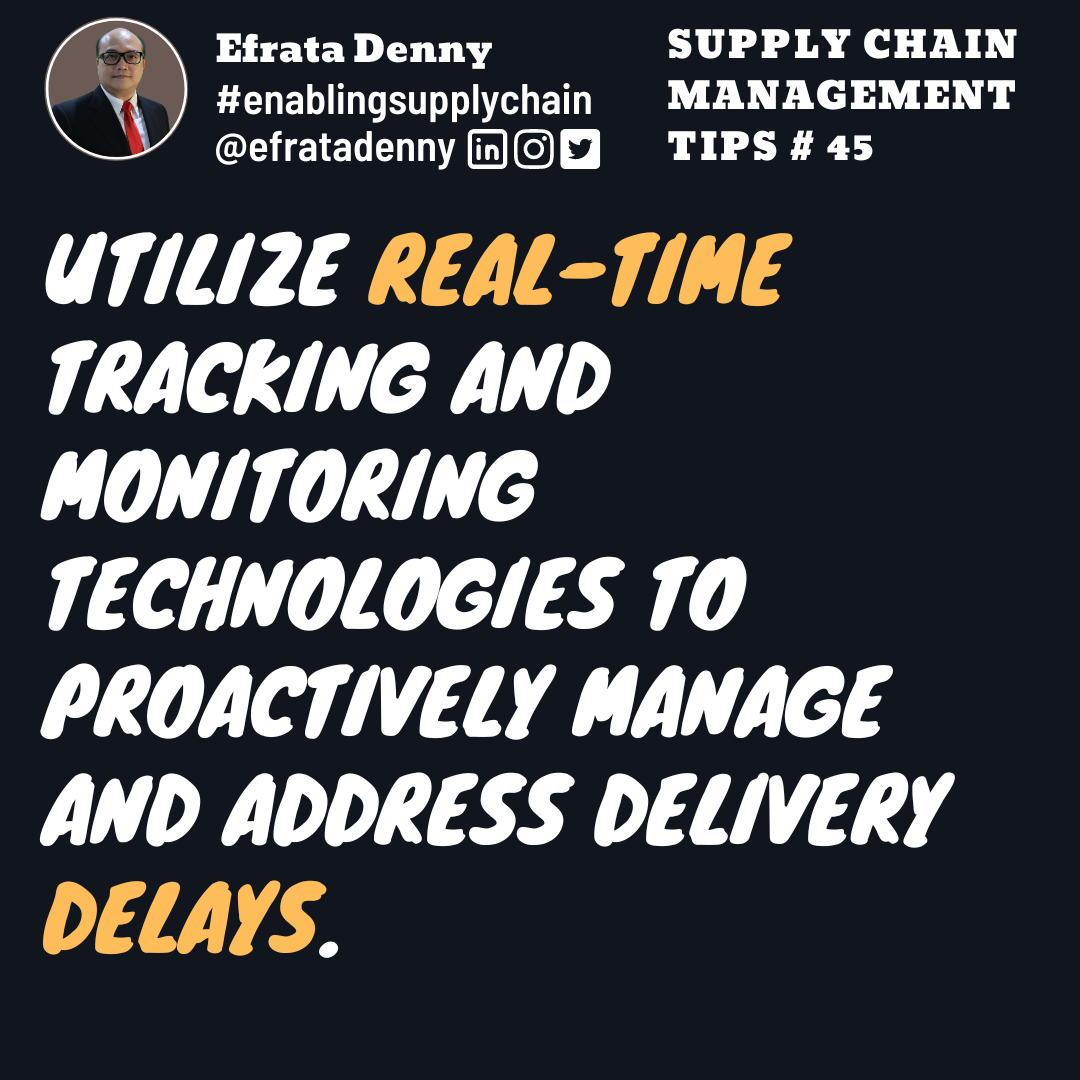
Utilize real-time tracking and monitoring technologies to proactively manage and address delivery delays

Posted by efratadenny on 7 November 2023
Posted in: Management, Supply Chain. Tagged: enablingsupplychain, Management, Supply Chain, Supply Chain Management. Leave a comment

“Utilize real-time tracking and monitoring technologies to proactively manage and address delivery delays.” – Efrata Denny

In today’s fast-paced business landscape, delivering products to customers on time is not just a goal, but a necessity. Whether it’s meeting the expectations of e-commerce customers or ensuring that your B2B partners receive their supplies promptly, efficient and timely deliveries play a crucial role in maintaining customer satisfaction and building a reputation for reliability. However, in the complex web of supply chain operations, delays and disruptions can sometimes occur, jeopardizing the smooth flow of goods from point A to point B.

This is where real-time tracking and monitoring technologies step in as invaluable tools for supply chain professionals. These technologies offer a dynamic solution to the age-old challenge of managing delivery delays. By leveraging real-time tracking and monitoring, businesses can gain unprecedented visibility into their delivery operations, anticipate potential delays, and take proactive measures to mitigate any issues that may arise.

The Power of Real-Time Tracking and Monitoring

Imagine this scenario: A package is scheduled for delivery to a customer who is eagerly awaiting its arrival. However, due to unexpected traffic congestion or a change in the delivery route, the package’s estimated arrival time gets pushed back. Without real-time tracking and monitoring, this delay might go unnoticed until the customer inquires about the whereabouts of their package. This not only leads to customer frustration but also puts your reputation on the line.

Real-time tracking and monitoring technologies eliminate this uncertainty by providing up-to-the-minute information about the location and status of deliveries. Through GPS tracking, IoT (Internet of Things) sensors, and advanced data analytics, businesses can monitor their shipments in real time. This data can be accessed through user-friendly interfaces, allowing supply chain professionals to oversee the movement of goods at a glance.

Proactive Management of Delivery Delays

The true power of real-time tracking lies in its ability to empower businesses to be proactive in managing delivery delays. Rather than reacting to delays after they’ve occurred, supply chain teams can now anticipate potential disruptions and take corrective actions in advance. For instance, if a delivery vehicle encounters unexpected road closures or traffic jams, real-time tracking can alert the team to the delay. This enables them to reroute the vehicle, communicate with the recipient about the new delivery time, and mitigate the impact of the delay.

Improved Customer Communication

Communication is paramount in managing customer expectations, especially when delays are involved. Real-time tracking and monitoring technologies facilitate transparent and effective communication with customers. Businesses can provide customers with accurate and timely updates about the status of their deliveries, including any potential delays. This level of transparency builds trust and reduces customer frustration, as customers appreciate being kept in the loop about the progress of their orders.

Efficiency and Optimization

Beyond addressing delays, real-time tracking and monitoring technologies also offer opportunities for supply chain optimization. By analyzing the data generated by these technologies, businesses can identify patterns and trends in delivery routes, traffic conditions, and other variables. This insight can inform decisions related to route optimization, resource allocation, and even predictive maintenance for delivery vehicles. As a result, businesses can operate more efficiently, reduce operational costs, and enhance overall supply chain performance.

Resolution and Satisfaction

In the rare event that a delay does occur, real-time tracking and monitoring can expedite issue resolution. When businesses are aware of delays as they happen, they can take immediate action to resolve the situation. Whether it’s dispatching a replacement delivery vehicle, coordinating with drivers to find alternative routes, or offering incentives to affected customers, real-time tracking allows businesses to respond swiftly and effectively. This proactive approach not only minimizes the impact of the delay but also demonstrates a commitment to customer satisfaction.

Building a Reputation for Excellence

In the competitive world of supply chain management, customer satisfaction and operational efficiency are key differentiators. By harnessing the capabilities of real-time tracking and monitoring technologies, businesses can consistently deliver on their promises and exceed customer expectations. Timely deliveries, accurate information, proactive issue resolution – these are the building blocks of a reputation for excellence in the eyes of customers, partners, and stakeholders.

In conclusion, the age-old challenge of managing delivery delays has found a modern solution in the form of real-time tracking and monitoring technologies. These tools provide businesses with the ability to proactively manage and mitigate delivery delays, enhance customer communication, optimize operations, and build a reputation for excellence. In a world where timing is everything, real-time tracking empowers supply chain professionals to stay ahead of delays and deliver with confidence.

So, whether you’re delivering products to end consumers or ensuring that critical supplies reach your business partners, consider integrating real-time tracking and monitoring technologies into your supply chain operations. By doing so, you’ll be taking a significant step toward delivering not just goods, but exceptional service and customer satisfaction.

Share this:

  • Share on Facebook (Opens in new window) Facebook
  • Share on X (Opens in new window) X
  • Share on LinkedIn (Opens in new window) LinkedIn
  • Email a link to a friend (Opens in new window) Email
  • Share on Tumblr (Opens in new window) Tumblr
  • Share on Pinterest (Opens in new window) Pinterest
Like Loading...

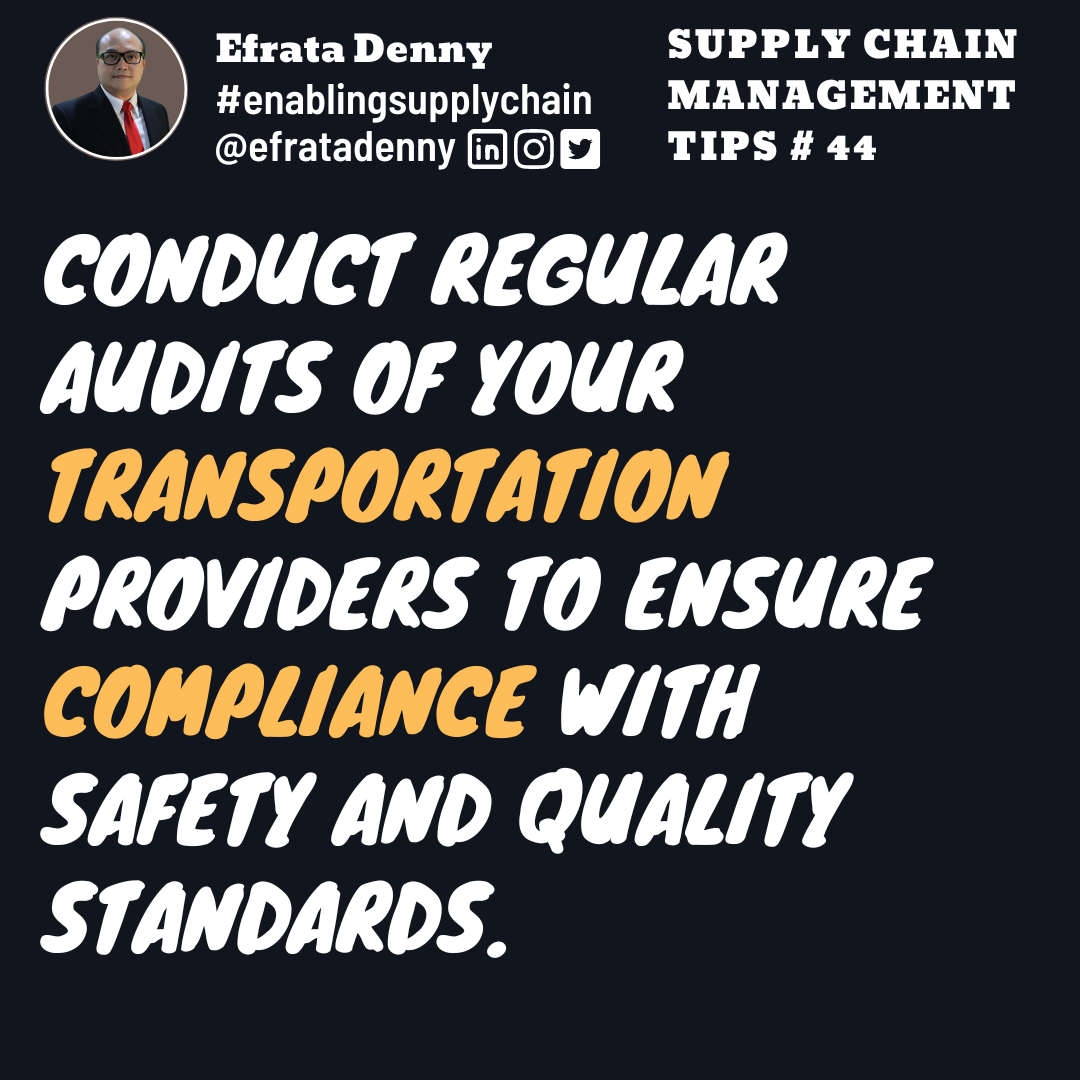
Prioritizing Safety and Quality: How Regular Transportation Audits Drive Supply Chain Excellence

Posted by efratadenny on 6 November 2023
Posted in: Management, Supply Chain. Tagged: enablingsupplychain, Management, Supply Chain, Supply Chain Management. Leave a comment

“Conduct regular audits of your transportation providers to ensure compliance with safety and quality standards.” – Efrata Denny

In today’s fast-paced and interconnected world, supply chain management has become a complex web of processes and relationships that extend far beyond the boundaries of a single organization. The reliability and efficiency of transportation providers play a critical role in ensuring that goods are delivered on time, intact, and in compliance with safety and quality standards. To achieve supply chain excellence, it’s imperative to conduct regular audits of transportation providers to guarantee their adherence to these standards.

Why Conduct Audits?

Safety and quality are paramount when it comes to transportation. Every link in the supply chain relies on the smooth movement of goods, and any disruption can lead to delays, losses, and damaged reputation. Regular audits of transportation providers serve as a proactive measure to ensure that these disruptions are minimized. Conducting audits allows businesses to evaluate if transportation providers are following established safety protocols, adhering to industry regulations, and meeting the agreed-upon service quality benchmarks.

Advantages of Regular Audits:

  1. Compliance with Regulations: Audits ensure that transportation providers are in line with safety and quality regulations set by relevant authorities. This compliance not only avoids legal repercussions but also contributes to the overall well-being of the supply chain.
  2. Enhanced Risk Mitigation: Identifying potential risks in transportation operations allows for corrective actions to be taken before they escalate into major issues. This proactive approach minimizes the likelihood of disruptions and ensures smoother operations.
  3. Improved Performance: Audits provide insights into transportation performance metrics, such as on-time deliveries, handling procedures, and responsiveness. Addressing any areas of improvement can lead to more reliable and efficient transportation services.
  4. Continuous Improvement: Audits are not merely about identifying problems; they also offer an opportunity for continuous improvement. Feedback and recommendations from audits can lead to adjustments that refine transportation processes over time.
  5. Customer Trust: Ensuring the safety and quality of transported goods instills confidence in customers. By demonstrating commitment to these aspects, businesses can strengthen customer trust and loyalty.

Implementing Successful Audits:

  1. Clear Standards: Clearly define safety and quality standards that transportation providers must adhere to. These standards should align with industry regulations and the unique requirements of your supply chain.
  2. Regular Auditing Schedule: Establish a consistent schedule for conducting audits. Regularity ensures that transportation providers are consistently held to the same standards.
  3. Thorough Evaluation: Audits should cover all aspects relevant to safety and quality, including driver qualifications, vehicle maintenance, handling procedures, documentation, and compliance with legal requirements.
  4. Collaboration: Collaborate with transportation providers to address any issues identified during audits. Encourage open communication and a cooperative approach to finding solutions.
  5. Technology Integration: Leverage technology such as tracking systems, data analytics, and real-time monitoring to enhance the effectiveness of audits and gather accurate information.

In a world where customer expectations are higher than ever and supply chain disruptions can have far-reaching consequences, ensuring the safety and quality of transportation is a critical component of supply chain excellence. By conducting regular audits of transportation providers, businesses can safeguard their reputation, minimize risks, and maintain the highest standards of service quality, thus driving overall success in a competitive marketplace.

Share this:

  • Share on Facebook (Opens in new window) Facebook
  • Share on X (Opens in new window) X
  • Share on LinkedIn (Opens in new window) LinkedIn
  • Email a link to a friend (Opens in new window) Email
  • Share on Tumblr (Opens in new window) Tumblr
  • Share on Pinterest (Opens in new window) Pinterest
Like Loading...

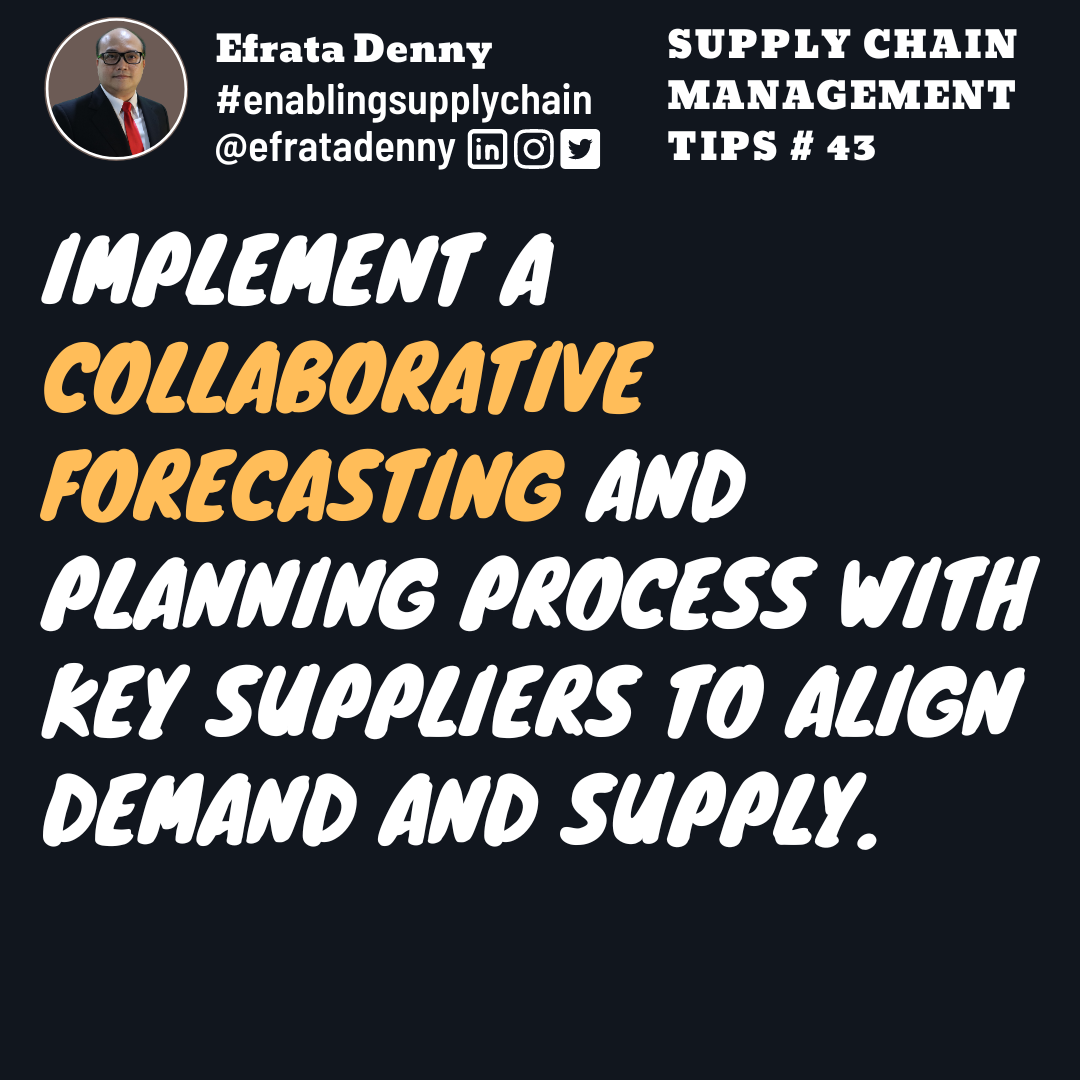
Unlock Success with Collaborative Forecasting and Planning

Posted by efratadenny on 5 November 2023
Posted in: Management, Supply Chain. Tagged: enablingsupplychain, Management, Supply Chain, Supply Chain Management. Leave a comment

“Implement a collaborative forecasting and planning process with key suppliers to align demand and supply.” – Efrata Denny

In the fast-paced and interconnected world of supply chain management, success hinges on the ability to forge strong partnerships and harness the power of collaboration. One of the most effective strategies for achieving this is by implementing a robust collaborative forecasting and planning process with key suppliers. This approach not only facilitates the alignment of demand and supply but also sets the stage for optimized inventory management, reduced costs, and enhanced customer satisfaction. Let’s dive into the depths of this transformative practice and explore how it can propel businesses towards a new level of supply chain excellence.

The Foundation of Collaborative Success

At the heart of collaborative forecasting and planning lies the concept of partnership. Unlike traditional supplier-customer relationships, where transactions are the focus, collaboration is about building mutual trust, sharing insights, and jointly solving challenges. By engaging in open and transparent communication, businesses can strengthen their supplier relationships and unlock a wealth of benefits that extend far beyond cost savings.

The Benefits of Collaborative Forecasting and Planning

  1. Improved Demand Forecast Accuracy: Collaborative forecasting involves the exchange of valuable data and insights between suppliers and buyers. By sharing information about market trends, customer behavior, and other relevant factors, both parties can create more accurate demand forecasts. This, in turn, enables better production planning, reduced stockouts, and improved customer satisfaction.
  2. Enhanced Supplier Relationships: Collaboration fosters a sense of shared responsibility for supply chain outcomes. When suppliers and buyers work together towards a common goal, it cultivates trust and a sense of partnership. This can lead to smoother interactions, faster issue resolution, and the ability to capitalize on joint improvement initiatives.
  3. Optimized Inventory Levels: The ability to align demand and supply through collaborative forecasting and planning results in optimal inventory levels. By avoiding overstock or stockout situations, businesses can reduce holding costs, minimize waste, and improve overall supply chain efficiency.
  4. Efficient Order Fulfillment: When suppliers are equipped with accurate demand forecasts, they can adjust their production schedules and allocate resources more efficiently. This agility translates into faster order fulfillment, reduced lead times, and an increased ability to respond to changing customer needs.
  5. Shared Insights for Strategic Decision-Making: Collaborative forecasting and planning bring together diverse perspectives and expertise. By pooling resources and data, businesses can make more informed decisions that drive strategic growth and long-term success.

Navigating the Path to Success

Implementing collaborative forecasting and planning requires a strategic and systematic approach:

  1. Data Sharing and Integration: Establish mechanisms for sharing data seamlessly between you and your key suppliers. This could involve integrating systems or using collaborative software solutions that facilitate real-time data exchange.
  2. Regular Communication: Communication is the bedrock of collaboration. Schedule regular meetings or discussions with your suppliers to review demand trends, address challenges, and jointly plan for the future.
  3. Mutual Goal Setting: Define common objectives and key performance indicators (KPIs) that both parties will work towards. This alignment ensures that everyone is moving in the same direction.
  4. Technology Enablement: Leverage technology solutions, such as collaborative forecasting software or supply chain management platforms, to facilitate data sharing, visibility, and analysis.
  5. Feedback Loop: Establish a feedback loop to continuously evaluate the effectiveness of your collaborative efforts. Regularly assess outcomes, identify areas for improvement, and adjust your approach accordingly.

The Path Forward: Collaboration as the Cornerstone of Excellence

As supply chains become more complex and interconnected, the value of collaboration becomes increasingly evident. Collaborative forecasting and planning is not just a strategy; it’s a mindset that nurtures innovation, builds trust, and fuels success. By embracing this approach, businesses can navigate uncertainties, optimize resources, and create a harmonious ecosystem where all stakeholders thrive. Let’s embark on this journey together, forging partnerships that lead to a brighter future of supply chain excellence.

Share this:

  • Share on Facebook (Opens in new window) Facebook
  • Share on X (Opens in new window) X
  • Share on LinkedIn (Opens in new window) LinkedIn
  • Email a link to a friend (Opens in new window) Email
  • Share on Tumblr (Opens in new window) Tumblr
  • Share on Pinterest (Opens in new window) Pinterest
Like Loading...

Unlocking the Power of Advanced Analytics and Machine Learning for Inventory Optimization

Posted by efratadenny on 4 November 2023
Posted in: Management, Supply Chain. Tagged: enablingsupplychain, Management, Supply Chain, Supply Chain Management. Leave a comment

“Leverage advanced analytics and machine learning to predict demand patterns and optimize inventory levels” – Efrata Denny

In today’s fast-paced and data-driven business landscape, staying ahead of the curve requires more than just reacting to market demands—it demands anticipating them. This is where the fusion of advanced analytics and machine learning comes into play. By harnessing these powerful tools, businesses can gain unprecedented insights into demand patterns, accurately forecast customer needs, and optimize inventory levels to create a lean, efficient, and highly responsive supply chain. In this article, we delve into the world of advanced analytics and machine learning for inventory optimization and explore the transformative impact they can have on supply chain management.

The Data-Driven Future of Inventory Management

Gone are the days of relying solely on historical data and gut feelings to make inventory decisions. The advent of advanced analytics and machine learning has brought about a seismic shift in how businesses approach inventory management. With these technologies, organizations can analyze vast amounts of data—ranging from past sales data to market trends, social media chatter, economic indicators, and more—to identify hidden patterns and correlations. By feeding this data into sophisticated algorithms, businesses can generate accurate demand forecasts, enabling them to anticipate shifts in customer preferences and market dynamics well in advance.

Optimizing Inventory Levels with Precision

One of the most significant challenges in supply chain management is finding the elusive balance between having enough inventory to meet customer demand and avoiding excessive stockpiles that tie up capital and resources. Advanced analytics and machine learning offer a solution to this age-old conundrum. By continuously analyzing and learning from real-time data, these technologies enable businesses to optimize inventory levels with precision. They can take into account various factors, such as seasonality, market trends, economic indicators, and even external events that could impact demand. As a result, inventory can be positioned strategically to prevent stockouts during peak demand periods and minimize excess inventory during slower seasons.

Reducing Stockouts and Overstocks

Stockouts and overstocks are not only costly but can also damage customer relationships and brand reputation. Advanced analytics and machine learning offer a proactive approach to mitigating these issues. By accurately predicting demand patterns, businesses can ensure that they have the right products available at the right time, preventing stockouts that lead to missed sales opportunities. Simultaneously, they can avoid overstock situations that result in unnecessary carrying costs, markdowns, and potential waste. This equilibrium between supply and demand not only optimizes inventory levels but also enhances overall operational efficiency and profitability.

Real-Time Insights for Proactive Decision-Making

In a rapidly evolving market, the ability to make informed decisions in real time is crucial. Advanced analytics and machine learning empower businesses with actionable insights that can guide decision-making. For instance, if a sudden surge in demand for a particular product is detected, the system can automatically trigger reorder points and adjust production schedules accordingly. This proactive approach ensures that businesses are well-prepared to capitalize on emerging opportunities and navigate potential challenges.

Enhancing Customer Satisfaction and Loyalty

At the heart of every supply chain is the customer. Meeting customer expectations and ensuring their satisfaction are paramount for sustained success. Advanced analytics and machine learning contribute significantly to this goal. By accurately predicting demand and optimizing inventory, businesses can consistently deliver the products customers want when they want them. This level of reliability not only enhances customer satisfaction but also fosters loyalty and encourages repeat business.

Embracing the Data-Driven Revolution

As the business landscape continues to evolve, embracing advanced analytics and machine learning for inventory optimization is no longer a luxury—it’s a necessity. These technologies hold the key to unlocking a new era of supply chain efficiency, accuracy, and responsiveness. By harnessing the power of data to predict demand patterns, optimize inventory levels, and make proactive decisions, businesses can position themselves for success in a rapidly changing world. The time to embrace the data-driven revolution is now—let’s optimize inventory, enhance customer satisfaction, and drive business growth through the synergy of advanced analytics and machine learning.

Share this:

  • Share on Facebook (Opens in new window) Facebook
  • Share on X (Opens in new window) X
  • Share on LinkedIn (Opens in new window) LinkedIn
  • Email a link to a friend (Opens in new window) Email
  • Share on Tumblr (Opens in new window) Tumblr
  • Share on Pinterest (Opens in new window) Pinterest
Like Loading...

Posts navigation

← Older Entries
Newer Entries →
  • Yes You Can Search

  • Yes This is Calendar

    January 2026
    M T W T F S S
     1234
    567891011
    12131415161718
    19202122232425
    262728293031  
    « Sep    
  • Yes These are Archives

  • Yes Recent Posts

    • The Future of Supply Chain: How AI and Automation Are Revolutionizing the Industry
    • Top 10 Supply Chain Innovations to Watch in 2024
    • The Rise of Sustainable Supply Chains: Why Going Green is Now a Business Imperative
    • The Great Debate: Centralized vs. Decentralized Supply Chains—Which is Better for 2024?
    • The Paradox of Supply Chain and Logistics
    • Agility Unleashed: The Power of Continuous Evaluation in Procurement Strategy
    • Cost Clarity: Mastering Total Cost of Acquisition for Procurement Excellence
    • Strategic Sourcing Mastery: Unleashing Procurement Excellence through Consolidated Purchasing
    • Unleashing Operational Excellence Through Just-in-Time (JIT) Inventory Management
    • Revolutionizing Procurement: The Strategic Impact of Harnessing Reverse Auctions for Maximum Cost Savings
  • Yes Follow Me

    Post a Day 2012 Twitter EfrataDenny
  • Yes This is My Twitter

    Tweets by efratadenny
  • Yes Advertising

    Roppopo.com
  • Yes This is Category

    Australia Bali Bandung China Collection Food France Indonesia Intermezzo Jakarta Kraft Foods Leadership Lighting Experiences Liquidart Manado Management Model Online Store Photography Portfolio Press Procurement Still Life Supply Chain Sustainability Traveling Underwater Wines Yes This is Me
  • Enter your email address to follow this blog and receive notifications of new posts by email.

    Join 986 other subscribers
  • Flickr Photos

    Last Supper Wood EngravingChristmas SockChristmas Bell
    More Photos
  • Recent Comments

    Bogdan Kolos's avatarBogdan Kolos on The Power of Strong Supplier R…
    Reighne Sq's avatarReighne Sq on Weekly Photo Challenge: One Sh…
    Shubham's avatarShubham on Long Tail and Short Tail Red…
    Terrence M's avatarTerrence M on Fettuccine Carbonara
    Ivan's avatarIvan on Maria Clara Sangria Red W…
    wahyu jatmiko krisdiyanto's avatarwahyu jatmiko krisdi… on Mie Bakso
    Weekly Photo Challen… on Weekly Photo Challenge: F…
    bali ratih's avatarbali ratih on Diving at Benoa
    Berita Hari Ini's avatarBerita Hari Ini on Miss Indonesia will increase W…
    geraldine's avatargeraldine on Maria Clara Sangria Red W…
    Chika Lesmana's avatarChika Lesmana on Shanghai Ice
    Chika Lesmana's avatarChika Lesmana on Shanghai Ice
    ipah kholipah's avataripah kholipah on Shanghai Ice
    Evi's avatarEvi on Platinum Hill Limited Edition…
    renxkyoko's avatarrenxkyoko on Sirloin Steak
  • Yes Page Info

    Yahoo bot last visit Msn bot last visit Google PageRank Checker

    The best of travel stories in and around Singapore TravelerVoice Bloggers - Meet Millions of Bloggers Personal Blogs visitor counters
  • Yes Facebook

    Yes Facebook
Blog at WordPress.com.
Efrata Denny
Blog at WordPress.com.
Privacy & Cookies: This site uses cookies. By continuing to use this website, you agree to their use.
To find out more, including how to control cookies, see here: Cookie Policy
  • Subscribe Subscribed
    • Efrata Denny
    • Join 966 other subscribers
    • Already have a WordPress.com account? Log in now.
    • Efrata Denny
    • Subscribe Subscribed
    • Sign up
    • Log in
    • Report this content
    • View site in Reader
    • Manage subscriptions
    • Collapse this bar
 

Loading Comments...
 

    %d