
Efrata Denny

Personal Blog contains Wines, Foods, Traveling, and Photography

  • Home
  • All About Me
    • Yes This is Me
    • Private Message
    • Guest Book
    • Collection
      • Cigars
      • IntermezZo
      • Liquors
      • Sketch
      • Zombie Story
    • Friends
    • Portfolio
      • Kraft Foods
      • Arnott’s
      • Glaxo Smith Kline
      • Online Store
    • Press
  • Wines
    • Argentina
    • Australia
    • Austria
    • Chile
    • France
    • Indonesia
    • Israel
    • Italia
    • Portugal
    • South Africa
    • Spain
    • USA
    • Vietnam
  • Food
  • Traveling
    • Australia
    • China
    • Hong Kong
    • Indonesia
    • Macau
    • Malaysia
    • Philippines
    • Singapore
    • Thailand
    • Vietnam
  • Photography
    • Model
    • Still Life
    • Liquidart
    • Underwater
  • Awards
  • Supply Chain
    • Sustainability
    • Workshop

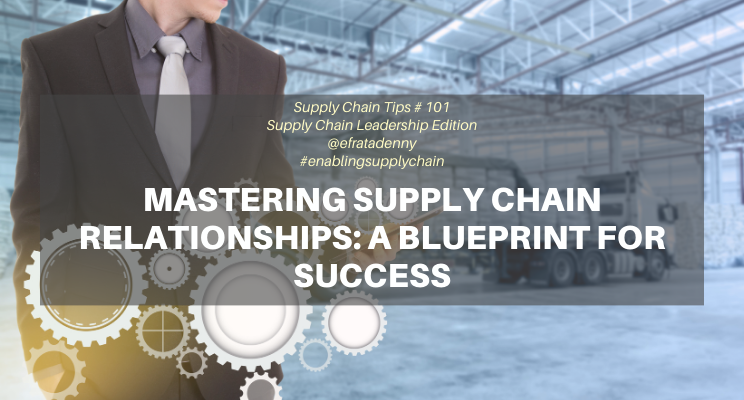
Mastering Supply Chain Relationships: A Blueprint for Success

Posted by efratadenny on 25 November 2023
Posted in: Leadership, Supply Chain. Tagged: Leadership, Supply Chain, Supply Chain Leadership, Supply Chain Management. Leave a comment

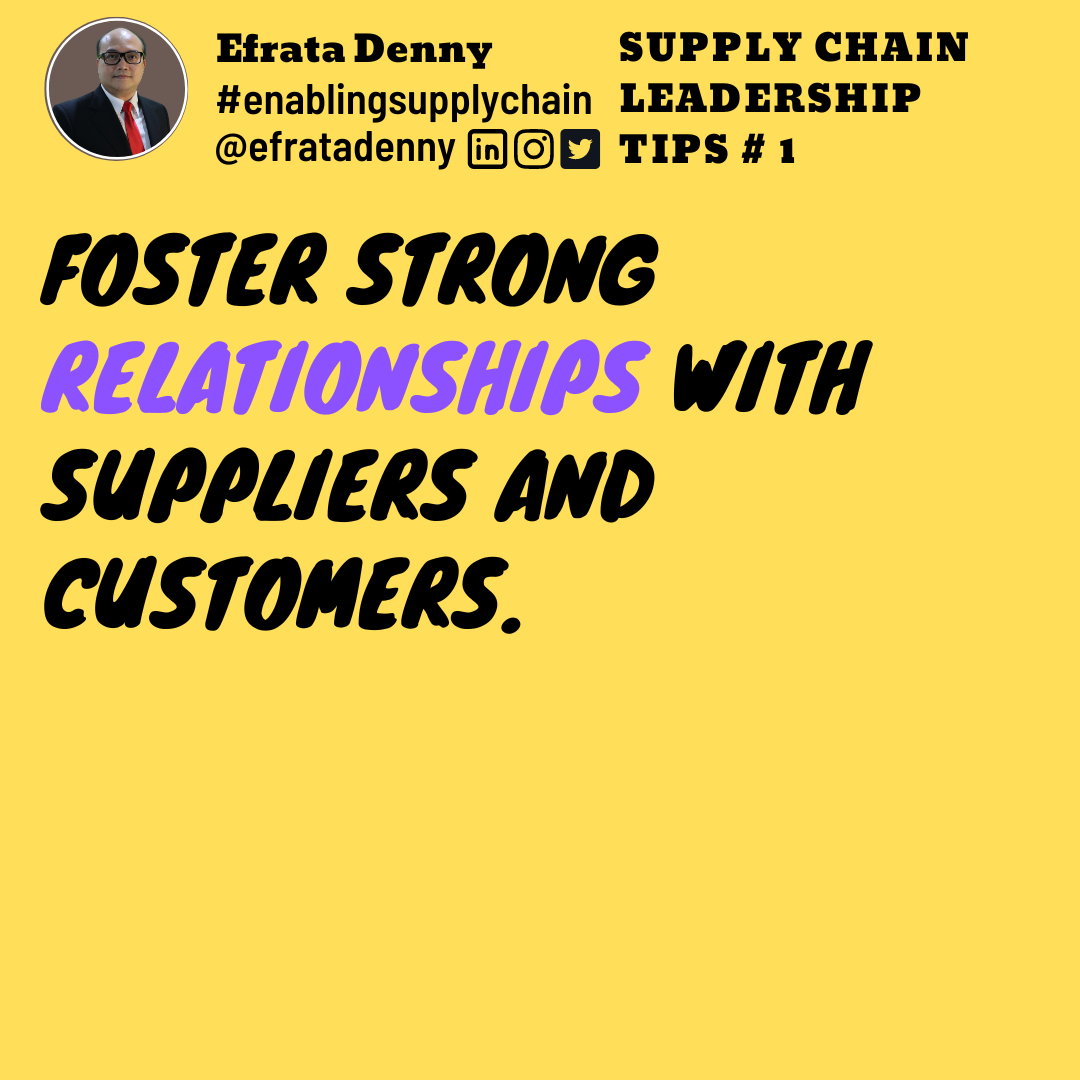
“Foster strong relationships with suppliers and customers.” – Efrata Denny

In the fast-paced world of supply chain leadership, success isn’t just about efficient logistics and cost-effective operations. It’s about building and nurturing strong relationships with both your suppliers and customers. These relationships form the very bedrock upon which your supply chain success is built. Here, we present some invaluable tips on how to foster better connections in the world of supply chain management.

1. Communication is key!

In any relationship, be it personal or professional, communication is the cornerstone. Regularly engaging with your suppliers and customers allows you to truly understand their needs and expectations. Open lines of communication foster trust, transparency, and a deeper connection.

2. Be proactive in addressing issues.

Problems are bound to arise, but proactive leadership is about taking the initiative to resolve these issues swiftly and effectively. By demonstrating your commitment to solving problems, you build and maintain trust with your supply chain partners.

3. Build partnerships based on mutual respect and transparency.

The best relationships are built on a foundation of mutual respect and transparency. Collaborate closely with your partners to achieve shared goals. By sharing insights, data, and plans openly, you create an environment of trust and cooperation.

4. Show appreciation for their contributions.

Never underestimate the power of a simple “thank you.” Recognize and acknowledge the efforts of your suppliers and customers. Celebrate successes together, and show gratitude for their role in your supply chain ecosystem.

5. Develop a win-win mindset.

Instead of zero-sum thinking, aim for win-win solutions. Seek strategies and collaborations that benefit all parties involved. When everyone sees value in the partnership, it becomes a sustainable, long-term relationship.

6. Be responsive and reliable.

In a world where speed and reliability are paramount, be the partner that can be counted on. Promptly address inquiries, concerns, and orders. Consistency builds trust over time.

7. Provide value-added support.

Go beyond the transactional aspects of your relationship. Offer your expertise, insights, and resources to help suppliers and customers succeed. When they see you as a partner in their growth, your relationship becomes invaluable.

8. Regularly evaluate and improve your relationship management practices.

Don’t rest on your laurels. Continuously evaluate and improve your relationship management strategies. Seek feedback from your partners and adapt your approach accordingly. The ability to evolve and grow together is a testament to a strong relationship.

Remember that strong relationships in supply chain leadership foster collaboration, innovation, and long-term success. These relationships are not just transactional; they’re the foundation upon which your supply chain excellence is built.
Share this:

  • Share on Facebook (Opens in new window) Facebook
  • Share on X (Opens in new window) X
  • Share on LinkedIn (Opens in new window) LinkedIn
  • Email a link to a friend (Opens in new window) Email
  • Share on Tumblr (Opens in new window) Tumblr
  • Share on Pinterest (Opens in new window) Pinterest
Like Loading...

Empowering Supply Chain Excellence through Continuous Learning and Improvement

Posted by efratadenny on 12 November 2023
Posted in: Management, Supply Chain. Tagged: enablingsupplychain, Management, Supply Chain, Supply Chain Management. Leave a comment

“Foster a culture of continuous learning and improvement by encouraging feedback and sharing best practices within your supply chain network.” – Efrata Denny

In the ever-evolving landscape of supply chain management, knowledge is the driving force behind excellence. To thrive in this dynamic environment, businesses must embrace a culture of continuous learning and improvement that permeates every corner of the supply chain network. By fostering an environment where feedback is valued, best practices are shared, and creativity is encouraged, organizations can harness the collective intelligence of their partners to fuel growth and innovation.

The Value of Continuous Learning and Improvement

A culture of continuous learning and improvement is a cornerstone of supply chain success. It’s more than just a catchphrase; it’s a mindset that propels businesses to stay ahead of the curve and remain agile in the face of challenges. When each participant in the supply chain network is committed to ongoing learning, a powerful synergy is created that benefits everyone involved.

Advantages of a Culture of Continuous Learning

  1. Exchange of Ideas and Knowledge Sharing: When partners collaborate and share their expertise, the entire network benefits from a diverse range of insights. Different perspectives can spark innovation and lead to creative solutions that drive the supply chain forward.
  2. Identification and Adoption of Best Practices: Continuous learning ensures that the latest industry trends and best practices are integrated into the network’s operations. This proactive approach enhances efficiency and effectiveness, leading to optimized processes and improved performance.
  3. Continuous Improvement: Supply chain processes are complex and multifaceted. A commitment to ongoing learning allows partners to identify bottlenecks, streamline workflows, and fine-tune operations for maximum efficiency.
  4. Nurturing a Collaborative Environment: When partners openly share knowledge and best practices, a sense of camaraderie and mutual support emerges. This collaborative environment fosters strong relationships that contribute to the network’s overall success.
  5. Inspiring Creativity and Adaptability: Learning is the foundation of adaptability. In a rapidly changing business landscape, the ability to adapt to new technologies, market trends, and consumer behaviors is crucial. Continuous learning ensures that the supply chain network is well-equipped to tackle whatever challenges arise.

Cultivating a Culture of Continuous Learning

Creating a culture of continuous learning and improvement doesn’t happen overnight; it requires deliberate effort and commitment from all stakeholders. Here are some strategies to foster this culture within your supply chain network:

  1. Encourage Open Communication: Establish channels for partners to communicate openly and share their experiences, challenges, and successes. This transparency fosters a sense of trust and collaboration.
  2. Recognize and Reward Innovation: Celebrate instances of innovation and improvement within the network. Recognizing and rewarding such efforts encourages others to contribute their ideas as well.
  3. Provide Learning Opportunities: Offer workshops, webinars, and training sessions that address the latest trends and challenges in supply chain management. Providing access to knowledge empowers partners to stay informed and engaged.
  4. Promote Cross-functional Collaboration: Encourage partners from different areas of the supply chain to collaborate on projects. Cross-functional collaboration broadens perspectives and encourages the exchange of diverse ideas.
  5. Lead by Example: Organizations at the core of the supply chain network can set the tone by demonstrating a commitment to continuous learning. When partners see leaders valuing learning, they are more likely to follow suit.

In a world of constant change, a culture of continuous learning and improvement is the compass that guides the supply chain network toward success. By nurturing this culture, businesses can unlock the full potential of their partners, drive innovation, and position themselves as leaders in the industry. Let’s embrace the power of knowledge and embark on a journey of growth and excellence together.

Share this:

  • Share on Facebook (Opens in new window) Facebook
  • Share on X (Opens in new window) X
  • Share on LinkedIn (Opens in new window) LinkedIn
  • Email a link to a friend (Opens in new window) Email
  • Share on Tumblr (Opens in new window) Tumblr
  • Share on Pinterest (Opens in new window) Pinterest
Like Loading...

Elevating Supply Chain Excellence Through Continuous Evaluation of Partners

Posted by efratadenny on 11 November 2023
Posted in: Management, Supply Chain. Tagged: enablingsupplychain, Management, Supply Chain, Supply Chain Management. Leave a comment

“Implement a continuous evaluation process for your supply chain partners to ensure they meet your business requirements.” – Efrata Denny

In the complex and interconnected landscape of modern supply chains, partnerships with suppliers and vendors play a pivotal role in determining the success of an organization. Establishing and maintaining a network of reliable and aligned supply chain partners is essential for ensuring the smooth flow of goods, services, and information. One of the key strategies that organizations can implement to sustain these partnerships and drive excellence is the continuous evaluation of their supply chain partners.

The Essence of Alignment

Alignment between an organization and its supply chain partners is crucial for achieving shared goals and objectives. Without proper alignment, miscommunication, inefficiencies, and even disruptions can arise, affecting the overall performance of the supply chain. By implementing a continuous evaluation process, businesses can ensure that their partners remain in sync with their business requirements, processes, and strategies.

Implementing a Continuous Evaluation Process

The continuous evaluation process involves regularly assessing and reviewing the performance, practices, and capabilities of supply chain partners. This evaluation goes beyond a one-time assessment and strives to foster ongoing alignment and improvement. Here’s how an organization can implement such a process:

  1. Clear Business Requirements: Establish clear and well-defined business requirements that reflect the organization’s strategic objectives. These requirements should serve as a benchmark for evaluating the performance of supply chain partners.
  2. Metrics and Key Performance Indicators (KPIs): Define metrics and KPIs that are aligned with the business requirements. These metrics can include on-time delivery, product quality, responsiveness, and innovation capabilities.
  3. Regular Assessment: Conduct regular assessments of supply chain partners’ performance against the defined metrics and KPIs. These assessments can occur monthly, quarterly, or annually, depending on the nature of the partnership and the industry’s dynamics.
  4. Feedback and Improvement: Share the assessment results with supply chain partners and collaborate on identifying areas for improvement. Constructive feedback can drive continuous improvement efforts and help partners align better with business requirements.
  5. Alignment Workshops: Organize workshops or meetings to discuss the results of the assessments, identify challenges, and explore opportunities for collaboration and innovation.
  6. Mutual Goal Setting: Set mutual goals and targets with supply chain partners to ensure that both parties are working together to achieve common objectives.

Advantages of Continuous Evaluation

Implementing a continuous evaluation process for supply chain partners offers several advantages:

  1. Ongoing Alignment: By regularly evaluating partners’ performance, an organization can ensure that its partners are consistently aligned with its business requirements and strategies.
  2. Identification of Improvement Areas: The evaluation process helps identify areas where supply chain partners can improve their practices, resulting in enhanced efficiency and effectiveness.
  3. Value Creation: Collaboration and open communication during the evaluation process can lead to the creation of new value-added solutions and innovative approaches.
  4. Strengthened Collaboration: Regular engagement through the evaluation process fosters strong relationships, trust, and open communication between organizations and their partners.
  5. Continuous Improvement: The evaluation process drives a culture of continuous improvement, as partners work together to address challenges and seize opportunities.
  6. Customer Satisfaction: Aligned partners contribute to improved customer satisfaction by ensuring timely and high-quality deliveries.
  7. Risk Mitigation: Identifying potential issues early allows organizations to proactively address them, reducing the risk of disruptions.

Nurturing Excellence and Partnership

In conclusion, implementing a continuous evaluation process for supply chain partners is a strategic approach to achieving and sustaining excellence. By fostering ongoing alignment, collaboration, and improvement, organizations can optimize their supply chain operations, enhance customer satisfaction, and create a resilient ecosystem that adapts to the ever-changing demands of the market. Through mutual commitment and the pursuit of shared objectives, businesses and their supply chain partners can elevate the supply chain’s performance and thrive in a competitive global landscape.

Share this:

  • Share on Facebook (Opens in new window) Facebook
  • Share on X (Opens in new window) X
  • Share on LinkedIn (Opens in new window) LinkedIn
  • Email a link to a friend (Opens in new window) Email
  • Share on Tumblr (Opens in new window) Tumblr
  • Share on Pinterest (Opens in new window) Pinterest
Like Loading...

Building Resilient Supplier Networks: The Power of Comprehensive Supplier Risk Assessment

Posted by efratadenny on 10 November 2023
Posted in: Management, Supply Chain. Tagged: enablingsupplychain, Management, Supply Chain, Supply Chain Management. Leave a comment

“Develop a robust supplier risk assessment framework to evaluate the financial stability and reliability of suppliers.” – Efrata Denny

In the dynamic landscape of supply chain management, the strength of your supplier network can make or break your business’s success. The advent of globalization and interconnected economies has underscored the importance of supplier reliability and financial stability. An organization’s supplier base is its lifeline, providing the raw materials, components, and services that keep the engine of commerce running. In such a scenario, mitigating supplier risks and ensuring their financial health is no longer an option—it’s a necessity.

The Need for a Comprehensive Supplier Risk Assessment Framework

In a world where disruptions can arise from unexpected corners, developing a robust supplier risk assessment framework is the cornerstone of proactive supply chain management. This framework goes beyond a cursory glance at potential suppliers; it involves a comprehensive evaluation of their financial stability, reliability, and resilience. This multifaceted approach enables organizations to make informed decisions about supplier partnerships, reducing the risk of disruptions, and fostering a network of partners that can weather storms together.

Advantages of a Supplier Risk Assessment Framework

  1. Evaluation of Financial Health: Understanding the financial stability of suppliers is crucial. A solid supplier risk assessment framework dives deep into financial metrics, providing insights into their creditworthiness, liquidity, and overall fiscal health.
  2. Identifying Potential Risks: A comprehensive assessment takes into account various risk factors that could impact supplier reliability. These factors can range from geopolitical issues to market volatility and beyond.
  3. Supply Chain Continuity: With a robust risk assessment framework, organizations can better prepare for potential disruptions. This leads to improved supply chain continuity planning and the ability to react swiftly to unexpected events.
  4. Enhanced Supplier Selection: Armed with data-driven insights, organizations can make smarter decisions when it comes to selecting suppliers. A reliable supplier contributes to a seamless supply chain, reduced lead times, and overall operational efficiency.
  5. Strengthened Resilience: Ultimately, a well-structured supplier risk assessment framework contributes to the overall resilience of the supply chain. By aligning with reliable partners, businesses can maintain operations even in the face of challenges.

Choose Wisely, Thrive Eternally

In the complex web of global trade and supply chain dynamics, building a resilient supplier network is not just prudent—it’s a strategic imperative. Developing and implementing a robust supplier risk assessment framework empowers organizations to make choices based on data, analysis, and a clear understanding of potential risks. As businesses continue to navigate an ever-evolving landscape, the ability to choose suppliers wisely and ensure their stability will be a defining factor in long-term success. In a world where disruptions are inevitable, fortifying your supplier network through a comprehensive risk assessment framework is the key to thriving in any circumstance.

Share this:

  • Share on Facebook (Opens in new window) Facebook
  • Share on X (Opens in new window) X
  • Share on LinkedIn (Opens in new window) LinkedIn
  • Email a link to a friend (Opens in new window) Email
  • Share on Tumblr (Opens in new window) Tumblr
  • Share on Pinterest (Opens in new window) Pinterest
Like Loading...

Fostering Growth and Accountability: The Art of Supplier Performance Reviews in Supply Chain Excellence

Posted by efratadenny on 9 November 2023
Posted in: Management, Supply Chain. Tagged: enablingsupplychain, Management, Supply Chain, Supply Chain Management. Leave a comment

“Conduct regular supplier performance reviews to identify opportunities for improvement and drive accountability.” – Efrata Denny

In the intricate tapestry of supply chain management, success is often woven from strong partnerships, impeccable performance, and a commitment to continuous improvement. At the heart of this endeavor lies the vital practice of conducting regular supplier performance reviews. These reviews serve as a dynamic tool that not only evaluates supplier performance but also fuels growth, nurtures accountability, and propels supply chain excellence to greater heights.

In a landscape where supply chains are more interconnected and interdependent than ever before, the significance of supplier relationships cannot be overstated. Suppliers are not just vendors; they are strategic partners who contribute to the seamless functioning of the supply chain ecosystem. Thus, fostering these relationships with mutual respect and a shared commitment to excellence is paramount.

The Power of Supplier Performance Reviews

Supplier performance reviews are a proactive measure that empowers organizations to assess and enhance the performance of their suppliers. These reviews are not intended to be critical evaluations but rather collaborative dialogues aimed at achieving mutual goals. When conducted systematically and consistently, supplier performance reviews can yield a plethora of advantages that ripple through the entire supply chain:

  • Objective Evaluation: Supplier performance reviews provide an objective framework to assess various aspects of supplier performance, including quality, reliability, and responsiveness. They help in gauging whether suppliers are meeting the pre-established standards and aligning with the organization’s objectives.
  • Identification of Improvement Opportunities: Every review is an opportunity to identify areas for improvement and innovation. These insights can range from process efficiencies and quality enhancements to cost-saving measures that benefit both parties. A culture of continuous improvement is nurtured through the dialogue that stems from these reviews.
  • Strengthened Relationships: Open and honest communication is the cornerstone of strong relationships. Supplier performance reviews facilitate this by creating a platform for transparent discussions. A two-way conversation, where challenges are acknowledged and successes are celebrated, paves the way for a resilient and productive partnership.
  • Accountability and Alignment: Regular reviews infuse a sense of accountability into the supplier relationship. When suppliers understand that their performance is consistently evaluated, they are more likely to align their practices with the organization’s expectations. This accountability ripples throughout the supply chain, enhancing overall performance.
  • Strategic Synchronization: Supplier performance reviews contribute to strategic synchronization, ensuring that suppliers’ efforts are harmoniously aligned with the organization’s strategic goals. This alignment fuels progress and shared success.

Conducting Effective Supplier Performance Reviews

The effectiveness of supplier performance reviews lies in their structure, frequency, and transparency. Here are some key considerations to ensure that these reviews drive excellence:

  • Clear Metrics: Define clear performance metrics that align with your organization’s objectives. These metrics should be quantifiable and measurable, allowing both parties to objectively evaluate performance.
  • Regular Cadence: Regularity is crucial. Set a schedule for these reviews that strikes the right balance between staying informed and not overwhelming the supplier. Quarterly or bi-annual reviews are common, but the frequency can vary based on the nature of the relationship and the industry.
  • Collaborative Approach: Approach these reviews as collaborative discussions rather than evaluations. Create an environment where both parties can openly discuss challenges, achievements, and ideas for improvement.
  • Actionable Insights: The outcome of these reviews should be actionable insights. Identify specific areas where improvement is needed and work together to create action plans that address these areas.
  • Transparency and Feedback: Transparency is key to building trust. Be open about your organization’s expectations, and encourage the same from the supplier. Provide constructive feedback that highlights both strengths and areas for growth.

The Path Forward

As supply chains continue to evolve and navigate the complexities of a global marketplace, supplier relationships play a pivotal role in determining success. Implementing regular supplier performance reviews is not just a best practice; it’s a strategic imperative. By fostering growth, nurturing accountability, and driving continuous improvement, these reviews empower organizations to build resilient supply chains that are agile, innovative, and poised for success. Through collaboration and a commitment to excellence, supplier performance reviews become a powerful catalyst for supply chain excellence.

In the end, it’s not just about supplier performance; it’s about propelling the entire supply chain toward a brighter future—one built on trust, partnership, and the relentless pursuit of excellence. As we embrace the power of supplier performance reviews, we embark on a journey that transforms challenges into opportunities and paves the way for mutual success in the dynamic landscape of supply chain management.

Share this:

  • Share on Facebook (Opens in new window) Facebook
  • Share on X (Opens in new window) X
  • Share on LinkedIn (Opens in new window) LinkedIn
  • Email a link to a friend (Opens in new window) Email
  • Share on Tumblr (Opens in new window) Tumblr
  • Share on Pinterest (Opens in new window) Pinterest
Like Loading...

Posts navigation

← Older Entries
Newer Entries →
  • Yes You Can Search

  • Yes This is Calendar

    January 2026
    M T W T F S S
     1234
    567891011
    12131415161718
    19202122232425
    262728293031  
    « Sep    
  • Yes These are Archives

  • Yes Recent Posts

    • The Future of Supply Chain: How AI and Automation Are Revolutionizing the Industry
    • Top 10 Supply Chain Innovations to Watch in 2024
    • The Rise of Sustainable Supply Chains: Why Going Green is Now a Business Imperative
    • The Great Debate: Centralized vs. Decentralized Supply Chains—Which is Better for 2024?
    • The Paradox of Supply Chain and Logistics
    • Agility Unleashed: The Power of Continuous Evaluation in Procurement Strategy
    • Cost Clarity: Mastering Total Cost of Acquisition for Procurement Excellence
    • Strategic Sourcing Mastery: Unleashing Procurement Excellence through Consolidated Purchasing
    • Unleashing Operational Excellence Through Just-in-Time (JIT) Inventory Management
    • Revolutionizing Procurement: The Strategic Impact of Harnessing Reverse Auctions for Maximum Cost Savings
  • Yes Follow Me

    Post a Day 2012 Twitter EfrataDenny
  • Yes This is My Twitter

    Tweets by efratadenny
  • Yes Advertising

    Roppopo.com
  • Yes This is Category

    Australia Bali Bandung China Collection Food France Indonesia Intermezzo Jakarta Kraft Foods Leadership Lighting Experiences Liquidart Manado Management Model Online Store Photography Portfolio Press Procurement Still Life Supply Chain Sustainability Traveling Underwater Wines Yes This is Me
  • Enter your email address to follow this blog and receive notifications of new posts by email.

    Join 986 other subscribers
  • Flickr Photos

    Last Supper Wood EngravingChristmas SockChristmas Bell
    More Photos
  • Recent Comments

    Bogdan Kolos's avatarBogdan Kolos on The Power of Strong Supplier R…
    Reighne Sq's avatarReighne Sq on Weekly Photo Challenge: One Sh…
    Shubham's avatarShubham on Long Tail and Short Tail Red…
    Terrence M's avatarTerrence M on Fettuccine Carbonara
    Ivan's avatarIvan on Maria Clara Sangria Red W…
    wahyu jatmiko krisdiyanto's avatarwahyu jatmiko krisdi… on Mie Bakso
    Weekly Photo Challen… on Weekly Photo Challenge: F…
    bali ratih's avatarbali ratih on Diving at Benoa
    Berita Hari Ini's avatarBerita Hari Ini on Miss Indonesia will increase W…
    geraldine's avatargeraldine on Maria Clara Sangria Red W…
    Chika Lesmana's avatarChika Lesmana on Shanghai Ice
    Chika Lesmana's avatarChika Lesmana on Shanghai Ice
    ipah kholipah's avataripah kholipah on Shanghai Ice
    Evi's avatarEvi on Platinum Hill Limited Edition…
    renxkyoko's avatarrenxkyoko on Sirloin Steak
  • Yes Page Info

    Yahoo bot last visit Msn bot last visit Google PageRank Checker

    The best of travel stories in and around Singapore TravelerVoice Bloggers - Meet Millions of Bloggers Personal Blogs visitor counters
  • Yes Facebook

    Yes Facebook
Blog at WordPress.com.
Efrata Denny
Blog at WordPress.com.
Privacy & Cookies: This site uses cookies. By continuing to use this website, you agree to their use.
To find out more, including how to control cookies, see here: Cookie Policy
  • Subscribe Subscribed
    • Efrata Denny
    • Join 966 other subscribers
    • Already have a WordPress.com account? Log in now.
    • Efrata Denny
    • Subscribe Subscribed
    • Sign up
    • Log in
    • Report this content
    • View site in Reader
    • Manage subscriptions
    • Collapse this bar
 

Loading Comments...
 

    %d