Efrata Denny

Personal Blog contains Wines, Foods, Traveling, and Photography

  • Home
  • All About Me
    • Yes This is Me
    • Private Message
    • Guest Book
    • Collection
      • Cigars
      • IntermezZo
      • Liquors
      • Sketch
      • Zombie Story
    • Friends
    • Portfolio
      • Kraft Foods
      • Arnott’s
      • Glaxo Smith Kline
      • Online Store
    • Press
  • Wines
    • Argentina
    • Australia
    • Austria
    • Chile
    • France
    • Indonesia
    • Israel
    • Italia
    • Portugal
    • South Africa
    • Spain
    • USA
    • Vietnam
  • Food
  • Traveling
    • Australia
    • China
    • Hong Kong
    • Indonesia
    • Macau
    • Malaysia
    • Philippines
    • Singapore
    • Thailand
    • Vietnam
  • Photography
    • Model
    • Still Life
    • Liquidart
    • Underwater
  • Awards
  • Supply Chain
    • Sustainability
    • Workshop

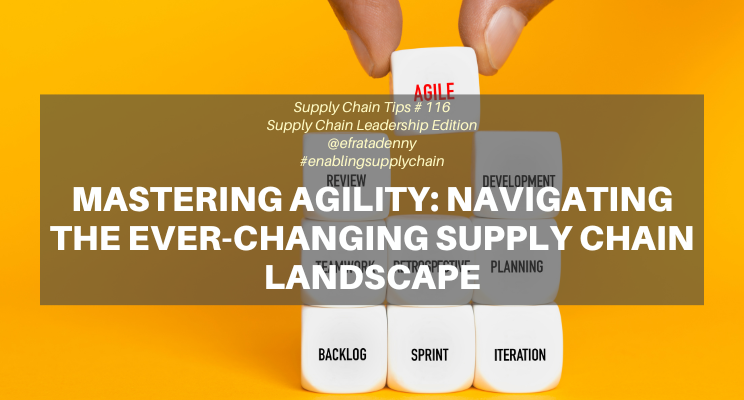
Mastering Agility: Navigating the Ever-Changing Supply Chain Landscape

Posted by efratadenny on 10 December 2023
Posted in: Leadership, Supply Chain. Tagged: enablingsupplychain, Leadership, Supply Chain, Supply Chain Leadership, Supply Chain Management. Leave a comment

“Stay agile and adaptable to changing market conditions.” – Efrata Denny

In the fast-paced realm of supply chain leadership, where market conditions can shift in the blink of an eye, agility is the secret to not only surviving but thriving. This article delves into essential strategies for staying agile and adaptable in the face of ever-changing market dynamics. By fostering a culture of agility, staying informed about market trends, and leveraging technology for real-time insights, supply chain leaders can navigate uncertainties, seize growth opportunities, and achieve lasting success.

1. Cultivating a Culture of Agility

At the heart of supply chain agility is a mindset that embraces change, innovation, and continuous improvement. Encouraging a culture of agility within your organization is the first step to staying responsive and adaptable. Embrace the idea that change can lead to progress and that agility is the cornerstone of your supply chain’s resilience.

2. Keeping an Eye on Market Trends

Staying well-informed about market conditions, customer demands, and emerging industry trends is vital. By regularly monitoring these factors, supply chain leaders can anticipate changes and prepare for shifts in the market, ensuring they remain one step ahead of competitors.

3. Embracing Flexible Planning and Forecasting

Static planning processes are a thing of the past. Agile planning allows for quick adjustments based on market dynamics. Explore the benefits of flexible planning and forecasting to align your strategies with the ever-evolving market conditions.

4. Cultivating Strong Supplier Relationships

Strong partnerships with suppliers are essential for flexibility and responsiveness. Collaborative relationships promote adaptability in meeting changing needs. Learn how building strong supplier relationships is key to supply chain success.

5. Leveraging Technology for Real-Time Insights

In today’s digital age, technology provides real-time visibility into your supply chain. Data analytics, artificial intelligence, and predictive tools are your allies in making informed decisions. Discover how technology can be harnessed to enhance agility.

6. Encouraging Cross-Functional Collaboration

Collaboration among different departments is essential for quick decision-making and adaptability. Encouraging cross-functional collaboration breaks down silos and paves the way for streamlined processes and greater agility.

7. Investing in Workforce Agility

A workforce armed with the skills needed to adapt to changing demands is your most valuable asset. Investing in workforce agility through training and development ensures your team is prepared to respond effectively to evolving challenges.

8. Embracing Lean Principles

Lean principles emphasize streamlining processes, reducing waste, and optimizing efficiency. Implementing these principles can enhance agility and responsiveness, resulting in a more efficient supply chain.

9. Staying Connected with Customers

Customer feedback is an invaluable resource for staying adaptable. Actively listening to customers, understanding their evolving needs, and adjusting your strategies accordingly is the path to customer-centric agility.

10. Continuously Evaluating and Adjusting Strategies

A commitment to regularly assess the effectiveness of your approaches is crucial. Be willing to make changes as needed, as this approach will help you fine-tune your strategies in real-time.

By embracing agility and adaptability, supply chain leaders can effectively navigate market uncertainties and seize opportunities for growth and success. This article offers a comprehensive guide to mastering agility in the supply chain and empowers leaders to navigate the ever-changing business landscape with confidence and success.
Share this:

  • Share on Facebook (Opens in new window) Facebook
  • Share on X (Opens in new window) X
  • Share on LinkedIn (Opens in new window) LinkedIn
  • Email a link to a friend (Opens in new window) Email
  • Share on Tumblr (Opens in new window) Tumblr
  • Share on Pinterest (Opens in new window) Pinterest
Like Loading...

Mastering Digital Transformation: Key Strategies for Supply Chain Efficiency

Posted by efratadenny on 9 December 2023
Posted in: Leadership, Supply Chain. Tagged: enablingsupplychain, Leadership, Supply Chain, Supply Chain Leadership, Supply Chain Management. Leave a comment

“Embrace automation and digitalization to streamline processes.” – Efrata Denny

In today’s rapidly evolving world of supply chain leadership, staying ahead of the curve means embracing the transformative power of technology. Automation and digitalization have become essential tools for unlocking efficiency, productivity, and competitiveness in the supply chain. In this article, we’ll explore ten valuable tips to help supply chain professionals harness the full potential of automation and digitalization for streamlined processes, enhanced visibility, and improved decision-making.

1. Automate the Mundane

One of the first steps in embracing automation is identifying and automating repetitive and time-consuming tasks that can be streamlined through technology. Tasks like data entry, order processing, and inventory management are prime candidates for automation.

2. Invest in Supply Chain Management Software

Advanced supply chain management software solutions can revolutionize your operations. These systems provide end-to-end visibility, enabling better decision-making and smoother processes.

3. Rethink Routine with RPA

Robotic Process Automation (RPA) is a game-changer. It allows software robots to take on routine tasks, freeing up your team to focus on strategic endeavors.

4. Seamless Integration

Efficiency thrives on data connectivity. Ensure that your various platforms and systems are integrated, enabling seamless data flow throughout your supply chain.

5. IoT for Real-Time Insights

Leverage the Internet of Things (IoT) with connected devices and sensors that provide real-time data on inventory, equipment performance, and environmental conditions.

6. Predictive Analytics as a Strategic Ally

Harness the power of predictive analytics to anticipate demand patterns, optimize inventory levels, and proactively address potential challenges before they become disruptions.

7. The Rise of Smart Warehouses

Smart warehouses equipped with technologies like RFID, automation, and machine learning can optimize warehouse operations, leading to improved order fulfillment and reduced costs.

8. Digital Collaboration is Key

Enable digital collaboration by utilizing platforms and tools that facilitate real-time communication and information sharing among supply chain partners.

9. Cloud-Based Solutions for Agility

Embrace cloud computing to enhance accessibility, scalability, and data security across your supply chain. Cloud-based solutions offer agility and flexibility.

10. Stay Informed about Emerging Technologies

Finally, it’s crucial to keep an eye on emerging technologies such as artificial intelligence, blockchain, and autonomous vehicles. These innovations might present new opportunities for improvement and optimization in your supply chain.

By integrating these tips into your supply chain strategy, you’ll embark on a digital transformation journey that promises enhanced efficiency, agility, and a competitive edge in today’s supply chain landscape. Embrace automation and digitalization to streamline processes and ensure that your supply chain remains agile and adaptable in a rapidly changing world.

Share this:

  • Share on Facebook (Opens in new window) Facebook
  • Share on X (Opens in new window) X
  • Share on LinkedIn (Opens in new window) LinkedIn
  • Email a link to a friend (Opens in new window) Email
  • Share on Tumblr (Opens in new window) Tumblr
  • Share on Pinterest (Opens in new window) Pinterest
Like Loading...

Sustainable Practices: The Cornerstone of Modern Supply Chain Leadership

Posted by efratadenny on 8 December 2023
Posted in: Leadership, Supply Chain. Tagged: enablingsupplychain, Leadership, Supply Chain, Supply Chain Leadership, Supply Chain Management. Leave a comment

“Implement sustainable and environmentally friendly practices.” – Efrata Denny

In the fast-paced and ever-evolving landscape of supply chain leadership, sustainability has become more than just a trend—it’s a necessity. As responsible stewards of the environment and global citizens, supply chain leaders are uniquely positioned to drive positive change. By adopting sustainable and environmentally friendly practices, we not only reduce our carbon footprint but also contribute to a greener, more sustainable future for generations to come. In this article, we will explore ten actionable strategies that can help supply chain professionals implement sustainability at the core of their operations.

1. Embrace a Circular Economy Mindset

A circular economy mindset entails minimizing waste and maximizing resource efficiency throughout your supply chain. It means thinking beyond the linear “take, make, dispose” model and finding innovative ways to reuse, refurbish, and recycle materials.

2. Optimize Transportation and Logistics

Transportation is a significant contributor to carbon emissions. By consolidating shipments, exploring eco-friendly transportation options (like electric vehicles or rail), and optimizing routes, you can reduce your supply chain’s carbon footprint.

3. Source Sustainably

Seek out suppliers who share your commitment to sustainability. Prioritize those who employ ethical sourcing practices and offer environmentally friendly materials. Collaboration with responsible suppliers can have a profound impact on your supply chain’s sustainability.

4. Reduce Packaging Waste

Packaging waste is a significant concern. To address it, minimize excessive packaging, explore alternatives like biodegradable materials, and promote recycling and reuse of packaging materials within your supply chain.

5. Encourage Energy Efficiency

Implement energy-saving measures in your facilities, promote the use of renewable energy sources, and invest in energy-efficient technologies. Reducing energy consumption not only lowers costs but also decreases your carbon footprint.

6. Promote Responsible Water Management

Water is a precious resource. Monitor water consumption, implement water-saving practices, and support initiatives for clean water access, both within your operations and among your suppliers.

7. Engage with Local Communities

Supply chains are integral to communities around the world. Support local initiatives, contribute to community development, and foster positive relationships with stakeholders. This not only enhances your reputation but also strengthens the social fabric of the regions you operate in.

8. Prioritize Ethical Labor Practices

Fair wages, safe working conditions, and respect for human rights are essential components of sustainability. Ensure these principles are upheld throughout your supply chain to create a more ethical and equitable world.

9. Foster Transparency and Traceability

Transparency builds trust. Promote transparency in your supply chain by providing visibility into sustainability practices and product origins. This helps consumers make informed choices and holds you accountable for your commitments.

10. Collaborate for Sustainable Innovation

Innovation is often a collective effort. Partner with suppliers, customers, and industry peers to drive innovation in sustainability. Collaborative problem-solving can lead to breakthroughs and sustainable solutions.

By implementing these strategies, supply chain leaders can make a tangible difference in the world. These actions not only align with global sustainability goals but also create a competitive advantage by reducing costs, increasing efficiency, and enhancing brand reputation. By sharing these strategies with your supply chain network, you can inspire others to join the journey towards a more sustainable and responsible future. Together, we can make a positive impact on the environment and society.

Share this:

  • Share on Facebook (Opens in new window) Facebook
  • Share on X (Opens in new window) X
  • Share on LinkedIn (Opens in new window) LinkedIn
  • Email a link to a friend (Opens in new window) Email
  • Share on Tumblr (Opens in new window) Tumblr
  • Share on Pinterest (Opens in new window) Pinterest
Like Loading...

Navigating the Supply Chain Maze: A Proactive Approach to Risk Management

Posted by efratadenny on 7 December 2023
Posted in: Leadership, Supply Chain. Tagged: enablingsupplychain, Leadership, Supply Chain, Supply Chain Leadership, Supply Chain Management. Leave a comment

“Understand and mitigate supply chain risks.” – Efrata Denny

In the world of supply chain leadership, proactive risk management isn’t just a choice; it’s the lifeline of success. This article delves into ten strategic steps that supply chain leaders can adopt to not only understand but also mitigate supply chain risks effectively. From conducting comprehensive risk assessments and building strong supplier relationships to leveraging technology, diversifying transportation modes, and investing in supply chain insurance, these strategies empower supply chain professionals to safeguard their operations against disruptions.

1. Comprehensive Risk Assessment

Kickstart your risk management journey by conducting a comprehensive risk assessment. Identify potential risks, including natural disasters, geopolitical events, and supplier disruptions, that could impact your supply chain.

2. Build Strong Supplier Relationships

Establish open lines of communication with your suppliers, perform regular audits, and diversify your supplier base to reduce dependency risks. Strong supplier relationships are your first line of defense.

3. Develop a Robust Business Continuity Plan

Create a robust business continuity plan outlining steps to be taken in the event of a disruption. Ensure that the plan is regularly updated and tested to maintain its effectiveness.

4. Monitor Key Performance Indicators (KPIs)

Establish and track KPIs to measure supplier performance, delivery times, inventory levels, and other critical factors. Monitoring KPIs helps in early risk identification.

5. Leverage Technology and Data Analytics

Embrace technology and data analytics tools that provide real-time insights into your supply chain operations. These tools empower proactive risk identification and mitigation.

6. Stay Informed about Geopolitical and Economic Factors

Keep a keen eye on global events and market trends that could impact your supply chain. Staying informed enables early risk assessment and strategic planning.

7. Diversify Transportation Modes

Consider using multiple transportation options to minimize disruptions caused by issues like capacity constraints or unforeseen circumstances.

8. Collaborate with Supply Chain Partners

Engage in open dialogue and coordination with supply chain partners. Collaborative risk mitigation strategies and the sharing of best practices strengthen the resilience of your supply chain.

9. Continuous Monitoring and Evaluation

Regularly review and assess potential risks, making adjustments as needed to ensure ongoing resilience. Risk management is an evolving process.

10. Invest in Supply Chain Insurance

Explore insurance options that can provide financial protection against unforeseen disruptions and mitigate potential losses. Insurance serves as a safety net in uncertain times.

By understanding and mitigating supply chain risks, we fortify our operations, ensuring resilience and stability even when faced with challenges. These strategies are valuable assets to share with your supply chain network, collectively strengthening operations against potential risks. In a world of uncertainty, proactive risk management is the key to supply chain stability and success.

In the ever-changing landscape of supply chain leadership, proactive risk management is not a luxury; it’s a necessity. These ten strategies empower supply chain leaders to navigate the complex maze of risks effectively, safeguarding their operations against disruptions. Share these strategies with your supply chain network, and together, we fortify the backbone of global commerce.

Share this:

  • Share on Facebook (Opens in new window) Facebook
  • Share on X (Opens in new window) X
  • Share on LinkedIn (Opens in new window) LinkedIn
  • Email a link to a friend (Opens in new window) Email
  • Share on Tumblr (Opens in new window) Tumblr
  • Share on Pinterest (Opens in new window) Pinterest
Like Loading...

The Path to Supply Chain Excellence: Fostering a Culture of Continuous Learning and Development

Posted by efratadenny on 6 December 2023
Posted in: Leadership, Supply Chain. Tagged: enablingsupplychain, Leadership, Supply Chain, Supply Chain Leadership, Supply Chain Management. Leave a comment

“Foster a learning environment and encourage professional development.” – Efrata Denny

In the fast-paced realm of supply chain leadership, the key to enduring success lies in fostering a culture of continuous learning and supporting professional development. This article unveils ten strategies that supply chain leaders can employ to create a dynamic learning environment, driving both personal and professional growth. From encouraging a growth mindset and providing learning opportunities to emphasizing cross-functional learning and staying informed about industry trends, these strategies empower supply chain teams to stay ahead in an ever-evolving landscape.

1. Embrace a Growth Mindset

Start by instilling the belief that learning and development are ongoing processes that lead to personal and professional growth. A growth mindset is the foundation of a learning culture.

2. Provide Diverse Learning Opportunities

Offer a variety of learning opportunities, including training programs, workshops, webinars, and conferences. This diverse range of options caters to different learning preferences and needs within your team.

3. Support Further Education

Encourage team members to pursue advanced degrees, certifications, or specialized courses related to supply chain management. Investing in education elevates the expertise within your team.

4. Establish Mentorship Programs

Connect experienced professionals with aspiring individuals through mentorship programs. This fosters knowledge sharing and career guidance, benefiting both mentors and mentees.

5. Promote Self-Directed Learning

Promote the use of online resources, books, and industry publications for self-improvement. Encourage team members to take ownership of their learning journey.

6. Allocate Dedicated Learning Time

Set aside dedicated time for employees to engage in learning activities. This ensures that continuous learning remains a priority in their daily work routines.

7. Recognize and Celebrate Learning Achievements

Acknowledge and celebrate individuals who actively pursue professional development and acquire new skills. Recognition reinforces the value of learning.

8. Foster a Collaborative Learning Environment

Encourage team members to share their knowledge, experiences, and best practices with one another. Collaboration enhances the collective learning experience.

9. Stay Informed about Industry Trends

Stay up-to-date with the latest advancements and emerging technologies in supply chain management. A deep understanding of industry trends is essential for informed decision-making.

10. Emphasize Cross-Functional Learning

Encourage team members to explore other areas of the supply chain. A holistic understanding of the entire process enhances problem-solving and innovation.

By fostering a learning environment and supporting professional development, supply chain leaders empower their teams to thrive and adapt in the ever-evolving supply chain landscape. Share these strategies with your supply chain network and collectively embrace a culture of continuous learning and growth. Together, we embark on a journey towards supply chain excellence.

In the world of supply chain leadership, continuous learning is not just a choice; it’s the cornerstone of excellence. Supply chain leaders who prioritize and invest in a culture of continuous learning and development create teams that are not only adaptable but also innovative, a vital asset in navigating the ever-evolving landscape of supply chain management.

Share this:

  • Share on Facebook (Opens in new window) Facebook
  • Share on X (Opens in new window) X
  • Share on LinkedIn (Opens in new window) LinkedIn
  • Email a link to a friend (Opens in new window) Email
  • Share on Tumblr (Opens in new window) Tumblr
  • Share on Pinterest (Opens in new window) Pinterest
Like Loading...

Posts navigation

← Older Entries
Newer Entries →
  • Yes You Can Search

  • Yes This is Calendar

    January 2026
    M T W T F S S
     1234
    567891011
    12131415161718
    19202122232425
    262728293031  
    « Sep    
  • Yes These are Archives

  • Yes Recent Posts

    • The Future of Supply Chain: How AI and Automation Are Revolutionizing the Industry
    • Top 10 Supply Chain Innovations to Watch in 2024
    • The Rise of Sustainable Supply Chains: Why Going Green is Now a Business Imperative
    • The Great Debate: Centralized vs. Decentralized Supply Chains—Which is Better for 2024?
    • The Paradox of Supply Chain and Logistics
    • Agility Unleashed: The Power of Continuous Evaluation in Procurement Strategy
    • Cost Clarity: Mastering Total Cost of Acquisition for Procurement Excellence
    • Strategic Sourcing Mastery: Unleashing Procurement Excellence through Consolidated Purchasing
    • Unleashing Operational Excellence Through Just-in-Time (JIT) Inventory Management
    • Revolutionizing Procurement: The Strategic Impact of Harnessing Reverse Auctions for Maximum Cost Savings
  • Yes Follow Me

    Post a Day 2012 Twitter EfrataDenny
  • Yes This is My Twitter

    Tweets by efratadenny
  • Yes Advertising

    Roppopo.com
  • Yes This is Category

    Australia Bali Bandung China Collection Food France Indonesia Intermezzo Jakarta Kraft Foods Leadership Lighting Experiences Liquidart Manado Management Model Online Store Photography Portfolio Press Procurement Still Life Supply Chain Sustainability Traveling Underwater Wines Yes This is Me
  • Enter your email address to follow this blog and receive notifications of new posts by email.

    Join 986 other subscribers
  • Flickr Photos

    Last Supper Wood EngravingChristmas SockChristmas Bell
    More Photos
  • Recent Comments

    Bogdan Kolos's avatarBogdan Kolos on The Power of Strong Supplier R…
    Reighne Sq's avatarReighne Sq on Weekly Photo Challenge: One Sh…
    Shubham's avatarShubham on Long Tail and Short Tail Red…
    Terrence M's avatarTerrence M on Fettuccine Carbonara
    Ivan's avatarIvan on Maria Clara Sangria Red W…
    wahyu jatmiko krisdiyanto's avatarwahyu jatmiko krisdi… on Mie Bakso
    Weekly Photo Challen… on Weekly Photo Challenge: F…
    bali ratih's avatarbali ratih on Diving at Benoa
    Berita Hari Ini's avatarBerita Hari Ini on Miss Indonesia will increase W…
    geraldine's avatargeraldine on Maria Clara Sangria Red W…
    Chika Lesmana's avatarChika Lesmana on Shanghai Ice
    Chika Lesmana's avatarChika Lesmana on Shanghai Ice
    ipah kholipah's avataripah kholipah on Shanghai Ice
    Evi's avatarEvi on Platinum Hill Limited Edition…
    renxkyoko's avatarrenxkyoko on Sirloin Steak
  • Yes Page Info

    Yahoo bot last visit Msn bot last visit Google PageRank Checker

    The best of travel stories in and around Singapore TravelerVoice Bloggers - Meet Millions of Bloggers Personal Blogs visitor counters
  • Yes Facebook

    Yes Facebook
Blog at WordPress.com.
Efrata Denny
Create a free website or blog at WordPress.com.
Privacy & Cookies: This site uses cookies. By continuing to use this website, you agree to their use.
To find out more, including how to control cookies, see here: Cookie Policy
  • Subscribe Subscribed
    • Efrata Denny
    • Join 966 other subscribers
    • Already have a WordPress.com account? Log in now.
    • Efrata Denny
    • Subscribe Subscribed
    • Sign up
    • Log in
    • Report this content
    • View site in Reader
    • Manage subscriptions
    • Collapse this bar
 

Loading Comments...
 

    %d