Efrata Denny

Personal Blog contains Wines, Foods, Traveling, and Photography

  • Home
  • All About Me
    • Yes This is Me
    • Private Message
    • Guest Book
    • Collection
      • Cigars
      • IntermezZo
      • Liquors
      • Sketch
      • Zombie Story
    • Friends
    • Portfolio
      • Kraft Foods
      • Arnott’s
      • Glaxo Smith Kline
      • Online Store
    • Press
  • Wines
    • Argentina
    • Australia
    • Austria
    • Chile
    • France
    • Indonesia
    • Israel
    • Italia
    • Portugal
    • South Africa
    • Spain
    • USA
    • Vietnam
  • Food
  • Traveling
    • Australia
    • China
    • Hong Kong
    • Indonesia
    • Macau
    • Malaysia
    • Philippines
    • Singapore
    • Thailand
    • Vietnam
  • Photography
    • Model
    • Still Life
    • Liquidart
    • Underwater
  • Awards
  • Supply Chain
    • Sustainability
    • Workshop

The Power of KPIs: Steering Your Supply Chain Towards Success

Posted by efratadenny on 20 December 2023
Posted in: Leadership, Supply Chain. Tagged: enablingsupplychain, Leadership, Supply Chain, Supply Chain Leadership, Supply Chain Management. Leave a comment

“Establish key performance indicators (KPIs) to measure success.” – Efrata Denny

In the dynamic realm of supply chain management, where efficiency, quality, and customer satisfaction are paramount, establishing clear and meaningful Key Performance Indicators (KPIs) is essential for measuring and enhancing success. These performance metrics serve as the compass guiding your supply chain operations toward strategic objectives and business goals. To help you navigate the complex landscape of supply chain KPIs, we’ve outlined some valuable tips to ensure your KPIs are both effective and relevant:

1. Align with Business Objectives

Your KPIs should form a direct and visible connection between your supply chain performance and the overarching business goals. This alignment ensures that every effort made within your supply chain contributes to your organization’s success.

2. Define Measurable and Specific Metrics

KPIs must be quantifiable and specific to be meaningful. Cover various aspects of your supply chain, such as cost, quality, delivery, customer satisfaction, and sustainability. Each KPI should provide a clear and unique insight into your performance.

3. Set Ambitious but Realistic Targets

KPIs should inspire continuous improvement. While setting ambitious targets, it’s crucial to keep them rooted in reality by considering historical data, industry benchmarks, and current market conditions.

4. Monitor KPIs in Real-Time

Thanks to technology and data analytics tools, you can now track your KPIs in real-time. This allows for proactive decision-making and quick interventions when deviations occur.

5. Establish a Balanced Scorecard Approach

A holistic set of KPIs is often more informative. By considering financial, operational, customer, and employee perspectives, you ensure that you’re not just excelling in one area at the expense of another.

6. Involve Stakeholders in KPI Selection

Don’t make KPI selection a solitary process. Collaborate with key stakeholders, including customers, suppliers, and internal teams. Their insights can help identify relevant KPIs and ensure everyone’s buy-in.

7. Conduct Regular Performance Reviews

Regular review of KPI performance is essential. It enables you to spot trends, identify the root causes of deviations, and take corrective actions to drive continuous improvement.

8. Communicate KPIs Across the Organization

Ensuring that all relevant stakeholders are aware of the KPIs, their targets, and the significance of their contributions to achieving supply chain success is vital. Transparency and understanding of the objectives are key to KPI effectiveness.

9. Foster a Culture of Accountability

Accountability is a cornerstone of KPI success. By encouraging ownership and responsibility at all levels of the organization, you empower individuals and teams to actively contribute to achieving KPI targets.

10. Continuously Refine and Evolve Your KPIs

The business world is in constant flux. Therefore, it’s imperative to assess the relevance and effectiveness of your KPIs regularly. Be open to adapting to changes in business priorities, market dynamics, and emerging industry trends.

By following these best practices in KPI establishment and utilization, you’ll not only measure success but also drive continuous improvement and operational excellence within your supply chain operations. In the era of rapidly evolving markets and customer expectations, the ability to adapt and excel is the key to a prosperous supply chain.

In the complex web of supply chain management, your ability to measure, understand, and enhance your performance through effective Key Performance Indicators is nothing short of indispensable. By applying these ten tips, you can craft a KPI strategy that aligns your supply chain with your broader business objectives, ensuring that every link in the chain contributes to your organization’s success. As you establish measurable, specific, and balanced KPIs and foster a culture of accountability, your supply chain’s capabilities will grow in efficiency, quality, and customer satisfaction, setting you on the path to continuous improvement and operational excellence.

Share this:

  • Share on Facebook (Opens in new window) Facebook
  • Share on X (Opens in new window) X
  • Share on LinkedIn (Opens in new window) LinkedIn
  • Email a link to a friend (Opens in new window) Email
  • Share on Tumblr (Opens in new window) Tumblr
  • Share on Pinterest (Opens in new window) Pinterest
Like Loading...

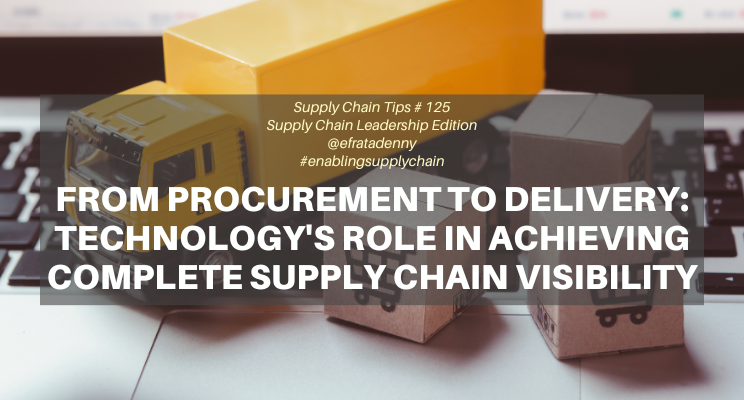
From Procurement to Delivery: Technology’s Role in Achieving Complete Supply Chain Visibility

Posted by efratadenny on 19 December 2023
Posted in: Leadership, Supply Chain. Tagged: enablingsupplychain, Leadership, Supply Chain, Supply Chain Leadership, Supply Chain Management. Leave a comment

“Leverage technology for end-to-end supply chain visibility.” – Efrata Denny

In today’s complex supply chain landscape, achieving end-to-end visibility is no longer a luxury but a strategic imperative. It’s the key to informed decision-making, optimized operations, and ultimately, ensuring customer satisfaction. The good news is that technology has opened the door to an era of unprecedented visibility, allowing supply chain professionals to track products, shipments, and processes at every stage, from procurement to delivery. In this article, we’ll explore how leveraging technology can help you achieve end-to-end supply chain visibility and why it matters.

1. A Robust Supply Chain Management System

It all begins with a robust supply chain management system. Think of it as the digital command center for your supply chain operations. With the right software solution, you can gain real-time visibility into all aspects of your supply chain, from procurement and production to inventory management and delivery. This comprehensive view provides a solid foundation for data-driven decision-making.

2. The Cloud Advantage

Cloud-based platforms are the backbone of modern supply chain visibility. They allow you to securely store and access supply chain data from anywhere, facilitating collaboration and transparency among stakeholders. This accessibility is especially crucial in today’s global supply chains, where partners and teams may be scattered across the world.

3. The Rise of IoT

The Internet of Things (IoT) has introduced a new level of granularity to supply chain visibility. With IoT devices such as sensors and trackers, you can collect and transmit data on a variety of parameters. From monitoring inventory levels in real time to tracking the location of shipments, IoT offers the real-time data needed to make proactive decisions.

4. Trust Through Blockchain

Blockchain technology has emerged as a game-changer for transparency in the supply chain. It offers secure and transparent record-keeping, enabling end-to-end traceability of products and transactions. With blockchain, you can build trust among supply chain partners and consumers, as every step of a product’s journey is recorded and immutable.

5. Actionable Insights Through Analytics

Data analytics and visualization tools provide the means to turn raw data into actionable insights. By analyzing supply chain data, you can identify trends, spot anomalies, and make informed decisions. These tools are a must-have for turning data into meaningful action.

6. Integration Is the Key

In the modern supply chain, data comes from various sources. It’s not just your supply chain management system; it’s your ERP, CRM, transportation management, and more. Integrating these data sources is essential to create a holistic view of your operations.

7. Collaboration in Real Time

Digital platforms for collaboration are another vital component of supply chain visibility. They allow you to connect with suppliers, customers, and logistics partners in real time. This real-time information exchange is crucial for responding to changes and challenges promptly.

8. Stay Ahead with Emerging Tech

The technology landscape is constantly evolving. Staying updated on emerging technologies like artificial intelligence, machine learning, and robotic process automation is essential. These technologies have the potential to further enhance supply chain visibility and efficiency.

9. Data Security Is Non-Negotiable

With great data comes great responsibility. Robust cybersecurity measures are essential to protect sensitive supply chain data. Ensuring data security and privacy not only preserves confidentiality but also ensures compliance with data protection regulations.

10. The Journey of Continuous Improvement

Technology is a dynamic field, and your technology stack should be too. Regularly evaluating the effectiveness of your technology solutions, identifying areas for improvement, and investing in innovative technologies is part of the journey toward end-to-end supply chain visibility.

In conclusion, end-to-end supply chain visibility is no longer a buzzword; it’s a necessity. By leveraging technology, you can not only survive but thrive in the complex world of supply chain management. Technology provides the tools for enhancing efficiency, reducing risks, and delivering superior customer experiences. It’s time to embark on a digital transformation journey and unlock the power of real-time visibility in your supply chain. The future is bright for those who can see it clearly.

Share this:

  • Share on Facebook (Opens in new window) Facebook
  • Share on X (Opens in new window) X
  • Share on LinkedIn (Opens in new window) LinkedIn
  • Email a link to a friend (Opens in new window) Email
  • Share on Tumblr (Opens in new window) Tumblr
  • Share on Pinterest (Opens in new window) Pinterest
Like Loading...

The Quality Quotient: Elevating Your Supply Chain Game

Posted by efratadenny on 18 December 2023
Posted in: Leadership, Supply Chain. Tagged: enablingsupplychain, Leadership, Supply Chain, Supply Chain Leadership, Supply Chain Management. Leave a comment

“Implement robust quality control processes.” – Efrata Denny

Quality control is the linchpin of any successful supply chain. Ensuring that your products meet or exceed the expected standards is not just good practice; it’s a business imperative. Quality control processes are designed to identify and rectify issues before they reach the customer, safeguarding product integrity, customer satisfaction, and your brand’s reputation. In a world where consumers are increasingly discerning, maintaining top-notch quality control is non-negotiable.

1. Setting Clear Quality Standards

The foundation of any quality control process is clear and unambiguous quality standards. These standards must not only meet regulatory requirements but also align with customer expectations. Communicating these standards effectively to suppliers, manufacturers, and your internal teams is a critical first step.

2. Establishing Comprehensive Inspection Procedures

Once the standards are in place, you need robust inspection procedures. This entails detailed protocols for evaluating product quality at every stage, from the acquisition of raw materials to the final product. The key is to leave no room for ambiguity in how to assess quality.

3. Conducting Regular Quality Audits

Regular quality audits are akin to health check-ups for your supply chain. Scheduled audits are essential to gauge adherence to quality standards, identify areas for improvement, and ensure compliance with industry regulations.

4. Implementing Statistical Process Control (SPC) Techniques

Modern quality control doesn’t just rely on visual inspections; it uses statistical techniques to monitor production processes. SPC helps in early detection of deviations from quality standards, thereby ensuring consistent quality.

5. Utilizing Technology for Quality Monitoring

Automation and technology have become invaluable assets in quality control. Vision systems, sensors, and data analytics offer increased accuracy and efficiency in monitoring and ensuring quality.

6. Training and Empowering Quality Control Personnel

Quality control teams are at the forefront of maintaining product integrity. They need training and resources to empower them to identify defects, analyze root causes, and take corrective actions.

7. Fostering Supplier Collaboration

Quality control isn’t just an internal affair. Collaborating with suppliers to establish quality requirements, conduct joint inspections, and drive continuous improvement in their processes is a strategic move to maintain high standards.

8. Implementing a Robust Non-Conformance Management System

When issues do arise, having a well-defined process to handle non-conforming products is essential. This process should cover identification, segregation, investigation, and resolution.

9. Encouraging Employee Involvement in Quality Improvement

Quality is everyone’s responsibility. Creating a culture where all employees are encouraged to report quality issues, suggest improvements, and actively participate in problem-solving helps maintain high standards.

10. Continuous Measurement and Analysis of Quality Performance

Lastly, quality control doesn’t end with processes in place. Continuous measurement of key quality metrics, such as defect rates, customer complaints, and return rates, is vital. It identifies trends and drives proactive improvements.

Implementing robust quality control processes is more than just a best practice; it’s an essential component of your supply chain’s success. Quality excellence is not only about producing flawless products; it’s about creating an environment where excellence is the standard. By ensuring that every product that leaves your facility meets or exceeds quality standards, you not only satisfy customers but also build a trusted reputation in the market. In an era where customer expectations are at an all-time high, a commitment to quality control is a commitment to success.

Share this:

  • Share on Facebook (Opens in new window) Facebook
  • Share on X (Opens in new window) X
  • Share on LinkedIn (Opens in new window) LinkedIn
  • Email a link to a friend (Opens in new window) Email
  • Share on Tumblr (Opens in new window) Tumblr
  • Share on Pinterest (Opens in new window) Pinterest
Like Loading...

Turning Innovation into Supply Chain Excellence

Posted by efratadenny on 17 December 2023
Posted in: Leadership, Supply Chain. Tagged: enablingsupplychain, Leadership, Supply Chain, Supply Chain Leadership, Supply Chain Management. Leave a comment

“Foster innovation and encourage creativity within the supply chain.” – Efrata Denny

In today’s ever-evolving business landscape, innovation isn’t just a buzzword; it’s a necessity for supply chain success. As supply chain leaders, we’re constantly tasked with finding new ways to improve efficiency, reduce costs, and meet the ever-changing demands of our customers. In this article, we’ll explore the importance of fostering innovation and encouraging creativity within your supply chain, providing you with practical tips to drive continuous improvement and gain a competitive edge.

1. The Innovation Imperative

Innovation and creativity aren’t merely nice-to-haves; they’re essential components of a thriving supply chain. In a rapidly changing world, the ability to adapt, think outside the box, and devise novel solutions is what sets top-tier supply chains apart. By fostering innovation, you not only stay ahead of the competition but also future-proof your operations.

2. Creating a Culture of Innovation

The first step in fostering innovation is creating a culture that encourages it. Your workplace should be a space where ideas are celebrated, and employees are empowered to think creatively. Encourage a mindset where no idea is too outlandish and where every member of your team feels they can make a valuable contribution. By valuing innovation, you set the stage for groundbreaking ideas to emerge.

3. Embracing Diversity and Collaboration

Innovation thrives in diverse and collaborative environments. Seek input from team members with different backgrounds, experiences, and perspectives. The unique insights they bring can spark creativity and fresh ideas. Encourage cross-functional teams where experts from various departments can share knowledge and develop novel solutions. Collaborative spaces are fertile grounds for innovation.

4. Building an Innovation Framework

Innovation doesn’t happen by chance; it needs structure. Define a clear process for innovation within your supply chain, from idea generation and evaluation to implementation and feedback loops. Having a structured framework ensures that innovative ideas are not lost in the hustle of day-to-day operations.

5. Providing Resources and Support

Innovation requires resources. Allocate budget, time, and tools to support innovation initiatives. Offer training and development opportunities to equip your team with the skills necessary for creative problem-solving. When your team has the resources they need, they’re better positioned to innovate.

6. Rewarding and Recognizing Creativity

Innovation should be celebrated. When individuals or teams contribute innovative ideas or implement creative solutions, be sure to acknowledge and reward their efforts. Recognizing creativity not only boosts morale but also encourages more of it.

7. Promoting Continuous Learning

Innovation doesn’t occur in a vacuum. Encourage your employees to stay updated on industry trends, emerging technologies, and best practices. A culture of ongoing learning and development can lead to groundbreaking discoveries.

8. Embracing Experimentation and Risk-Taking

Innovation often involves a degree of experimentation and risk. Create a safe environment for trying new approaches, learning from failures, and taking calculated risks. Not every idea will be a winner, but each can contribute to the learning process.

9. Fostering External Partnerships

Innovation often thrives when it’s exposed to external perspectives. Collaborate with external organizations, startups, or academic institutions to access fresh insights, technologies, and innovative ideas. External partnerships can provide a breath of fresh air for your innovation efforts.

10. Celebrating Successes and Sharing Learnings

Highlighting successful innovation stories within your organization can inspire others. Share lessons learned and create forums for knowledge sharing. Celebrating successes reinforces the importance of innovation and demonstrates its practical benefits.

Fostering innovation and encouraging creativity within your supply chain isn’t a one-time task; it’s an ongoing journey. By following these tips and creating a culture where innovation is valued, you’ll drive continuous improvement, adapt to changing market dynamics, and stay ahead of the competition. Embracing creativity and innovation isn’t just a choice; it’s a commitment to building a future-ready and dynamic supply chain.

Share this:

  • Share on Facebook (Opens in new window) Facebook
  • Share on X (Opens in new window) X
  • Share on LinkedIn (Opens in new window) LinkedIn
  • Email a link to a friend (Opens in new window) Email
  • Share on Tumblr (Opens in new window) Tumblr
  • Share on Pinterest (Opens in new window) Pinterest
Like Loading...

From Transactional to Transformational: The Role of Key Suppliers in Your Supply Chain

Posted by efratadenny on 16 December 2023
Posted in: Leadership, Supply Chain. Tagged: enablingsupplychain, Leadership, Supply Chain, Supply Chain Leadership, Supply Chain Management. Leave a comment

“Cultivate strategic partnerships with key suppliers.” – Efrata Denny

In the intricate web of supply chain management, the bonds you forge with key suppliers are the threads that hold it all together. These strategic partnerships form the backbone of a resilient and efficient supply chain. Building and nurturing these relationships is a dynamic and multifaceted process, one that requires careful planning, ongoing commitment, and shared vision.

1. Define Your Strategic Objectives

Before you embark on the journey of cultivating strategic partnerships, it’s crucial to clearly articulate your goals. What do you seek in a supplier partnership? What values and expectations are non-negotiable for your business? These questions form the foundation of your partnership.

2. Thorough Supplier Evaluations

Your suppliers are more than just transactional entities; they are your allies in delivering quality products and services. Before you commit to a partnership, assess your potential suppliers rigorously. Look at their capabilities, financial stability, quality standards, and crucially, their alignment with your business values.

3. Foster Open and Transparent Communication

Communication is the lifeblood of successful partnerships. Establish regular and open channels to discuss performance, challenges, and opportunities for improvement. Remember that this isn’t a one-way street – listening to your supplier’s concerns is just as important as expressing your own.

4. Share Information and Collaborate

Sharing is caring in the world of supplier partnerships. Provide suppliers with insights into your business plans, market trends, and customer demands. This enables proactive collaboration, helping both parties anticipate and address challenges.

5. Mutual Trust and Respect

Trust and integrity are the bedrock of strong partnerships. Build relationships that are based on trust, respect, and shared values. These relationships are what drive long-term partnerships that withstand the tests of time.

6. Seek Win-Win Outcomes

The best partnerships are those where both parties benefit. Collaborate with your suppliers to identify areas where both sides can gain, whether it’s cost savings, process improvements, or innovative ideas that propel your products or services to new heights.

7. Invest in Supplier Development

Your partnership should be a journey of growth for both parties. Support your suppliers through training, technology transfer, and process improvement initiatives to enhance their capabilities. This not only benefits your supplier but also bolsters the value they can provide you.

8. Regular Performance Reviews

Metrics are the compass that guides you in the right direction. Develop Key Performance Indicators (KPIs) and conduct regular performance reviews with your suppliers. Provide constructive feedback to drive continuous improvement.

9. Joint Initiatives and Innovation

Collaboration is where innovation blossoms. Partner with your suppliers on product development, sustainability initiatives, and market expansion strategies. The synergy between your capabilities and your supplier’s expertise creates a powerful competitive advantage.

10. Build Contingency Plans Together

Disruptions are an inevitable part of supply chain life. Building robust contingency plans together ensures that you and your supplier are on the same page in addressing potential disruptions, minimizing their impact, and ensuring business continuity.

Cultivating strategic partnerships with key suppliers is not merely about strengthening the links in your supply chain; it’s about driving innovation, delivering exceptional value to your customers, and future-proofing your supply chain’s success.

Share this:

  • Share on Facebook (Opens in new window) Facebook
  • Share on X (Opens in new window) X
  • Share on LinkedIn (Opens in new window) LinkedIn
  • Email a link to a friend (Opens in new window) Email
  • Share on Tumblr (Opens in new window) Tumblr
  • Share on Pinterest (Opens in new window) Pinterest
Like Loading...

Posts navigation

← Older Entries
Newer Entries →
  • Yes You Can Search

  • Yes This is Calendar

    January 2026
    M T W T F S S
     1234
    567891011
    12131415161718
    19202122232425
    262728293031  
    « Sep    
  • Yes These are Archives

  • Yes Recent Posts

    • The Future of Supply Chain: How AI and Automation Are Revolutionizing the Industry
    • Top 10 Supply Chain Innovations to Watch in 2024
    • The Rise of Sustainable Supply Chains: Why Going Green is Now a Business Imperative
    • The Great Debate: Centralized vs. Decentralized Supply Chains—Which is Better for 2024?
    • The Paradox of Supply Chain and Logistics
    • Agility Unleashed: The Power of Continuous Evaluation in Procurement Strategy
    • Cost Clarity: Mastering Total Cost of Acquisition for Procurement Excellence
    • Strategic Sourcing Mastery: Unleashing Procurement Excellence through Consolidated Purchasing
    • Unleashing Operational Excellence Through Just-in-Time (JIT) Inventory Management
    • Revolutionizing Procurement: The Strategic Impact of Harnessing Reverse Auctions for Maximum Cost Savings
  • Yes Follow Me

    Post a Day 2012 Twitter EfrataDenny
  • Yes This is My Twitter

    Tweets by efratadenny
  • Yes Advertising

    Roppopo.com
  • Yes This is Category

    Australia Bali Bandung China Collection Food France Indonesia Intermezzo Jakarta Kraft Foods Leadership Lighting Experiences Liquidart Manado Management Model Online Store Photography Portfolio Press Procurement Still Life Supply Chain Sustainability Traveling Underwater Wines Yes This is Me
  • Enter your email address to follow this blog and receive notifications of new posts by email.

    Join 986 other subscribers
  • Flickr Photos

    Last Supper Wood EngravingChristmas SockChristmas Bell
    More Photos
  • Recent Comments

    Bogdan Kolos's avatarBogdan Kolos on The Power of Strong Supplier R…
    Reighne Sq's avatarReighne Sq on Weekly Photo Challenge: One Sh…
    Shubham's avatarShubham on Long Tail and Short Tail Red…
    Terrence M's avatarTerrence M on Fettuccine Carbonara
    Ivan's avatarIvan on Maria Clara Sangria Red W…
    wahyu jatmiko krisdiyanto's avatarwahyu jatmiko krisdi… on Mie Bakso
    Weekly Photo Challen… on Weekly Photo Challenge: F…
    bali ratih's avatarbali ratih on Diving at Benoa
    Berita Hari Ini's avatarBerita Hari Ini on Miss Indonesia will increase W…
    geraldine's avatargeraldine on Maria Clara Sangria Red W…
    Chika Lesmana's avatarChika Lesmana on Shanghai Ice
    Chika Lesmana's avatarChika Lesmana on Shanghai Ice
    ipah kholipah's avataripah kholipah on Shanghai Ice
    Evi's avatarEvi on Platinum Hill Limited Edition…
    renxkyoko's avatarrenxkyoko on Sirloin Steak
  • Yes Page Info

    Yahoo bot last visit Msn bot last visit Google PageRank Checker

    The best of travel stories in and around Singapore TravelerVoice Bloggers - Meet Millions of Bloggers Personal Blogs visitor counters
  • Yes Facebook

    Yes Facebook
Blog at WordPress.com.
Efrata Denny
Create a free website or blog at WordPress.com.
Privacy & Cookies: This site uses cookies. By continuing to use this website, you agree to their use.
To find out more, including how to control cookies, see here: Cookie Policy
  • Subscribe Subscribed
    • Efrata Denny
    • Join 966 other subscribers
    • Already have a WordPress.com account? Log in now.
    • Efrata Denny
    • Subscribe Subscribed
    • Sign up
    • Log in
    • Report this content
    • View site in Reader
    • Manage subscriptions
    • Collapse this bar
 

Loading Comments...
 

    %d