Efrata Denny

Personal Blog contains Wines, Foods, Traveling, and Photography

  • Home
  • All About Me
    • Yes This is Me
    • Private Message
    • Guest Book
    • Collection
      • Cigars
      • IntermezZo
      • Liquors
      • Sketch
      • Zombie Story
    • Friends
    • Portfolio
      • Kraft Foods
      • Arnott’s
      • Glaxo Smith Kline
      • Online Store
    • Press
  • Wines
    • Argentina
    • Australia
    • Austria
    • Chile
    • France
    • Indonesia
    • Israel
    • Italia
    • Portugal
    • South Africa
    • Spain
    • USA
    • Vietnam
  • Food
  • Traveling
    • Australia
    • China
    • Hong Kong
    • Indonesia
    • Macau
    • Malaysia
    • Philippines
    • Singapore
    • Thailand
    • Vietnam
  • Photography
    • Model
    • Still Life
    • Liquidart
    • Underwater
  • Awards
  • Supply Chain
    • Sustainability
    • Workshop

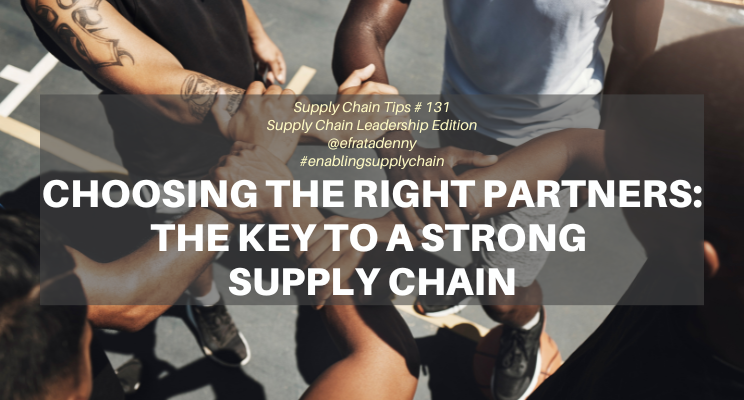
Choosing the Right Partners: The Key to a Strong Supply Chain

Posted by efratadenny on 25 December 2023
Posted in: Leadership, Supply Chain. Tagged: enablingsupplychain, Leadership, Supply Chain, Supply Chain Leadership, Supply Chain Management. Leave a comment

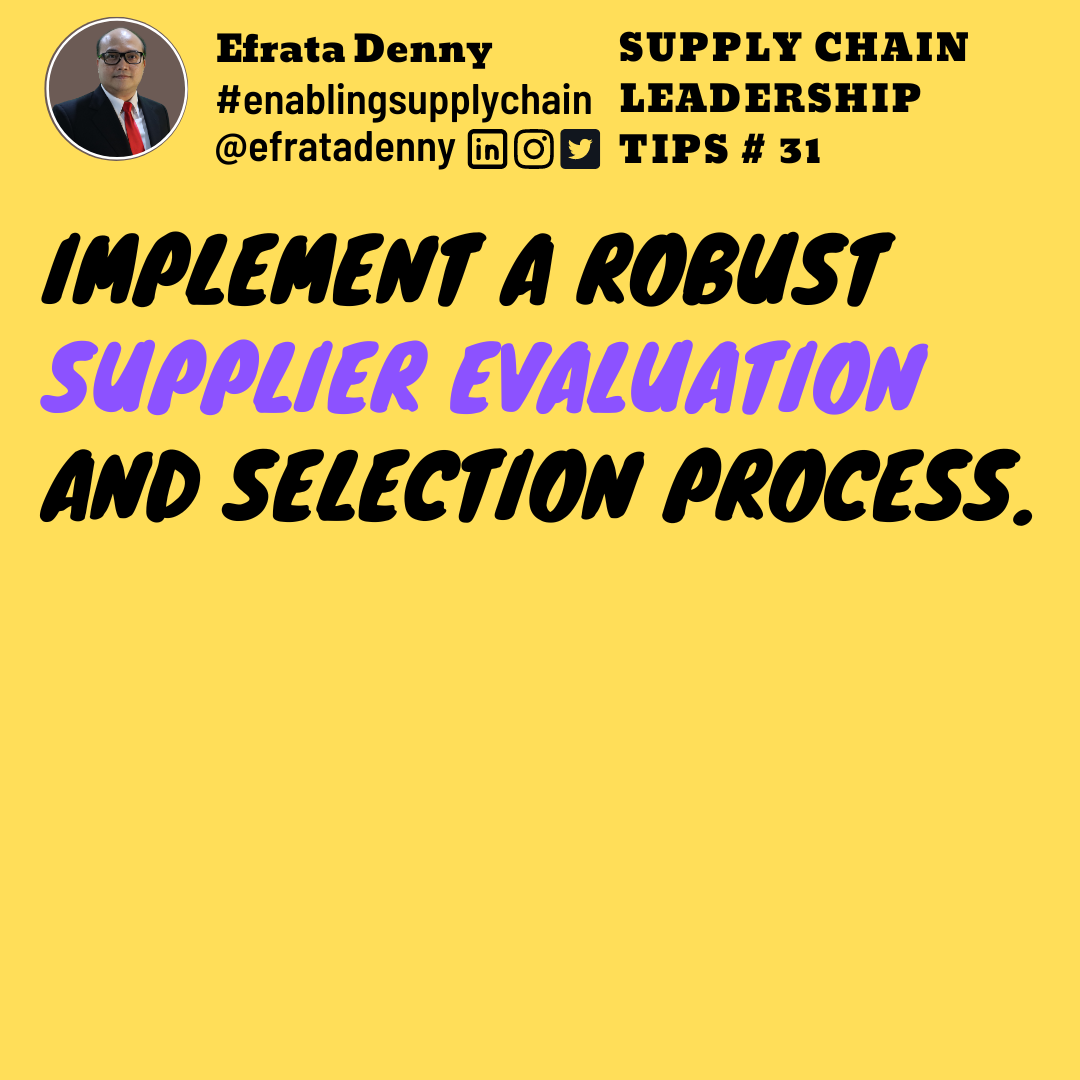
“Implement a robust supplier evaluation and selection process.” – Efrata Denny

In the world of supply chain management, success isn’t achieved in isolation. A resilient and efficient supply chain hinges on many interconnected components, and one of the most critical elements is your suppliers. They play a pivotal role in determining product quality, operational efficiency, and, by extension, customer satisfaction.

Therefore, it’s not just a matter of selecting suppliers; it’s about making the right choices, ones that align with your organization’s objectives and values. This requires implementing a comprehensive supplier evaluation and selection process that covers all the bases.

In this blog, we’ll guide you through ten essential steps to establish a robust supplier evaluation and selection process. These steps will serve as the cornerstone of a resilient and efficient supply chain that not only meets but exceeds your customers’ expectations.

1. Define Your Supplier Requirements

Before diving into the supplier selection process, it’s crucial to have a clear understanding of what you need from your suppliers. Define your criteria, specifications, and expectations. This includes quality standards, delivery capabilities, pricing, and compliance requirements. Having this clarity ensures that your evaluation process is efficient and effective.

2. Conduct Thorough Research

A critical step in the supplier selection process is gathering comprehensive information about potential suppliers. This includes assessing their reputation, financial stability, industry experience, and track record in delivering products or services. Understanding their background is essential for making informed decisions.

3. Assess Supplier Capabilities

Supplier capabilities are a fundamental consideration. You need to evaluate their capacity, production capabilities, technological advancements, and ability to meet your current and future demands. A close match between their capabilities and your supply chain goals is key.

4. Evaluate Quality Management Systems

The quality of the products or services your suppliers provide is a critical factor in your supply chain’s success. Scrutinize their quality control processes, certifications, and adherence to industry standards. Consistent, high-quality output is non-negotiable.

5. Consider Financial Stability

Your suppliers’ financial stability is directly tied to your supply chain’s stability. Assess their financial health, liquidity, and risk management capabilities. This minimizes the potential for disruptions in the supply chain due to supplier insolvency or financial difficulties.

6. Evaluate Responsiveness and Communication

Effective communication is at the heart of a successful supply chain. Suppliers need to communicate promptly and transparently. They should provide regular updates on order status and any potential issues that might affect the supply chain.

7. Assess Social and Environmental Responsibility

In today’s socially conscious world, ethical and responsible sourcing is a must. Evaluate your suppliers’ commitment to fair labor practices, social responsibility, and environmental sustainability. Their values should align with your organization’s corporate social responsibility goals.

8. Seek References and Feedback

References and feedback offer insights into a supplier’s performance, reliability, and ability to meet expectations. Request and review references from current or previous customers. Learning from others’ experiences is a valuable part of the evaluation process.

9. Conduct Site Visits and Audits

Whenever possible, consider on-site assessments and audits. This provides firsthand insights into your suppliers’ operations, quality control measures, and adherence to standards. It’s a proactive approach to ensure that your expectations are met.

10. Continuous Monitoring and Re-Evaluation

Selecting the right suppliers isn’t a one-time process. It’s an ongoing commitment. Regularly review supplier performance, seek feedback from internal stakeholders, and consider conducting periodic re-evaluations to ensure that your suppliers continue to align with your evolving needs.

In the ever-evolving landscape of supply chain management, supplier selection is the cornerstone of success. A robust supplier evaluation and selection process ensures that your supply chain is built on a solid foundation, capable of withstanding challenges and driving both operational excellence and customer satisfaction.

By following these ten essential steps, you can create a reliable supply chain network that not only meets your current goals but also adapts to the changing dynamics of the industry. This flexibility is key to ensuring that your customers continue to receive the high-quality products and services they expect.
Share this:

  • Share on Facebook (Opens in new window) Facebook
  • Share on X (Opens in new window) X
  • Share on LinkedIn (Opens in new window) LinkedIn
  • Email a link to a friend (Opens in new window) Email
  • Share on Tumblr (Opens in new window) Tumblr
  • Share on Pinterest (Opens in new window) Pinterest
Like Loading...

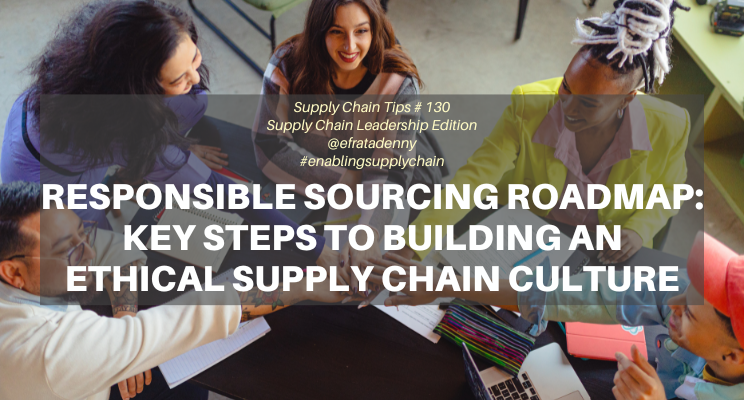
Responsible Sourcing Roadmap: Key Steps to Building an Ethical Supply Chain Culture

Posted by efratadenny on 24 December 2023
Posted in: Leadership, Supply Chain. Tagged: enablingsupplychain, Leadership, Supply Chain, Supply Chain Leadership, Supply Chain Management. Leave a comment

“Establish a culture of ethical and responsible sourcing.” – Efrata Denny

In today’s interconnected world, responsible sourcing is essential for building a sustainable and ethical supply chain. The choices we make as supply chain leaders have a far-reaching impact, not only on our businesses but also on the planet and the people who make our products. Establishing a culture of ethical and responsible sourcing is more than a trend; it’s a commitment to better business practices, ethical considerations, and environmental stewardship. Here are some key strategies and tips to help you navigate the path to responsible sourcing:

1. Define Your Ethical Sourcing Principles

The journey towards responsible sourcing begins with setting clear ethical principles. These principles should encompass social, environmental, and ethical considerations. Determine what values and standards matter most to your organization and use them as a guiding compass for your sourcing decisions.

2. Conduct Thorough Supplier Assessments

The first step in responsible sourcing is choosing the right partners. Your suppliers should align with your ethical values. To ensure this, evaluate potential suppliers based on their commitment to responsible practices. These practices may include fair labor, human rights, environmental stewardship, and transparency throughout the supply chain.

3. Collaborate with Trusted Partners

Strong, mutually beneficial relationships with your suppliers are key. They should share your ethical values and actively collaborate with you to promote responsible sourcing. Together, you can implement practices that make your supply chain more responsible, ethical, and sustainable.

4. Implement Robust Supplier Auditing and Monitoring

Regular assessments of your suppliers’ compliance with ethical standards are essential. Consider using audits, certifications, and performance evaluations as tools to ensure that your suppliers continuously adhere to your ethical guidelines.

5. Promote Fair Labor Practices

Responsible sourcing includes advocating for fair labor practices. Encourage your suppliers to provide fair wages, safe working conditions, and respect for workers’ rights. By prioritizing human dignity and improving livelihoods within the supply chain, you not only benefit workers but also enhance your brand’s reputation.

6. Embrace Sustainable Sourcing Practices

Environmental responsibility is a significant aspect of responsible sourcing. Prioritize suppliers who employ environmentally friendly practices, promote resource conservation, and minimize the carbon footprint throughout the supply chain. Sustainability benefits not only the planet but also your business’s long-term resilience.

7. Engage in Traceability and Transparency

Knowing where your products come from is a crucial element of responsible sourcing. Implement mechanisms that allow you to trace the origin of raw materials, ensuring supply chain transparency. Transparent sourcing practices provide assurance that your products are sourced responsibly.

8. Support Local Communities

Another way to promote ethical sourcing is by supporting local communities. Partner with local suppliers and actively contribute to their sustainable development. This commitment enhances the socio-economic well-being of local communities, aligning with responsible sourcing principles.

9. Educate and Empower Stakeholders

Creating a culture of responsible sourcing requires the active participation of all stakeholders, from your employees to your customers. Raise awareness among them about the importance of ethical sourcing. Encourage their participation and empower them to make ethical choices in their roles.

10. Continuously Improve Your Sourcing Practices

Finally, responsible sourcing is an evolving journey. Regularly review and refine your ethical sourcing strategies. Stay informed about emerging best practices and remain up to date with industry standards. A commitment to continuous improvement ensures that your supply chain maintains its ethical and responsible focus.

By establishing a culture of ethical and responsible sourcing, we contribute to a better world, protect human rights, preserve the environment, and build resilient supply chains. Together, we can create a more sustainable and ethical future. Let us prioritize ethics and responsibility in our sourcing practices and make a positive impact. Your supply chain can be a driving force for positive change in our interconnected world.

Share this:

  • Share on Facebook (Opens in new window) Facebook
  • Share on X (Opens in new window) X
  • Share on LinkedIn (Opens in new window) LinkedIn
  • Email a link to a friend (Opens in new window) Email
  • Share on Tumblr (Opens in new window) Tumblr
  • Share on Pinterest (Opens in new window) Pinterest
Like Loading...

A Roadmap to Customer-Centric Supply Chain Excellence

Posted by efratadenny on 23 December 2023
Posted in: Leadership, Supply Chain. Tagged: enablingsupplychain, Leadership, Supply Chain, Supply Chain Leadership, Supply Chain Management. Leave a comment

“Foster a customer-centric mindset throughout the supply chain.” – Efrata Denny

In today’s dynamic business landscape, customer-centricity is more than just a buzzword; it’s a fundamental approach that underlines a successful supply chain. Whether you are involved in manufacturing, distribution, or retail, your ability to cater to your customers’ demands and expectations can make or break your supply chain. Here are ten essential strategies to help you imbue a customer-centric mindset throughout your supply chain operations:

1. Understand Your Customers’ Needs

The journey begins with a deep understanding of your customers. Take the time to research, analyze, and gather feedback to comprehend their preferences, pain points, and what truly matters to them. This knowledge forms the foundation of customer-centric decision-making.

2. Align Supply Chain Goals with Customer Expectations

Ensure that your supply chain objectives are in direct alignment with meeting and exceeding customer expectations. Establish a clear line of sight between your supply chain strategy and the seamless customer experience you aim to provide.

3. Collaborate Closely with Customers

Build strong relationships with your customers. Open lines of communication, engage in co-creation, solicit their input, and involve them in shaping your supply chain strategies. The more involved they feel, the more invested they become in the success of your supply chain.

4. Design Processes with the Customer in Mind

Look at your supply chain processes from the customer’s perspective. Strive for efficiency, responsiveness, and delivering value at every touchpoint. Map your processes accordingly, with a focus on making the customer experience as smooth and enjoyable as possible.

5. Tailor Products and Services to Customer Needs

Where possible, customize your products and services to match specific customer requirements. Personalization is a powerful tool for enhancing customer satisfaction and meeting unique demands.

6. Optimize Order Fulfillment and Delivery

One key to delighting customers is efficient order processing, minimized lead times, and ensuring timely and accurate deliveries. Consistently exceeding customer expectations for speed and reliability is a surefire way to build loyalty.

7. Provide Proactive and Transparent Communication

Communication is the bedrock of trust. Keep your customers informed about order status, potential delays, and any changes in the supply chain. By offering proactive and transparent communication, you manage expectations effectively and build trust.

8. Continuously Monitor Customer Satisfaction

Regularly assess customer satisfaction through surveys, feedback mechanisms, and performance metrics. Use these insights to drive improvements across the supply chain. A commitment to continuous enhancement is central to customer-centricity.

9. Empower Employees as Customer Advocates

Encourage all supply chain team members to prioritize customer satisfaction. Empower them to proactively address customer concerns, provide exceptional service, and exceed customer expectations.

10. Embrace a Culture of Continuous Improvement

Finally, make continuous improvement a way of life in your supply chain. This entails constantly seeking opportunities to enhance the customer experience, learning from customer feedback, and iterating on your supply chain processes accordingly.

By fostering a customer-centric mindset throughout the supply chain, you create not only immediate customer satisfaction but also long-term customer loyalty. This approach drives growth and positions your organization as a trusted partner in your customers’ success.

Share this:

  • Share on Facebook (Opens in new window) Facebook
  • Share on X (Opens in new window) X
  • Share on LinkedIn (Opens in new window) LinkedIn
  • Email a link to a friend (Opens in new window) Email
  • Share on Tumblr (Opens in new window) Tumblr
  • Share on Pinterest (Opens in new window) Pinterest
Like Loading...

Mastering the Art of Project Management in the Supply Chain

Posted by efratadenny on 22 December 2023
Posted in: Leadership, Supply Chain. Tagged: enablingsupplychain, Leadership, Supply Chain, Supply Chain Leadership, Supply Chain Management. Leave a comment

“Develop strong project management skills to execute initiatives effectively.” – Efrata Denny

Effective project management is the cornerstone of successful supply chain initiatives. It serves as the guiding force that transforms ideas and strategies into tangible results. Whether you’re streamlining processes, implementing new technologies, or optimizing logistics, strong project management skills are essential. In this article, we will delve into the key principles of project management within the supply chain and provide valuable insights to help you develop and refine these skills.

1. Clear Project Objectives and Scope

At the heart of every successful project lies a crystal-clear definition of objectives and scope. Without this foundation, projects can easily drift off course, leading to delays, resource wastage, and missed opportunities.

2. Crafting a Detailed Project Plan

Creating a comprehensive project plan is akin to mapping out your journey. It’s the blueprint that outlines the tasks, timelines, resource requirements, and dependencies necessary for a project’s success. This plan serves as your roadmap throughout the project lifecycle.

3. Proactive Risk Management

Project managers must act as both strategists and chess players, foreseeing potential challenges and planning for contingencies. By conducting thorough risk assessments and developing mitigation strategies, they ensure project resilience in the face of adversity.

4. Assembling the Dream Team

A successful project is only as good as the team behind it. Choose your project team wisely, combining the right expertise, skills, and diversity to effectively tackle project tasks and navigate challenges.

5. Open and Regular

Communication Effective communication is the glue that holds a project together. Establish clear channels for communication and keep all stakeholders informed about project progress, milestones, and any changes or challenges that arise.

6. Define Roles and Responsibilities

In a well-structured project, everyone knows their role and responsibilities. Clarify these from the start to ensure accountability and efficient collaboration among team members and stakeholders.

7. Monitoring Project Performance

To stay on course, you need a compass. In project management, that compass is performance metrics and milestones. Regularly measure project progress against these indicators, allowing for timely course corrections and overall performance improvement.

8. Fostering Collaboration

Harmony and synergy among team members and stakeholders are essential for project success. Encourage open and transparent communication, teamwork, and knowledge sharing among all involved.

9. Embrace Change

In the dynamic world of supply chain management, change is the only constant. Stay flexible and agile in the face of unexpected shifts or evolving project requirements. Adjust your plans and resource allocation to ensure project success.

10. A Culture of Learning and Improvement

Every project is an opportunity to learn and grow. Reflect on lessons learned from each project, seek feedback from team members and stakeholders, and leverage best practices to enhance your project management skills continually.

By mastering these project management skills, you empower yourself to lead initiatives effectively, drive efficiency, and achieve your desired outcomes within the supply chain. Whether you’re overseeing process optimizations, technology implementations, or logistics enhancements, these principles will serve as your guide to success. Share these insights with your supply chain network and watch as your project management capabilities elevate your ability to deliver impactful and successful projects.

Share this:

  • Share on Facebook (Opens in new window) Facebook
  • Share on X (Opens in new window) X
  • Share on LinkedIn (Opens in new window) LinkedIn
  • Email a link to a friend (Opens in new window) Email
  • Share on Tumblr (Opens in new window) Tumblr
  • Share on Pinterest (Opens in new window) Pinterest
Like Loading...

The Power of Inclusivity: Elevating Supply Chain Excellence Through Ideas and Feedback

Posted by efratadenny on 21 December 2023
Posted in: Leadership, Supply Chain. Tagged: enablingsupplychain, Leadership, Supply Chain, Supply Chain Leadership, Supply Chain Management. Leave a comment

“Encourage feedback and ideas from all levels of the organization.” – Efrata Denny

In the ever-evolving world of supply chain management, success hinges on more than just the latest technology and streamlined processes. It relies on tapping into the collective wisdom and insights of every individual within your organization. Encouraging feedback and ideas from all levels can lead to innovation, enhanced problem-solving, and continuous improvement. In this article, we’ll delve into ten invaluable tips on how to create an environment that empowers everyone to share their thoughts and ideas without hesitation. From promoting diversity of perspectives to implementing formal feedback mechanisms and innovation platforms, we’ll explore the strategies that can help your supply chain become more resilient and successful. So, let’s unlock the potential of your entire team and foster a culture of innovation that propels your supply chain forward.

1. Create a Safe and Inclusive Environment

The journey to harnessing the collective intelligence of your team begins with fostering an environment where every member feels comfortable sharing their thoughts. Create a safe space where employees can voice their opinions without fear of judgment or reprisal.

2. Emphasize the Value of Diverse Perspectives

Diversity within your organization extends beyond demographics. It also encompasses the range of experiences, skills, and backgrounds your team members bring to the table. Recognizing and appreciating these differences can spark innovative thinking and generate fresh ideas.

3. Implement Formal Feedback Mechanisms

Structured channels for feedback are crucial. Establishing mechanisms such as suggestion boxes, surveys, or regular feedback sessions ensures that employees have designated outlets to express their ideas and concerns. Anonymity can be especially important in some cases.

4. Actively Listen and Engage

When feedback is shared, active listening is essential. Understanding different viewpoints and engaging in constructive dialogue helps encourage further exploration of ideas. This collaborative approach can lead to more innovative solutions.

5. Recognize and Appreciate Contributions

Acknowledging the contributions of employees who provide valuable feedback or suggest innovative ideas is crucial. Celebrating these individuals fosters a culture of recognition and appreciation, motivating others to follow suit.

6. Encourage Cross-Functional Collaboration

Break down silos within your organization by creating opportunities for employees from different departments and levels to collaborate. Encourage the exchange of ideas, working together to address problems and innovate solutions.

7. Provide Training and Development

Effective communication, creativity, and problem-solving are skills that can be nurtured and developed. Offering training programs and workshops in these areas can empower your employees to contribute their best ideas.

8. Lead by Example

Leaders play a significant role in setting the tone for an organization’s culture. Demonstrating openness to feedback, actively seeking input, and being receptive to ideas from all levels of the organization can inspire others to do the same.

9. Establish Innovation Platforms

Dedicated platforms or forums, such as online idea portals or innovation challenges, are excellent tools for crowd-sourcing ideas. These platforms create a space where employees can freely share their innovative thoughts and contribute to a culture of innovation.

10. Implement Feedback Loops

Transparency is key in maintaining trust. Communicate the outcomes and actions taken based on employee feedback. By demonstrating that their input is valued and contributes to positive change, you reinforce the culture of continuous improvement and innovation.

Encouraging feedback and ideas from all levels of your organization is a powerful strategy to drive innovation and continuous improvement in your supply chain. When you harness the collective creativity, knowledge, and expertise of your team, you unlock the potential for a stronger and more resilient supply chain. Foster a culture that empowers every individual to contribute their best ideas and watch your supply chain thrive in an ever-changing landscape.

Share this:

  • Share on Facebook (Opens in new window) Facebook
  • Share on X (Opens in new window) X
  • Share on LinkedIn (Opens in new window) LinkedIn
  • Email a link to a friend (Opens in new window) Email
  • Share on Tumblr (Opens in new window) Tumblr
  • Share on Pinterest (Opens in new window) Pinterest
Like Loading...

Posts navigation

← Older Entries
Newer Entries →
  • Yes You Can Search

  • Yes This is Calendar

    January 2026
    M T W T F S S
     1234
    567891011
    12131415161718
    19202122232425
    262728293031  
    « Sep    
  • Yes These are Archives

  • Yes Recent Posts

    • The Future of Supply Chain: How AI and Automation Are Revolutionizing the Industry
    • Top 10 Supply Chain Innovations to Watch in 2024
    • The Rise of Sustainable Supply Chains: Why Going Green is Now a Business Imperative
    • The Great Debate: Centralized vs. Decentralized Supply Chains—Which is Better for 2024?
    • The Paradox of Supply Chain and Logistics
    • Agility Unleashed: The Power of Continuous Evaluation in Procurement Strategy
    • Cost Clarity: Mastering Total Cost of Acquisition for Procurement Excellence
    • Strategic Sourcing Mastery: Unleashing Procurement Excellence through Consolidated Purchasing
    • Unleashing Operational Excellence Through Just-in-Time (JIT) Inventory Management
    • Revolutionizing Procurement: The Strategic Impact of Harnessing Reverse Auctions for Maximum Cost Savings
  • Yes Follow Me

    Post a Day 2012 Twitter EfrataDenny
  • Yes This is My Twitter

    Tweets by efratadenny
  • Yes Advertising

    Roppopo.com
  • Yes This is Category

    Australia Bali Bandung China Collection Food France Indonesia Intermezzo Jakarta Kraft Foods Leadership Lighting Experiences Liquidart Manado Management Model Online Store Photography Portfolio Press Procurement Still Life Supply Chain Sustainability Traveling Underwater Wines Yes This is Me
  • Enter your email address to follow this blog and receive notifications of new posts by email.

    Join 986 other subscribers
  • Flickr Photos

    Last Supper Wood EngravingChristmas SockChristmas Bell
    More Photos
  • Recent Comments

    Bogdan Kolos's avatarBogdan Kolos on The Power of Strong Supplier R…
    Reighne Sq's avatarReighne Sq on Weekly Photo Challenge: One Sh…
    Shubham's avatarShubham on Long Tail and Short Tail Red…
    Terrence M's avatarTerrence M on Fettuccine Carbonara
    Ivan's avatarIvan on Maria Clara Sangria Red W…
    wahyu jatmiko krisdiyanto's avatarwahyu jatmiko krisdi… on Mie Bakso
    Weekly Photo Challen… on Weekly Photo Challenge: F…
    bali ratih's avatarbali ratih on Diving at Benoa
    Berita Hari Ini's avatarBerita Hari Ini on Miss Indonesia will increase W…
    geraldine's avatargeraldine on Maria Clara Sangria Red W…
    Chika Lesmana's avatarChika Lesmana on Shanghai Ice
    Chika Lesmana's avatarChika Lesmana on Shanghai Ice
    ipah kholipah's avataripah kholipah on Shanghai Ice
    Evi's avatarEvi on Platinum Hill Limited Edition…
    renxkyoko's avatarrenxkyoko on Sirloin Steak
  • Yes Page Info

    Yahoo bot last visit Msn bot last visit Google PageRank Checker

    The best of travel stories in and around Singapore TravelerVoice Bloggers - Meet Millions of Bloggers Personal Blogs visitor counters
  • Yes Facebook

    Yes Facebook
Blog at WordPress.com.
Efrata Denny
Create a free website or blog at WordPress.com.
Privacy & Cookies: This site uses cookies. By continuing to use this website, you agree to their use.
To find out more, including how to control cookies, see here: Cookie Policy
  • Subscribe Subscribed
    • Efrata Denny
    • Join 966 other subscribers
    • Already have a WordPress.com account? Log in now.
    • Efrata Denny
    • Subscribe Subscribed
    • Sign up
    • Log in
    • Report this content
    • View site in Reader
    • Manage subscriptions
    • Collapse this bar
 

Loading Comments...
 

    %d