Efrata Denny

Personal Blog contains Wines, Foods, Traveling, and Photography

  • Home
  • All About Me
    • Yes This is Me
    • Private Message
    • Guest Book
    • Collection
      • Cigars
      • IntermezZo
      • Liquors
      • Sketch
      • Zombie Story
    • Friends
    • Portfolio
      • Kraft Foods
      • Arnott’s
      • Glaxo Smith Kline
      • Online Store
    • Press
  • Wines
    • Argentina
    • Australia
    • Austria
    • Chile
    • France
    • Indonesia
    • Israel
    • Italia
    • Portugal
    • South Africa
    • Spain
    • USA
    • Vietnam
  • Food
  • Traveling
    • Australia
    • China
    • Hong Kong
    • Indonesia
    • Macau
    • Malaysia
    • Philippines
    • Singapore
    • Thailand
    • Vietnam
  • Photography
    • Model
    • Still Life
    • Liquidart
    • Underwater
  • Awards
  • Supply Chain
    • Sustainability
    • Workshop

Igniting Supply Chain Innovation: The Power of Collaboration with External Partners

Posted by efratadenny on 30 December 2023
Posted in: Leadership, Supply Chain. Tagged: enablingsupplychain, Leadership, Supply Chain, Supply Chain Leadership, Supply Chain Management. Leave a comment

“Foster innovation through collaboration with external partners.” – Efrata Denny

In today’s fast-paced and ever-evolving business landscape, innovation is the driving force behind staying competitive and achieving supply chain excellence. One of the most powerful ways to foster innovation is through collaboration with external partners. By engaging with startups, research institutions, and industry experts, you can tap into fresh perspectives, cutting-edge technologies, and innovative ideas that have the potential to transform your supply chain. In this article, we’ll explore ten practical tips for igniting innovation through collaboration, from seeking strategic partnerships to celebrating both successes and failures. Let’s embark on a journey to unlock new possibilities, drive market differentiation, and shape the future of your supply chain.

1. Seek out strategic partnerships

The first step in fostering innovation is to identify and establish strategic partnerships with external organizations. Look for startups, research institutions, or industry experts who can offer unique insights and technologies that align with your supply chain objectives. These partnerships bring fresh perspectives and cutting-edge solutions that can revolutionize your operations.

2. Foster a culture of collaboration

Creating a culture of collaboration within your organization is essential. Encourage cross-functional teamwork that values diverse ideas, promotes knowledge sharing, and sparks creativity. When employees feel empowered to collaborate, they are more likely to contribute innovative solutions.

3. Engage in open innovation

Embrace the principles of open innovation by actively seeking external inputs, ideas, and technologies. Participate in events like hackathons and innovation challenges, or explore partnerships with innovation ecosystems. This approach broadens your horizons and exposes your supply chain to new and exciting opportunities.

4. Leverage co-creation opportunities

Collaborating with external partners to co-create innovative solutions is a powerful way to address specific challenges and seize market opportunities. By joining forces, you can combine your expertise and resources to develop products, processes, or services that stand out in the market.

5. Tap into industry networks

Networking is a valuable avenue for collaboration. Participate in industry associations, attend conferences, and engage in networking events to connect with like-minded professionals. These connections can lead to fruitful collaborations and the exchange of innovative ideas.

6. Embrace technology scouting

To stay at the forefront of innovation, engage in technology scouting activities. Attend tech showcases and explore partnerships with tech-driven companies. By staying updated on emerging technologies and trends relevant to your industry, you can infuse innovation into your supply chain.

7. Encourage pilot projects and experiments

Creating a safe space for testing new ideas and concepts is crucial. Initiate pilot projects or proof-of-concept initiatives with external partners. These experiments allow for rapid learning and innovation, with the freedom to explore without fear of immediate consequences.

8. Emphasize mutual benefits

Approach collaborations with a win-win mindset. Seek opportunities to create shared value and mutual benefits for all parties involved. When all stakeholders see the advantages of the collaboration, it paves the way for fruitful partnerships.

9. Provide resources and support

Allocate dedicated resources, such as funding, expertise, and time, to support collaborative innovation projects. Demonstrating your commitment to fostering innovation encourages external partners to engage fully and contribute their best ideas.

10. Celebrate successes and learn from failures

Recognition is a powerful motivator for continued innovation. Celebrate successful collaborative innovations within your supply chain, acknowledging the achievements of both internal and external partners. At the same time, embrace a culture that views failures as learning opportunities and encourages continuous improvement.

Fostering innovation through collaboration with external partners is a journey that can shape the future of your supply chain. By seeking strategic partnerships, creating a culture of collaboration, and embracing open innovation principles, you unlock new possibilities and drive market differentiation. Your supply chain can become a hotbed of creativity and ingenuity, ensuring that you stay ahead in the dynamic business landscape. So, share these tips with your supply chain network, and let the power of collaboration ignite innovation within your organization. Together, you can shape the future of your supply chain and make a lasting impact in your industry.

Share this:

  • Click to share on Facebook (Opens in new window) Facebook
  • Click to share on X (Opens in new window) X
  • Click to share on LinkedIn (Opens in new window) LinkedIn
  • Click to email a link to a friend (Opens in new window) Email
  • Click to share on Tumblr (Opens in new window) Tumblr
  • Click to share on Pinterest (Opens in new window) Pinterest
Like Loading...

Beyond Supplier Relationships: Building a Comprehensive Risk Management Strategy

Posted by efratadenny on 29 December 2023
Posted in: Leadership, Supply Chain. Tagged: enablingsupplychain, Leadership, Supply Chain, Supply Chain Leadership, Supply Chain Management. Leave a comment

“Implement a comprehensive supplier risk management strategy.” – Efrata Denny

In the complex landscape of modern supply chains, managing supplier risks is a critical endeavor. These risks can encompass financial instability, operational disruptions, quality issues, and even geopolitical factors. To ensure the resilience and continuity of your supply chain operations, it’s essential to implement a comprehensive supplier risk management strategy. This article provides a roadmap for identifying, assessing, and mitigating supplier risks effectively. By diversifying your supplier base, establishing clear contractual agreements, and fostering open communication, you can safeguard your operations and protect against potential disruptions. Let’s explore these strategies and more to fortify your supply chain’s resilience in the face of uncertainty.

1. Identify Potential Supplier Risks

The first step in effective supplier risk management is to conduct a thorough assessment to identify and understand the potential risks associated with each of your suppliers. These risks can vary widely, from financial instability and operational disruptions to quality issues and even geopolitical factors. By identifying these risks, you lay the foundation for a proactive risk management strategy.

2. Establish Risk Assessment Criteria

Once you’ve identified potential supplier risks, it’s crucial to develop a set of criteria to assess and prioritize these risks. Consider factors such as the criticality of supply, the impact on your operations, and the likelihood of each risk occurring. Prioritizing risks will help you allocate resources and focus on the most significant threats to your supply chain.

3. Perform Due Diligence

Conducting comprehensive due diligence on potential suppliers is a critical part of your risk management strategy. This involves financial health checks, reference checks, site visits, and audits to ensure that potential suppliers meet your risk management standards. Due diligence provides you with a thorough understanding of a supplier’s capabilities and their ability to meet your requirements.

4. Diversify Your Supplier Base

Reducing dependence on a single supplier is a fundamental risk mitigation strategy. By diversifying your supplier network, you spread the risk and minimize the potential for disruptions caused by supplier failures or unforeseen events. Having alternative sources of supply in place can be a lifesaver during times of crisis.

5. Monitor Supplier Performance

Continuous monitoring of supplier performance is essential for identifying any signs of underperformance or increased risk. Key performance indicators (KPIs), regular audits, and performance reviews help you keep tabs on your suppliers and take action when necessary. This proactive approach ensures that you can address issues before they escalate into significant disruptions.

6. Develop Contingency Plans

Contingency planning involves creating alternative sourcing strategies to address potential disruptions. These strategies can include identifying backup suppliers, maintaining safety stock, or having alternative production facilities on standby. The goal is to be well-prepared to mitigate the impact of unforeseen events.

7. Establish Clear Contractual Agreements

Supplier contracts should include provisions for risk mitigation. These can encompass penalties for non-compliance, dispute resolution mechanisms, and business continuity plans. Clear contractual agreements ensure that both parties understand their obligations and responsibilities in managing risks.

8. Foster Open Communication

Open and transparent communication with suppliers is a vital component of risk management. Encourage your suppliers to share any potential risks, challenges, or changes that may impact their ability to meet their obligations. By maintaining open channels of communication, you can address issues promptly and collaboratively.

9. Stay Informed About Market Trends

To effectively manage supplier risks, it’s crucial to stay updated on market trends, industry developments, and emerging risks that may affect your suppliers. This information enables proactive risk management and mitigation. By being aware of potential risks on the horizon, you can develop strategies to address them before they impact your supply chain.

10. Continuously Evaluate and Improve

Finally, supplier risk management is not a one-time activity but an ongoing process. Regularly assess your supplier risk management strategy, learn from past experiences, and implement improvements to enhance its effectiveness. A continuous improvement mindset ensures that your risk management approach remains robust and adaptable.

Implementing a comprehensive supplier risk management strategy is essential for safeguarding your supply chain operations. By identifying and assessing potential risks, diversifying your supplier base, monitoring supplier performance, and fostering open communication, you can ensure the stability, resilience, and continuity of your supply chain operations. Stay informed, stay proactive, and continually refine your risk management strategies to protect against potential disruptions.

Share this:

  • Click to share on Facebook (Opens in new window) Facebook
  • Click to share on X (Opens in new window) X
  • Click to share on LinkedIn (Opens in new window) LinkedIn
  • Click to email a link to a friend (Opens in new window) Email
  • Click to share on Tumblr (Opens in new window) Tumblr
  • Click to share on Pinterest (Opens in new window) Pinterest
Like Loading...

Building Resilience in a Shifting World: Geopolitical and Regulatory Insights for Supply Chains

Posted by efratadenny on 28 December 2023
Posted in: Leadership, Supply Chain. Tagged: enablingsupplychain, Leadership, Supply Chain, Supply Chain Leadership, Supply Chain Management. Leave a comment

“Stay informed about geopolitical and regulatory changes that may impact the supply chain.” – Efrata Denny

In today’s fast-paced global landscape, staying informed about geopolitical and regulatory changes is vital for the success and resilience of your supply chain. As the world continues to evolve, it’s essential to adapt and anticipate shifts that can impact your industry and supply chain operations. Here are some valuable tips to help you navigate these changes effectively and ensure your supply chain remains robust and agile.

1. Trust Reliable News Sources

Keeping up with global affairs, trade policies, and regulatory changes starts with following reputable news outlets and publications. Whether it’s international trade agreements, government policies, or geopolitical events, staying informed is key.

2. Engage in Industry Associations and Networks

Consider becoming part of industry associations and networks related to your field. These platforms provide access to valuable information, insights, and discussions about geopolitical and regulatory developments that directly impact your business.

3. Keep a Close Eye on Trade Agreements and Tariffs

International trade agreements and tariffs can have a profound effect on your supply chain. Make sure to closely monitor any changes in these areas to understand how they might affect your costs and operations.

4. Leverage Real-Time Information with Technology

Modern technology offers supply chain management systems, online platforms, and monitoring tools that can provide real-time updates on geopolitical events, regulatory shifts, and their potential implications for your supply chain.

5. Collaborate with Regulatory Experts

Legal and regulatory experts who specialize in international trade and supply chain management can provide invaluable insights and guidance on compliance requirements, helping you navigate complex regulatory changes.

6. Plan for Different Scenarios

Anticipate potential geopolitical or regulatory scenarios that may affect your supply chain. Develop contingency plans that outline how to mitigate risks and ensure operational continuity in the face of such changes.

7. Encourage Cross-Functional Collaboration

Encourage collaboration among different departments within your organization, such as supply chain, legal, compliance, and procurement. Together, assess and address the impact of geopolitical and regulatory changes from multiple perspectives.

8. Stay Connected with Government and Industry Stakeholders

Maintaining connections with government authorities, trade associations, and industry bodies is essential for understanding upcoming regulatory changes. It also provides the opportunity to provide input and influence policy discussions when possible.

9. Continuously Assess and Update Risk Management Strategies

Regularly evaluate and update your risk management strategies to account for geopolitical and regulatory risks. Ensure your strategies are proactive, adaptable, and capable of mitigating potential disruptions.

10. Attend Conferences and Webinars

Industry conferences, webinars, and seminars focused on geopolitical and regulatory topics can provide valuable insights from experts in the field. These events offer a platform to share experiences and expand your knowledge.

By implementing these tips and staying informed about geopolitical and regulatory changes, your supply chain will proactively manage risks, seize opportunities, and ensure resilience in a rapidly evolving world. Together with your supply chain network, you can confidently navigate the complexities of the global landscape.

Share this:

  • Click to share on Facebook (Opens in new window) Facebook
  • Click to share on X (Opens in new window) X
  • Click to share on LinkedIn (Opens in new window) LinkedIn
  • Click to email a link to a friend (Opens in new window) Email
  • Click to share on Tumblr (Opens in new window) Tumblr
  • Click to share on Pinterest (Opens in new window) Pinterest
Like Loading...

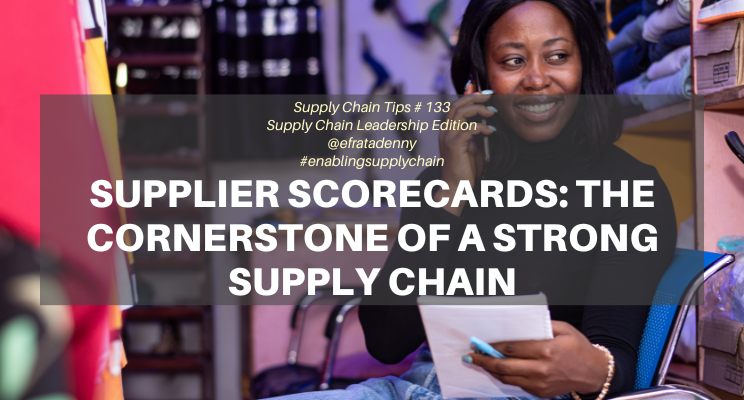
Supplier Scorecards: The Cornerstone of a Strong Supply Chain

Posted by efratadenny on 27 December 2023
Posted in: Leadership, Supply Chain. Tagged: enablingsupplychain, Leadership, Supply Chain, Supply Chain Leadership, Supply Chain Management. Leave a comment

“Conduct regular performance reviews with suppliers.” – Efrata Denny

In the dynamic realm of supply chain management, success hinges not only on efficient processes but also on the relationships forged with suppliers. These partnerships play a pivotal role in ensuring a seamless and reliable flow of goods, making the practice of conducting regular performance reviews with your suppliers a cornerstone of supply chain excellence. In this article, we will explore how the judicious use of supplier performance reviews can elevate your supply chain management. From establishing clear expectations to fostering open communication, we present a comprehensive guide to nurturing strong supplier relationships and achieving operational brilliance.

1. Clear Expectations

The foundation of a productive supplier relationship is a shared understanding of performance expectations. Open and transparent communication regarding quality standards, on-time delivery, and key performance indicators (KPIs) sets the stage for a productive collaboration.

2. Specific Metrics

Measurable metrics are essential for evaluating supplier performance. Metrics like defect rates, lead times, responsiveness, and compliance with contractual agreements provide an objective basis for performance assessment.

3. Data-Driven Insights

Regularly collect and analyze performance data such as delivery performance, product quality, and customer feedback. These insights provide a holistic view of supplier performance and help in identifying areas for improvement.

4. Scheduled Reviews

Periodic performance reviews with suppliers are vital for assessing current performance, addressing concerns, providing constructive feedback, and jointly identifying avenues for enhancement. These reviews should be built into your supply chain management rhythm.

5. Balanced Scorecard Approach

A balanced scorecard framework evaluates supplier performance across various dimensions, including quality, cost, delivery, and responsiveness. This holistic perspective ensures that suppliers are contributing to your supply chain’s success from multiple angles.

6. Constructive Feedback

Supplier relationships thrive on constructive feedback. Share specific feedback highlighting strengths and areas that require improvement. This open and honest approach fosters a culture of mutual growth and collaboration.

7. Collaborative Improvement Plans

Collaborate with suppliers to develop performance improvement plans. Set clear targets, define corrective actions, and work together to raise the bar on performance. An attitude of shared responsibility can drive significant enhancements.

8. Recognize Exceptional Performance

Recognizing and rewarding exceptional supplier performance is a powerful motivator. Acknowledge suppliers who consistently meet or exceed expectations, nurturing a positive and mutually beneficial partnership.

9. Open Communication

Create an environment where suppliers are encouraged to share their challenges and innovative ideas freely. Open and honest dialogue enables the identification of opportunities for improvement and continuous growth.

10. Continuous Monitoring

The journey doesn’t end with a single review. It is imperative to track supplier performance over time to ensure progress and identify further areas for enhancement. This consistent monitoring creates a culture of continuous improvement.

Regular supplier performance reviews are not just a box to check in supply chain management; they are a cornerstone of success. These reviews pave the way for fruitful collaboration, innovation, and continuous improvement. By following these tips, you can optimize your supplier relationships, achieve operational excellence, and fortify your supply chain for the long haul. As the supply chain landscape continues to evolve, the strength of your supplier relationships will be your secret weapon in overcoming challenges and thriving in this complex environment. Dive into the practice of supplier performance reviews and unlock the power of a thriving supply chain!

Share this:

  • Click to share on Facebook (Opens in new window) Facebook
  • Click to share on X (Opens in new window) X
  • Click to share on LinkedIn (Opens in new window) LinkedIn
  • Click to email a link to a friend (Opens in new window) Email
  • Click to share on Tumblr (Opens in new window) Tumblr
  • Click to share on Pinterest (Opens in new window) Pinterest
Like Loading...

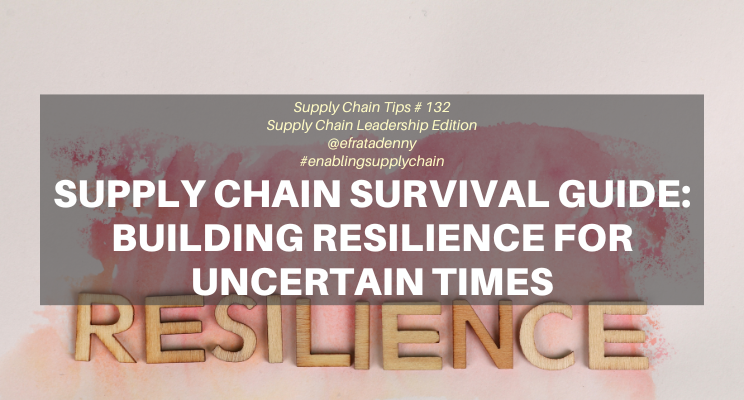
Supply Chain Survival Guide: Building Resilience for Uncertain Times

Posted by efratadenny on 26 December 2023
Posted in: Leadership, Supply Chain. Tagged: enablingsupplychain, Leadership, Supply Chain, Supply Chain Leadership, Supply Chain Management. Leave a comment

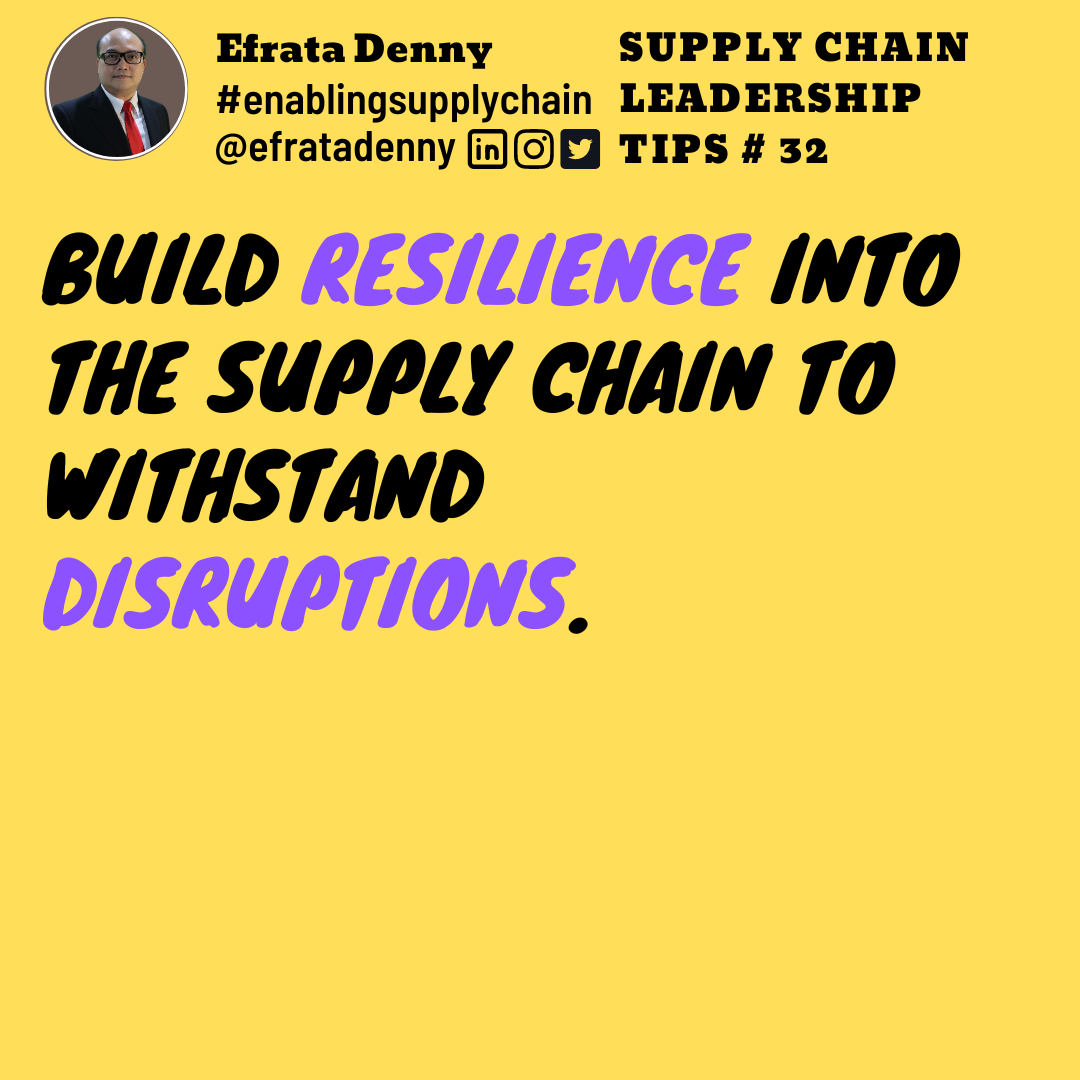
“Build resilience into the supply chain to withstand disruptions.” – Efrata Denny

The modern business landscape is fraught with uncertainty, making supply chain resilience a top priority for organizations. Disruptions can come in various forms, from natural disasters and geopolitical events to supplier issues and cybersecurity threats. In this article, we explore ten crucial strategies to help you build a resilient supply chain that can withstand these disruptions, ensuring uninterrupted operations and customer satisfaction. Let’s dive in!

1. Identify Potential Risks and Vulnerabilities

Resilience starts with awareness. Conduct a comprehensive risk assessment to pinpoint internal and external risks that could impact your supply chain. These may include natural disasters, political instability, supplier vulnerabilities, and more. By understanding the potential challenges, you can proactively prepare for them.

2. Diversify Your Supplier Base

Over-reliance on a single supplier can be a significant vulnerability. Diversify your supplier network to spread risk and establish alternative sources of supply. This approach ensures that you have backup options in case a disruption occurs with one of your suppliers.

3. Maintain Clear and Open Communication

Effective communication is the backbone of supply chain resilience. Establish transparent communication channels with suppliers, customers, and key stakeholders. This enables the timely exchange of information and collaboration during uncertain times, fostering trust and efficient problem-solving.

4. Establish Backup Plans and Alternative Routes

When disruptions strike, having a plan in place can make all the difference. Develop contingency plans that include alternative logistics routes, backup suppliers, and safety stock to minimize the impact of disruptions. Being prepared will help you react swiftly and effectively.

5. Implement Robust Inventory Management Practices

Balancing optimal inventory levels with working capital management is an art. Strive to ensure the availability of critical components or products during disruptions while keeping inventory costs in check. Effective inventory management is key to minimizing downtime.

6. Leverage Technology for Real-Time Visibility

In today’s digital age, real-time visibility is a game-changer. Implement supply chain visibility tools and technologies that provide insights into inventory levels, production status, and demand patterns. With real-time data, you can make informed decisions and quickly adapt to changing circumstances.

7. Foster Collaboration and Information Sharing

Collaboration is a powerful tool in building supply chain resilience. Work closely with key suppliers, customers, and industry partners to share best practices, insights, and innovative solutions for managing disruptions collectively. Collaborative efforts often yield innovative solutions.

8. Build Agility into Your Operations

Flexibility is the cornerstone of resilience. Develop agile production and distribution capabilities that can quickly adapt to changing circumstances. Whether it’s adjusting production volumes or rerouting shipments, agility ensures you can respond promptly to disruptions.

9. Invest in Robust Data Security and Cybersecurity Measures

In a world where digital threats are ever-present, protecting your digital infrastructure is paramount. Invest in robust data security and cybersecurity measures to safeguard your supply chain from potential cyber threats. Ensuring data security adds an extra layer of resilience.

10. Continuously Learn and Improve

Resilience is an ongoing journey. Regularly evaluate and learn from disruptions to enhance your supply chain’s resilience. Implement lessons learned, update risk mitigation strategies, and embrace innovation to stay ahead of potential challenges.

Building a resilient supply chain is no longer a choice but a necessity in today’s unpredictable world. By following these ten strategies, you can fortify your supply chain against disruptions, ensuring business continuity and customer satisfaction. Together, we can overcome challenges and thrive in a world filled with uncertainties.

Share this:

  • Click to share on Facebook (Opens in new window) Facebook
  • Click to share on X (Opens in new window) X
  • Click to share on LinkedIn (Opens in new window) LinkedIn
  • Click to email a link to a friend (Opens in new window) Email
  • Click to share on Tumblr (Opens in new window) Tumblr
  • Click to share on Pinterest (Opens in new window) Pinterest
Like Loading...

Posts navigation

← Older Entries
Newer Entries →
  • Yes You Can Search

  • Yes This is Calendar

    December 2025
    M T W T F S S
    1234567
    891011121314
    15161718192021
    22232425262728
    293031  
    « Sep    
  • Yes These are Archives

  • Yes Recent Posts

    • The Future of Supply Chain: How AI and Automation Are Revolutionizing the Industry
    • Top 10 Supply Chain Innovations to Watch in 2024
    • The Rise of Sustainable Supply Chains: Why Going Green is Now a Business Imperative
    • The Great Debate: Centralized vs. Decentralized Supply Chains—Which is Better for 2024?
    • The Paradox of Supply Chain and Logistics
    • Agility Unleashed: The Power of Continuous Evaluation in Procurement Strategy
    • Cost Clarity: Mastering Total Cost of Acquisition for Procurement Excellence
    • Strategic Sourcing Mastery: Unleashing Procurement Excellence through Consolidated Purchasing
    • Unleashing Operational Excellence Through Just-in-Time (JIT) Inventory Management
    • Revolutionizing Procurement: The Strategic Impact of Harnessing Reverse Auctions for Maximum Cost Savings
  • Yes Follow Me

    Post a Day 2012 Twitter EfrataDenny
  • Yes This is My Twitter

    Tweets by efratadenny
  • Yes Advertising

    Roppopo.com
  • Yes This is Category

    Australia Bali Bandung China Collection Food France Indonesia Intermezzo Jakarta Kraft Foods Leadership Lighting Experiences Liquidart Manado Management Model Online Store Photography Portfolio Press Procurement Still Life Supply Chain Sustainability Traveling Underwater Wines Yes This is Me
  • Enter your email address to follow this blog and receive notifications of new posts by email.

    Join 986 other subscribers
  • Flickr Photos

    Last Supper Wood EngravingChristmas SockChristmas Bell
    More Photos
  • Recent Comments

    Bogdan Kolos's avatarBogdan Kolos on The Power of Strong Supplier R…
    Reighne Sq's avatarReighne Sq on Weekly Photo Challenge: One Sh…
    Shubham's avatarShubham on Long Tail and Short Tail Red…
    Terrence M's avatarTerrence M on Fettuccine Carbonara
    Ivan's avatarIvan on Maria Clara Sangria Red W…
    wahyu jatmiko krisdiyanto's avatarwahyu jatmiko krisdi… on Mie Bakso
    Weekly Photo Challen… on Weekly Photo Challenge: F…
    bali ratih's avatarbali ratih on Diving at Benoa
    Berita Hari Ini's avatarBerita Hari Ini on Miss Indonesia will increase W…
    geraldine's avatargeraldine on Maria Clara Sangria Red W…
    Chika Lesmana's avatarChika Lesmana on Shanghai Ice
    Chika Lesmana's avatarChika Lesmana on Shanghai Ice
    ipah kholipah's avataripah kholipah on Shanghai Ice
    Evi's avatarEvi on Platinum Hill Limited Edition…
    renxkyoko's avatarrenxkyoko on Sirloin Steak
  • Yes Page Info

    Yahoo bot last visit Msn bot last visit Google PageRank Checker

    The best of travel stories in and around Singapore TravelerVoice Bloggers - Meet Millions of Bloggers Personal Blogs visitor counters
  • Yes Facebook

    Yes Facebook
Create a free website or blog at WordPress.com.
Efrata Denny
Create a free website or blog at WordPress.com.
Privacy & Cookies: This site uses cookies. By continuing to use this website, you agree to their use.
To find out more, including how to control cookies, see here: Cookie Policy
  • Subscribe Subscribed
    • Efrata Denny
    • Join 966 other subscribers
    • Already have a WordPress.com account? Log in now.
    • Efrata Denny
    • Subscribe Subscribed
    • Sign up
    • Log in
    • Report this content
    • View site in Reader
    • Manage subscriptions
    • Collapse this bar
 

Loading Comments...
 

    %d