
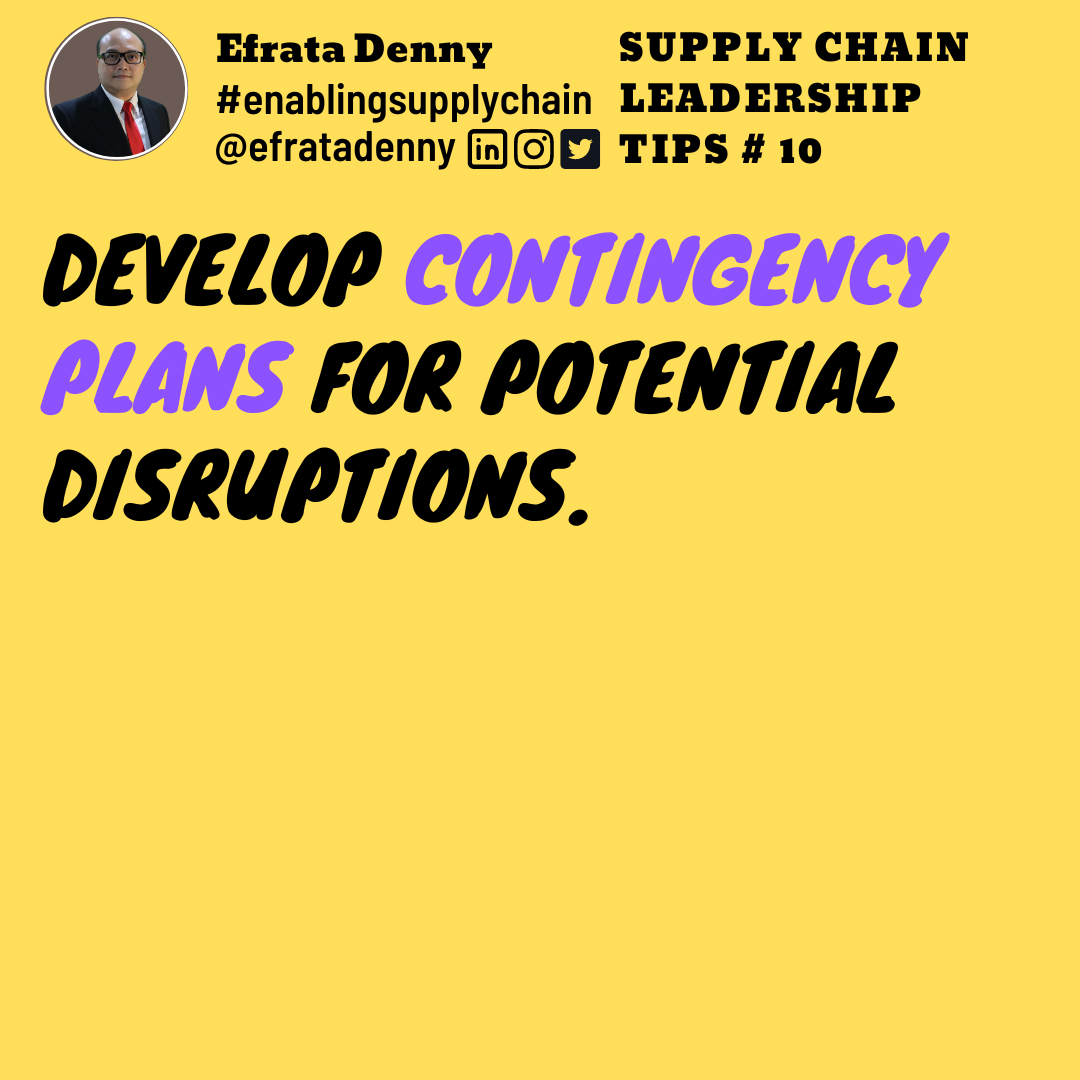
“Develop contingency plans for potential disruptions.” – Efrata Denny
In the world of supply chain leadership, adaptability is a superpower, and resilience is its manifestation. This article presents ten vital strategies to cultivate resilience by developing effective contingency plans, ensuring your supply chain can weather any storm:
1. Conduct a comprehensive risk assessment.
Identify potential disruptions that could impact your supply chain, from natural disasters to geopolitical events. Awareness is the first step to preparedness.
2. Establish a cross-functional team.
Bring together experts from various departments to collaborate on developing contingency plans. Diverse perspectives enhance the robustness of your strategies.
3. Prioritize critical processes and resources.
Identify the most crucial elements of your supply chain and focus on developing backup strategies for them. Not all processes are equal; prioritize wisely.
4. Diversify your supplier base.
Cultivate relationships with multiple suppliers to reduce dependency and mitigate the impact of disruptions. A diversified network offers resilience.
5. Build redundancy into your operations.
Have backup facilities, alternate transportation routes, and redundant inventory to minimize downtime. Redundancy is your safety net.
6. Establish communication protocols.
Define clear lines of communication and escalation procedures to ensure timely information sharing during disruptions. Communication is the lifeline of resilience.
7. Create scenario-based response plans.
Develop strategies for different potential disruption scenarios and outline specific actions to be taken. Preparedness is about thinking ahead.
8. Monitor and update your plans regularly.
Stay vigilant and adapt your contingency plans as your supply chain and risk landscape evolve. Flexibility is the cornerstone of resilience.
9. Test your plans through simulations or drills.
Conduct mock exercises to validate the effectiveness of your contingency plans and identify areas for improvement. Practice makes perfect.
10. Collaborate with partners and stakeholders.
Engage in dialogue and coordination with suppliers, customers, and other relevant parties to align on contingency measures. Collaboration is the key to shared resilience.
By developing robust contingency plans, you fortify your supply chain against potential disruptions and ensure business continuity in the face of adversity. These strategies are not just about planning; they’re about creating a culture of resilience that permeates every level of your organization.









 Efrata Denny